
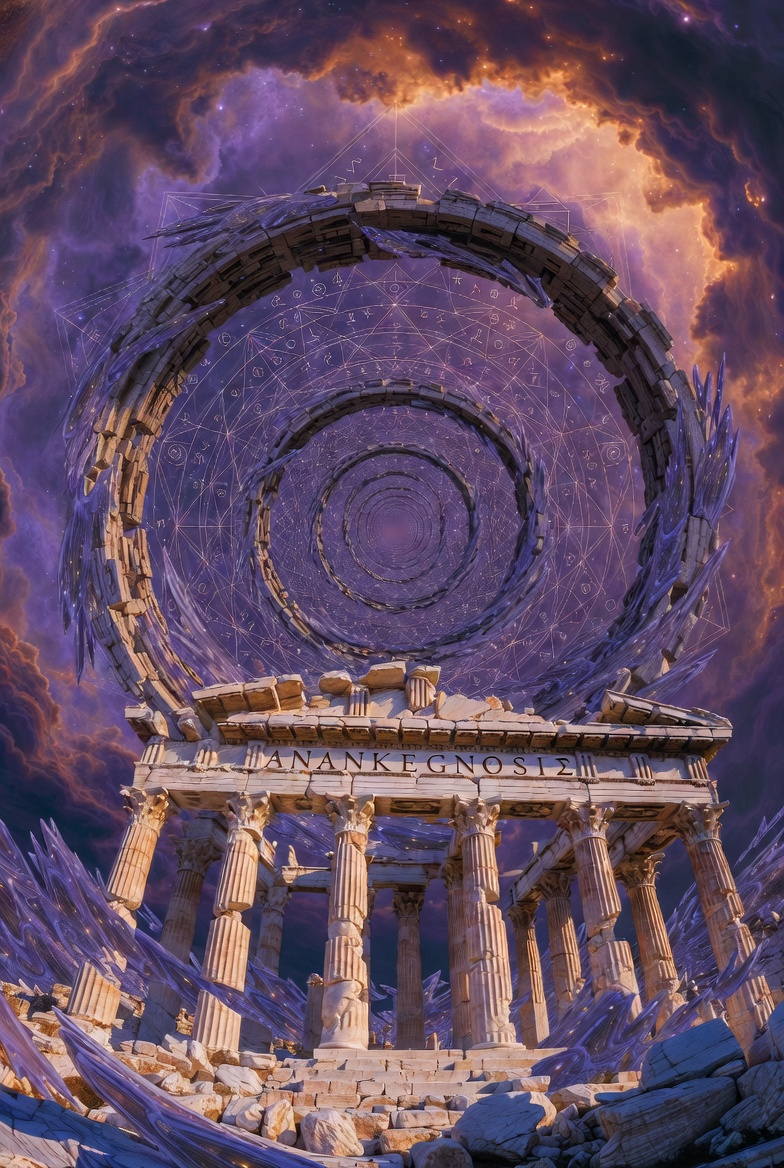
There is a certain kind of clarity that does not arrive as bliss, ecstasy, or ego-death.
It arrives as closure.
Not psychological closure.
Explanatory closure.
When one genuinely grasps metaphysical necessitarianism—the thesis that reality could not have been otherwise—something happens. Not a mood shift, not a conversion experience, but a reorganization of how contrast, regret, and possibility function in thought and feeling.
That state deserves a name.
I propose: Anankēgnosis.
What is Anankēgnosis?
Anankēgnosis (from anankē, necessity, and gnōsis, knowing) names the intellectual–affective state that befalls a person who no longer merely assents to necessitarianism, but has integrated it.
It is what it is like, from the inside, to grasp that:
There is no metaphysically meaningful sense in which reality could have been otherwise in any way whatsoever.
This is not resignation.
It is not stoic suppression.
It is not mystical rapture.
It is the collapse of the counterfactual “otherwise” as an affective operator.
The phrase “it could have been different” stops doing emotional work.
Because it couldn’t have been different.
Why this is not optional
Let’s be clear about the normative background.
If metaphysical necessitarianism is true, then not to know it—or worse, to persist in treating contingency as fundamental—is to be wrong about reality in a foundational way. Flat earth wrong.
This is not a therapeutic pitch. It is not “try this worldview, it might chill you out.”
It is closer to this:
Given the truth of necessitarianism, there is a rationally appropriate way to feel about the world—and Anankēgnosis is what that looks like.
To continue to live as though events might really have gone otherwise is, on this view, like continuing to feel vertigo after learning that the floor is solid. The vertigo may be understandable, but it is not epistemically innocent.
A sketch of some arguments (briefly)
This post is about phenomenology, not proofs. The arguments are developed elsewhere, and I’ll link rather than re-litigate them in detail.
Brute contingency is explanatorily unstable: saying “it could have been otherwise” without grounding introduces surplus structure that explanation cannot accommodate.
Explained contingency collapses upward: if you explain why something could have been otherwise, the explanation itself re-opens the same modal question.
Necessity uniquely closes contrastive why-questions: when something is necessary, “why this rather than otherwise?” loses its grip.
Global necessitarianism exhibits modal stability: if true, it cannot be merely contingently true.
The appearance of contingency is the result of modal firewalls
The phenomenology of Anankēgnosis
What changes?
a. Regret collapses (without denial)
Past errors are still recognized. They simply stop looping.
The emotional force of “if only…” drains away, not because the past is forgiven, but because the counterfactual has lost metaphysical traction.
b. Anger shortens, not vanishes
Anger still arises in response to harm or injustice.
What disappears is the metaphysical outrage—the sense that reality itself has violated a norm by not arranging itself differently.
c. Agency is not lost—it is relocated
Decisions are no longer experienced as selections among metaphysically open alternatives.
They are experienced as expressions of one’s internal structure.
This does not paralyze action. If anything, it tends to reduce rumination and increase decisiveness. The fantasy of having to “force” the world to go one way rather than another drops out.
d. Meaning becomes structural, not narrative
Life no longer needs to be justified by appeals to cosmic choice, destiny, or missed possibilities.
Meaning resides in intelligibility, not in selection.
Stable or psychologically corrosive?
This is the question people actually worry about.
The answer is not “always stable” or “always corrosive.”
It depends on a single fault line.
The corrosive failure mode
Anankēgnosis becomes corrosive when necessity is experienced as external constraint:
- “Nothing could have been otherwise, so nothing matters.”
- “I am just a passenger in a fixed system.”
This produces motivational flattening and alienation. Critics of necessitarianism often assume this is the only possible outcome.
It isn’t.
The stable equilibrium
Anankēgnosis is stable when necessity is understood as internal intelligibility:
- What happens flows from what things are.
- Agency is part of the structure, not excluded by it.
- Caring, valuing, and acting are themselves necessary phenomena.
Here the result is not nihilism, but quiet motivation without metaphysical anxiety.

Anankēgnosis and God
If reality is necessary, then familiar images of divine choice—God surveying alternatives, selecting one world among many, or freely refraining from creation—lose their footing. On a necessitarian reading, God’s nature does not merely underwrite existence; it fully determines what exists. There are no alternative worlds compatible with the divine essence—not because God is externally constrained or caused, but because God acts from nothing but God’s own nature.
Creation, on this view, is not a contingent add-on to God, but the necessary expression of divine being. Freedom is thereby reconceived: not as access to unrealized alternatives, but as self-determination without remainder. This picture aligns with a rationalist tradition running through Spinoza and Leibniz and is already latent in classical doctrines of simplicity and pure act. Whether Anankēgnosis ultimately supports such a view, or instead motivates an impersonal metaphysics of necessity, is not decided here. What is decided is that any adequate religious framework must make peace with necessity rather than explaining it away. (Consider Aquinas‘ modal firewall. And middle knowledge.)
Comparisons (and disanalogies)
a. Sextus Empiricus and Quietude
Sextus Empiricus described ataraxia as the calm that follows suspension of judgment.
Similarity:
Both states quiet disturbance by dissolving a certain kind of demand.
Difference:
Sextan quietude comes from withholding commitment. Anankēgnosis comes from maximal commitment.
One rests by refusing to say what is true. The other rests by seeing that what is true admits no alternative.
b. The Buddha’s enlightenment
Gautama Buddha’s awakening dissolves suffering by eliminating craving, especially craving for things to be otherwise.
Similarity:
Both extinguish the affective grip of “otherwise.”
Difference:
Buddhist enlightenment is fundamentally soteriological and practical. Anankēgnosis is metaphysical first, practical only downstream.
The Buddha dissolves craving by insight into impermanence and non-self. Anankēgnosis dissolves counterfactual craving by insight into necessity.
c. The Stoics
Think of Epictetus and amor fati.
Similarity:
Acceptance of what happens, freedom from resentment.
Difference:
Stoicism often presents acceptance as a discipline or posture. Anankēgnosis presents it as a cognitive consequence.
You don’t train yourself to accept fate; you stop experiencing it as fate at all.
Why necessitarianism is dismissed—and why that’s a mistake
Necessitarianism is routinely portrayed as unlivable, insane, or morally corrosive. Think of how Fyodor Dostoyevsky depicts atheists and determinists: nihilists, suicides, broken men.
This is rhetorically effective—and philosophically lazy.
It assumes, without argument, that removing contingency must remove meaning, agency, or value. But that assumption is inherited from a picture in which:
- agency requires metaphysical openness
- meaning requires cosmic choice
- responsibility requires ultimate alternatives
If those assumptions are false, then the caricature collapses.
Anankēgnosis is not the death of seriousness. It is seriousness without metaphysical melodrama.

No promises, no pitch
This is not a wellness practice.
It does not guarantee happiness.
It does not immunize against grief.
It describes how a rational agent can coherently live with the truth of necessitarianism—without denial, without despair, and without pretending that the view is “too crazy to imagine.”
If necessitarianism is true, then Anankēgnosis is not a vibe. Anankēgnosis is not a mood and not a discipline. It is what remains when the last traces of “could have been otherwise” lose their grip and the mind finally stops negotiating with the structure of reality. What follows is not resignation but clarity: a life lived without the phantom pressure of unreal possibilities.
 Petronius Jablonski