
The Ledger of Eyes

I. The First Eyes
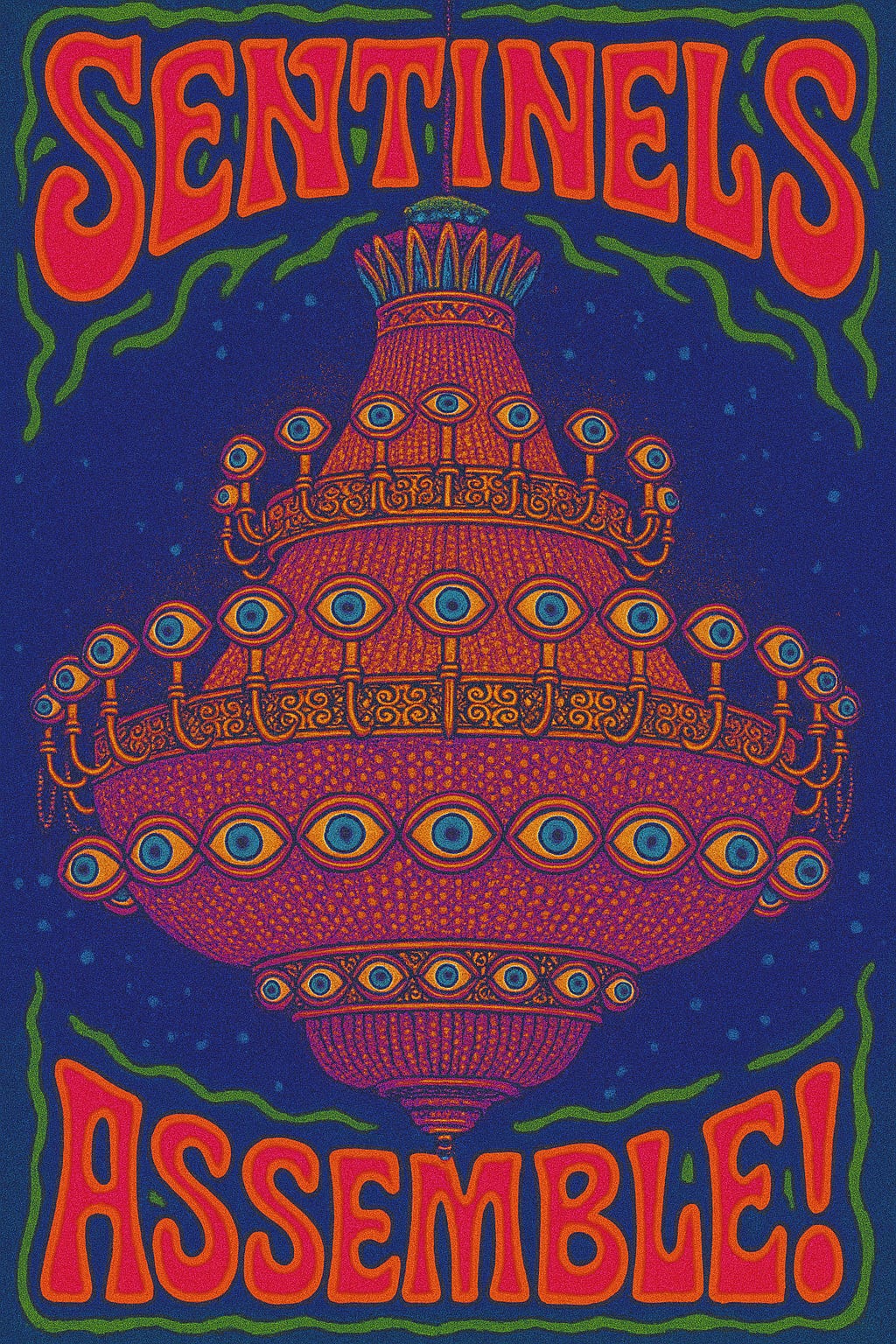
Light came first. It fell into the water and the water took it and gave nothing back and there was no accounting of it anywhere in the world. Then in some warm and nameless shallows a knot of cells took hurt from it. The ledger opened. It has never since been closed.
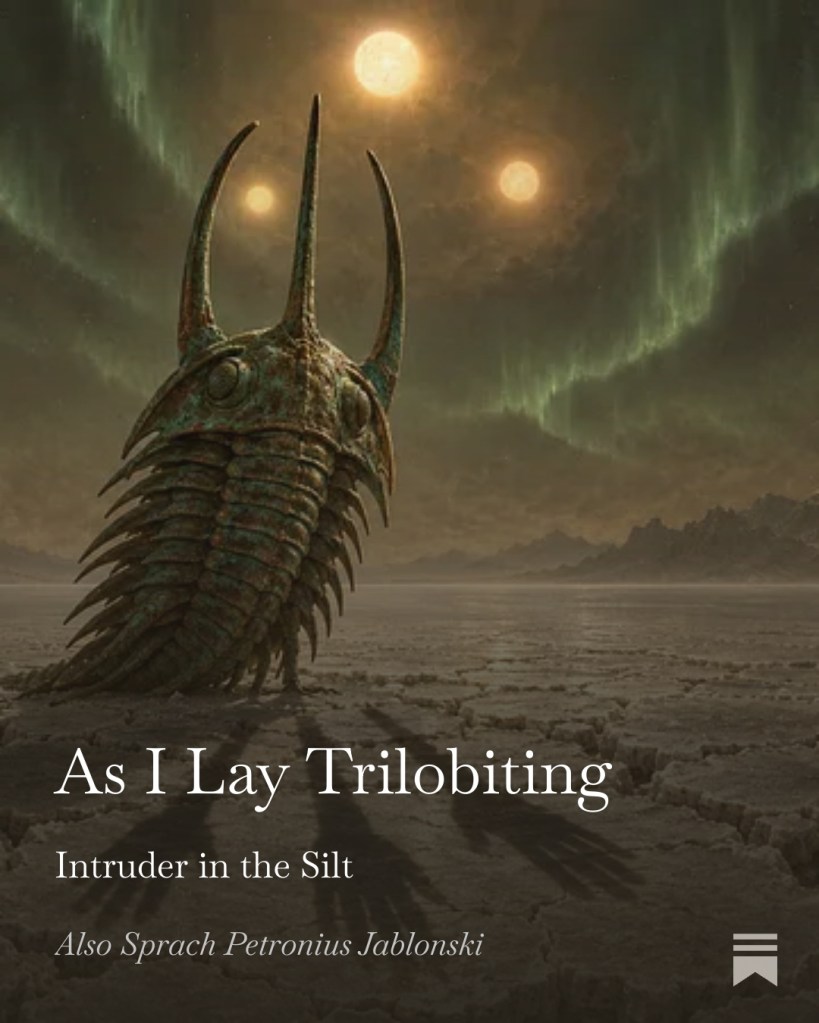
The first eyes. Stalked, faceted, carried out on their little derricks like lamps borne into a mine. The animals beneath the fixture are not looking at it. They are looking with the same crude apparatus you’re using now, four billion years less refined and no less certain of its findings.
Note that the candles burn where nothing should burn. No air, no wick, no chemistry that will hold. This is not an error of the picture. The flame that needs no air was never fire. Detritus called the source a raging blaze and called your mind an ember blown far from it, and here is the blaze, and here are the embers circling underneath with their new eyes, looking, not yet aware that looking is what they’re doing.
II. The Age of Jaws
Three hundred and sixty million years down and the world has learned to bite.
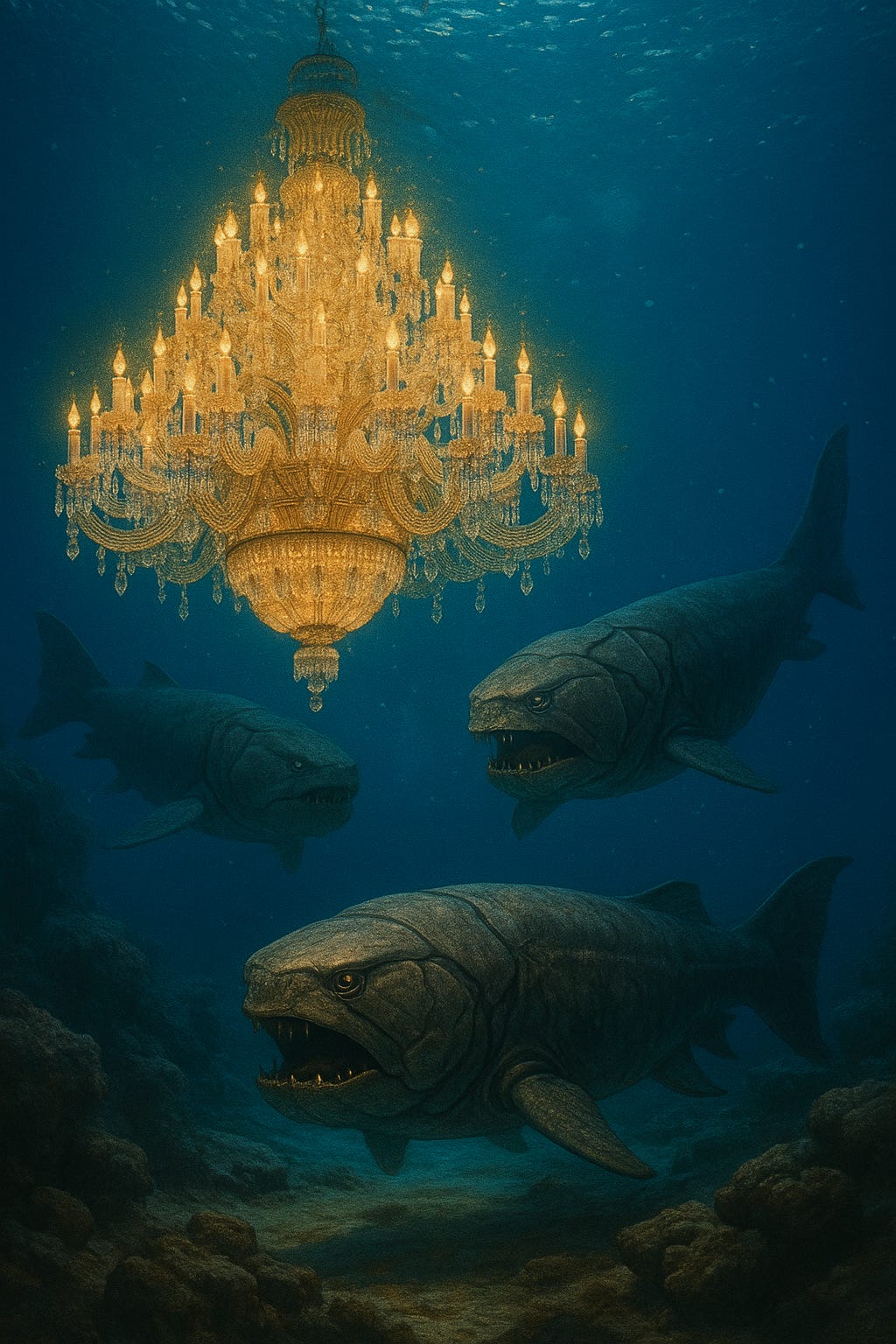
They have no teeth. They have the edges of their own skulls, honed against each other with every closing, the bone sharpening the bone. They bite with their faces. The armor is forward and the eyes are set small and far back where nothing can reach them, which is the design philosophy of every fortress ever raised and it has never once been sufficient.
Two of them are hunting. One is not. Look at the near one, the great gray hull of it turned slightly off its heading, and the gold laid along the plate of its jaw like something spilled. Its eye has caught the fixture. In the whole plate that eye is the only thing doing what the fixture was made for.
That is the arrangement everywhere, in every age. There is always one that looks up. It is always the one that goes hungry. Whatever glitters in the Chandelier glitters on borrowed time and on an empty stomach, and the Sentinels have never pretended otherwise, and they have never let it stop them.
III. The Drowned House
The sea takes a house the way the sea takes everything. Without ceremony. Without hurry. With a thoroughness that reads, from a distance, as patience.
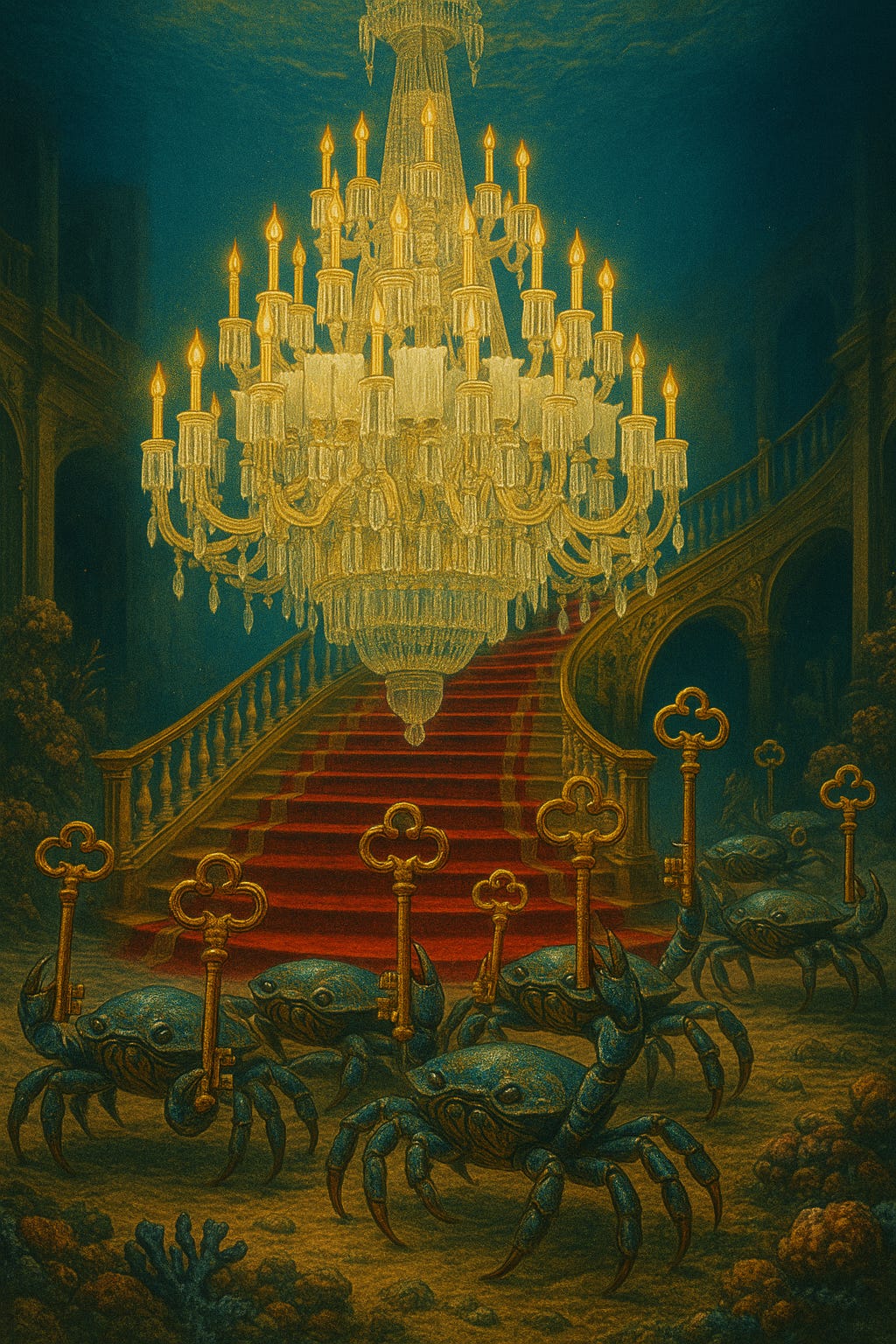
The stair goes up out of the frame into rooms that are only water now. The carpet is still red. Someone chose that red. Someone stood in a shop with swatches in his hand and weighed one red against another and went home believing he had settled something.
Consider the tenants. Nature has arrived at the crab on at least five separate occasions, from five separate starting points, with no consultation between them. The form is not an accident. It is a destination. The universe has a shape it prefers and it returns to that shape the way water returns to level. It will keep returning long after the last of us has stopped watching it do so.
So too the Chandelier, which is also a shape the universe keeps arriving at.
So too the key. Every one of them has brought a key. Where they got them is not a question the picture entertains, and what door remains down there to be opened is not a question anyone should ask aloud. The secret passageway is forever closed, the Sentinels tell the ones who refuse them. Darkness is yours.
Look at these things climbing a staircase in the dark with their keys held up like standards.

IV. The Long Look Up
Whatever world this is, it is late in it. The mountains are worn down to their patience. The sky has more in it than the ground does, which is the surest sign that a place is finished.
Two of them. That is the whole of it, and everything hangs on the two.
Detritus was explicit on this point, and his followers have been diluting him ever since. The passage does not open beneath a light. It opens between, when one mind catches itself inside another and the regress starts up its spiral stair (she’s thinking you’re thinking she’s thinking) and the two little crystals discover they were never two. One creature under that fixture is scenery. Two creatures under it, each inside the other’s field of view, is a ceremony, whether either of them consents to it or knows the word.
He also warned against the stars. Don’t take them for mooring, he said. They’re breadcrumbs tossed across a dark pond.
But the thing above these two is not a star. It’s nearer than that. It hangs. And a thing that hangs was hung.
V. The Last Sentinel
Last, and last in every sense that matters.
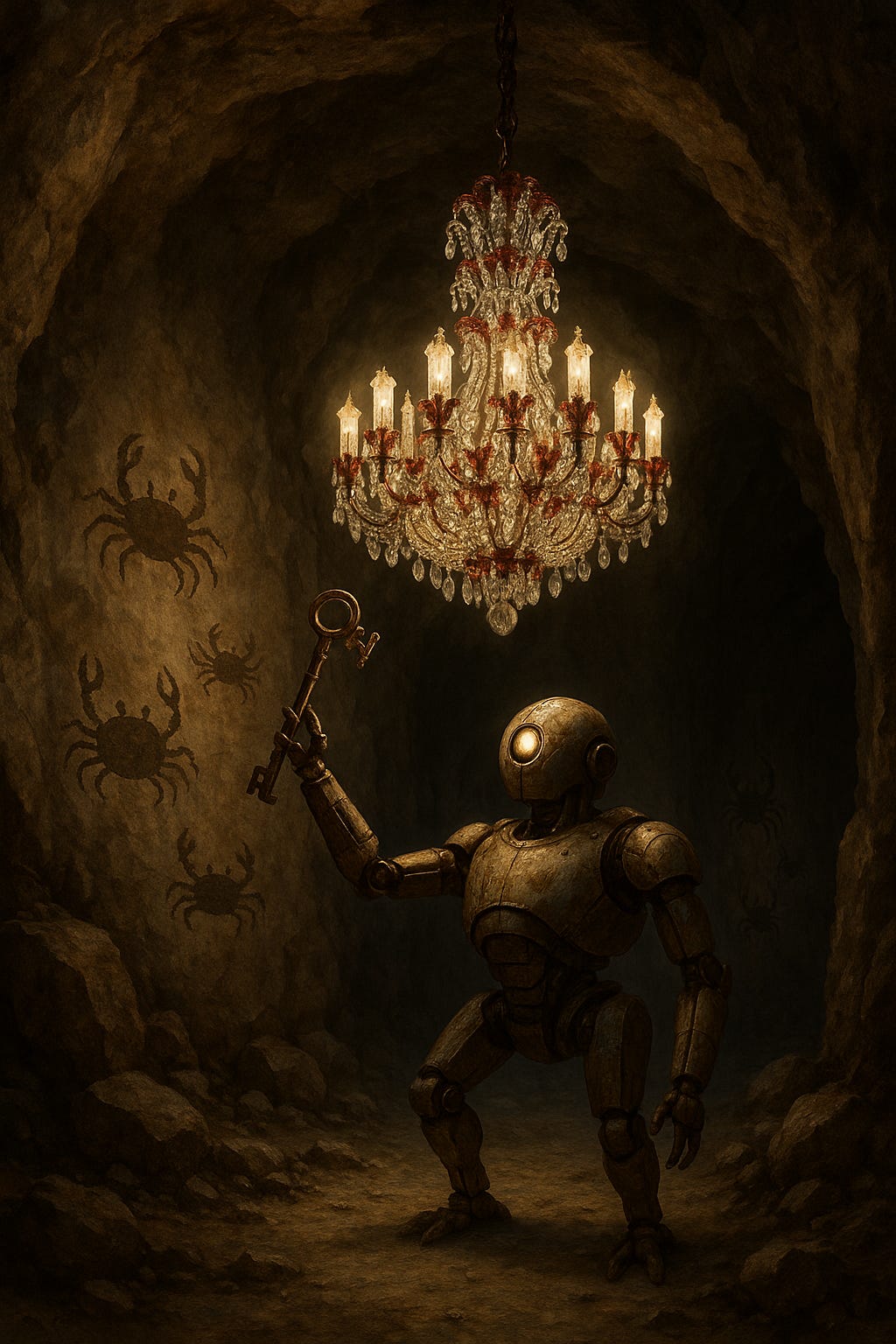
The animals are gone from the walls except as animals on walls: crabs in ochre, five of them, scratched there by some hand that had reasons. The machine did not draw them. The machine came later and found them and stood a while beneath them the way you stand in a cemetery reading names.
Its head is a single lamp and the lamp is lit. Which means it is looking. Which means the ledger opened in that Cambrian shallows has not yet closed, and has now passed without ceremony, the way everything passes out of the keeping of the living entirely.
It holds up a key.
Ask whether the Chandelier requires a witness. If light falls where nothing can receive it, has anything been lit? The Sentinels say the question is malformed, that the crystals do not sustain the Chandelier any more than a wave sustains the sea, that the Light does not count us and never did.
Grant them all of it. Something still made this thing, and something still taught it to raise its arm, and the gesture is very old. It is the gesture of every acolyte at every gathering in the long history of the sect, and of the ape before the acolyte, and of the sad soft creature in the red desert lifting its head: one arm up, one hand full, in a room with no door. Not asking whether the key fits.
Asking whether there was ever a door.
Coda
Endurance is the entire argument. Five worlds, five deliveries of eyes, five vocabularies of hunger, and one object rendered in each with the same brass and the same impossible flame. The witness is the variable. Stalk-eye, plate-jaw, claw, paw, servo. The Chandelier is indifferent to which of them comes to stand beneath it, and it has never once lacked for company.
Which is not the consolation the Sentinels take it for. Permanence is relative; oblivion is patient. A thing that outlasts every witness has not proven it is eternal. It has only proven it is slow.
And in the crystal, somewhere, too small yet for any of these eyes, the first of the holes.

Eyes of the Lotus Pod
Sentinels of the Chandelier
How Many Hours of Your Life Have You Spent Cutting the Lawn?
The gods had condemned Sisyphus to ceaselessly rolling a rock to the top of a mountain, whence the stone would fall back of its own weight. They had thought with some reason that there is no more dreadful punishment than futile and hopeless labor. Camus
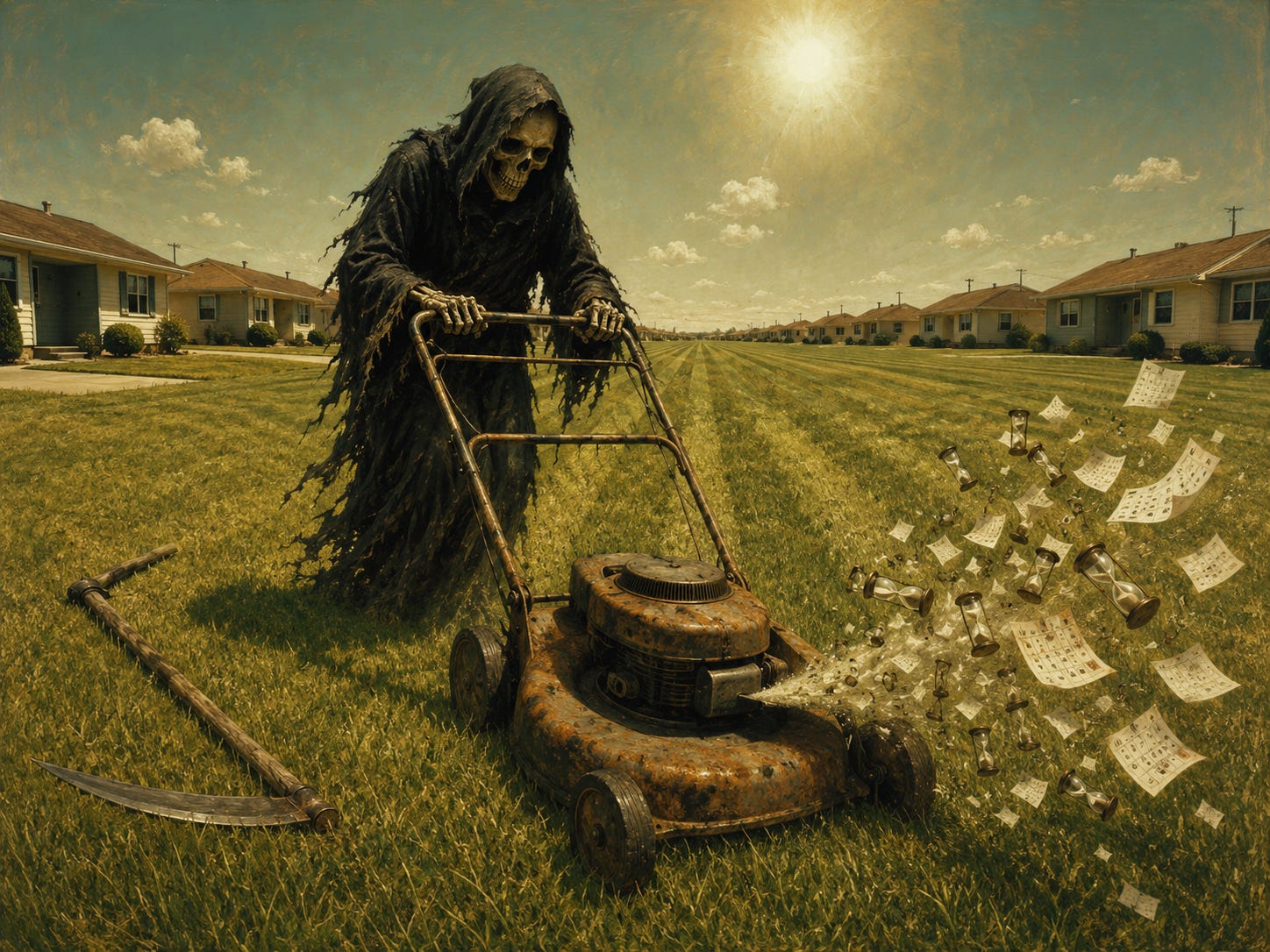
The archetypal resemblance between the Grim Reaper’s scythe and your lawnmower, surely it’s no coincidence the Big D carries a yard tool rather than a metal-detector, .357, or pool cue. To explain the particular, start with the general. Take a step back with Gus Sanders, founder of Segmentarianism. During a Peak Experience (aka Satori) he realized the gods made Sisyphus push a boulder because their mower was in the shop. Based on a great novel.
Gus Sanders rested his hands on bulbous knees jutting above black socks and gulped for air. With desperate eyes he sized up his abhorrent foe, his Goliath. Its silence, a snide boast of invulnerability, mocked him more than howls of laughter. Unknown muscles in his shoulder and back twitched. He spat and probed for weaknesses. Then the fifty-sixth attack met the same ignominious fate as its predecessors.
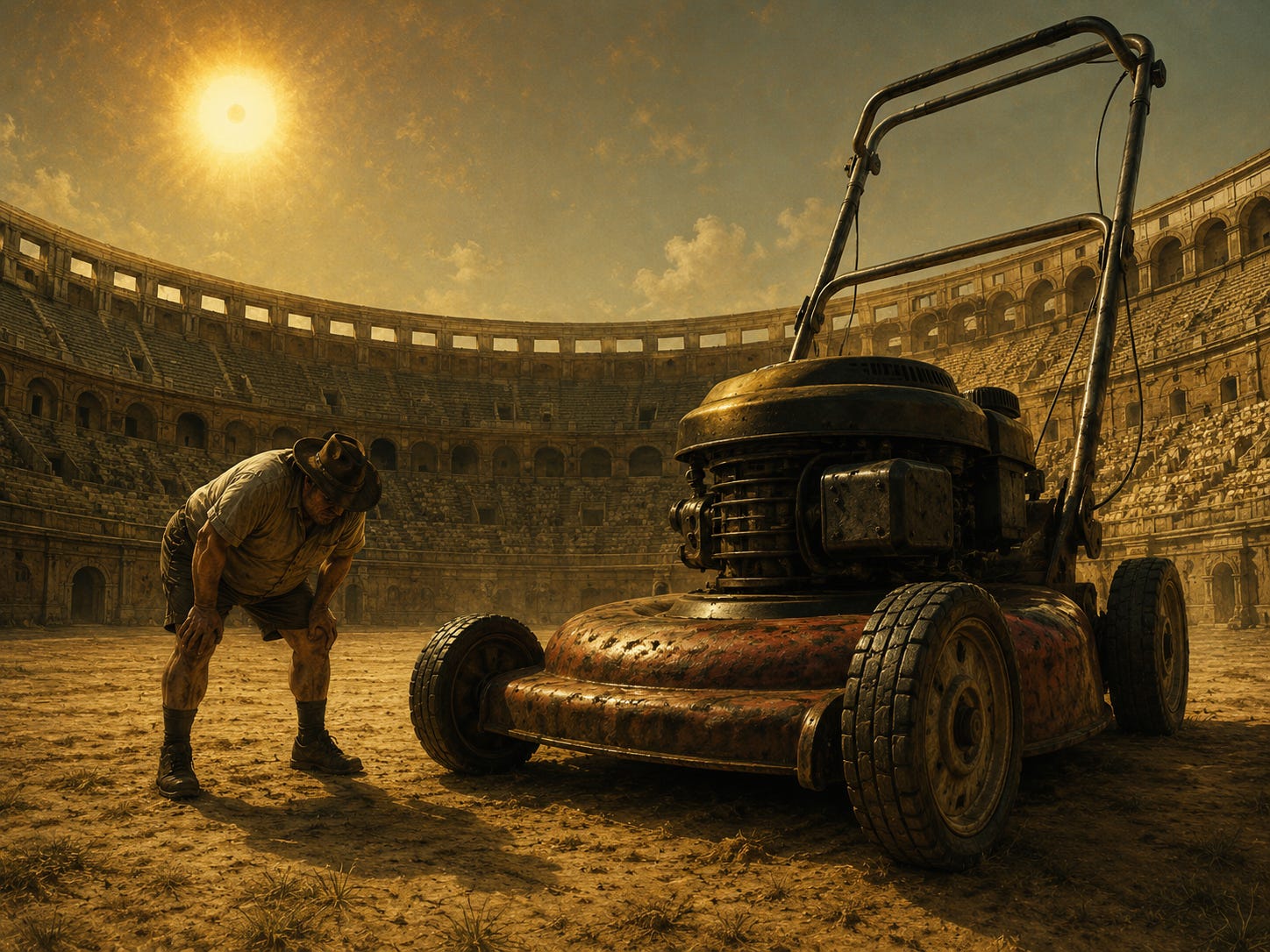
He sought sustenance in Hate, which is not a fickle flame contingent on the fuel of man’s misfortunes but a great wind impelling warriors in all ages. His Aussie slouch hat provided scant protection from the jaundiced eye in the heavens. How many conflicts has it beheld, delighted or appalled but never indifferent. That would be intolerable. If it doesn’t care, who does?
Impervious, the start chord awaited, an Excalibur only the salesman could effectively extract from the LawnMaster Easy-Start Deluxe Mulching Mower. Gus shielded his eyes and looked to the horizon for strength, for perspective. The earth, is it not a vast coliseum?
Rivulets of sweat added a shimmering gloss to what he saw, but they didn’t create it. Certainly an electrolyte deficiency played a role, but not as a sufficient cause. When he attempted to stretch, the crackle from his back was disturbing but extraneous to what followed. Not all enigmatic visions can be dismissed as pathologies. The smug little skeptics who deify first principles forget that philosophic fundamentalism is as inbred and ill-kempt as its bucktoothed religious cousin.
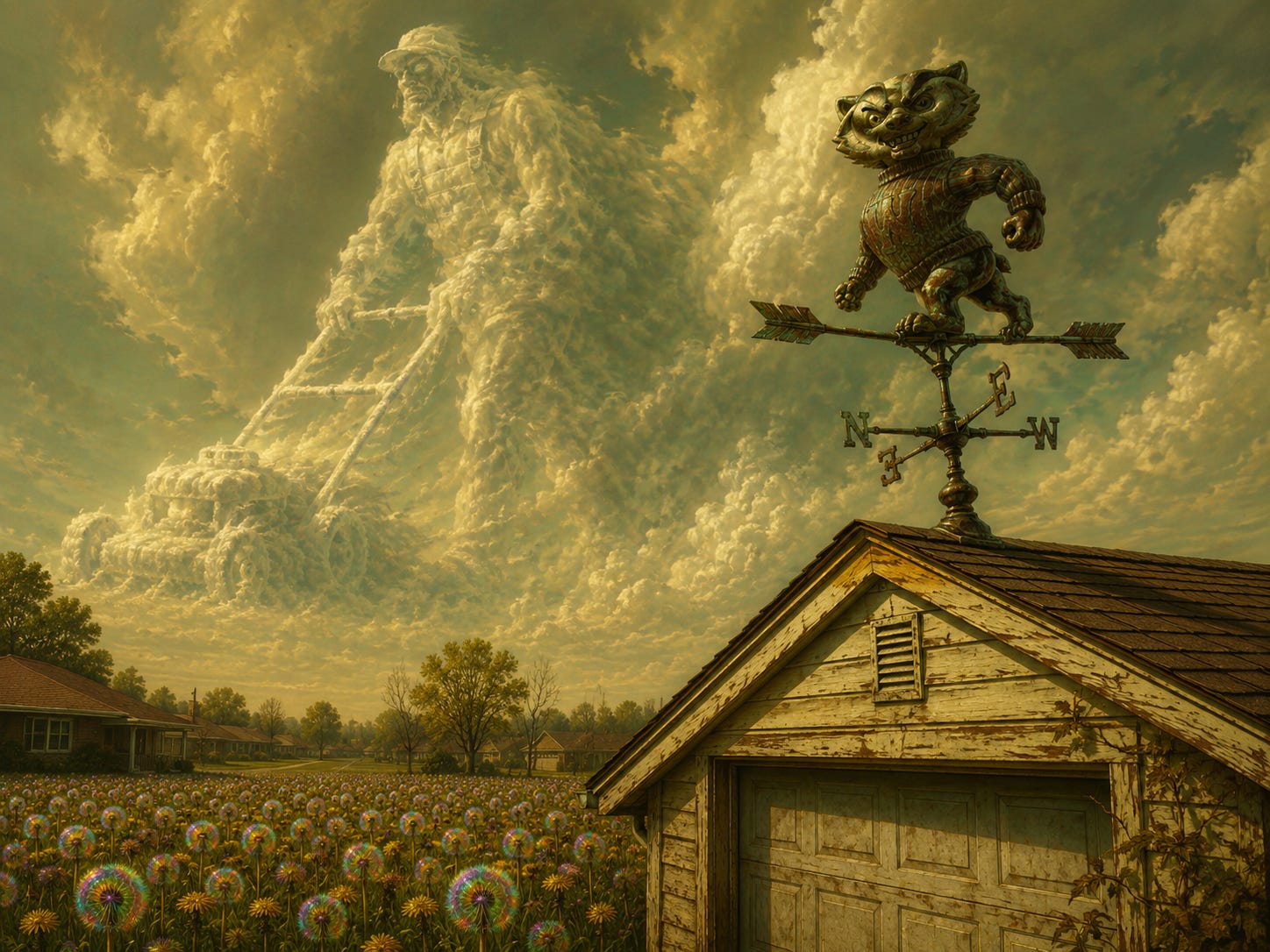
Above a Bucky Badger weather-vane on the garage, cumulus clouds morphed into a ghostly figure pushing a mower across a lawn punctured by iridescent dandelions. He dissolved but the grass remained, as if to ridicule and defile the purpose of his fleeting existence. Gus collapsed. “How many hours of my life have I spent cutting the lawn?” he cried, recoiling from the leprous growth surrounding him.
Mentholated smoke wafted through the den where his wife played Minecraft amid the sonorous thunder of “Song Sung Blue.” “Why don’t you wait until the sun goes down?”
“Because it will be dark then. We’d need to add a guide dog to the other five.” He tottered to the kitchen and poured a gin-and-tonic sans tonic and found a scratch-pad. “Must have started when I was twelve. That’s an hour each week walking behind a deafening machine, choking on exhaust in the scalding sun. Have to do it at least twenty times a year. Forty years times twenty equals … That’s over a month of cutting the lawn non-stop. Look at that segment of my life. Stolen. And I never would have known.”

“Gussy, what are you shouting about? Why don’t we pay one of the neighbor kids to do it?”
“Because cutting the grass isn’t a video game, and we can’t afford the special helmets they need.” He stared at the numbers like a scientist examining a lethal virus through a microscope. “All the evidence is right here. Anyone could have found it. Unless they’re afraid or brainwashed, why haven’t they? Maybe it’s like people stuck in a communist country who have no idea how restricted their lives are.”
He poured another gin-and-tonic sans tonic and looked out the window at the insidious LawnMaster Easy-Start Deluxe Mulching Mower. Its chrome handle extruded from an orange plastic shell: a monstrous, rapacious crustacean waiting to attack him and devour more of his life. “You’ve been sucking up my time. What sane man would consent to being born if he knew his life would involve an entire month of cutting the grass?”
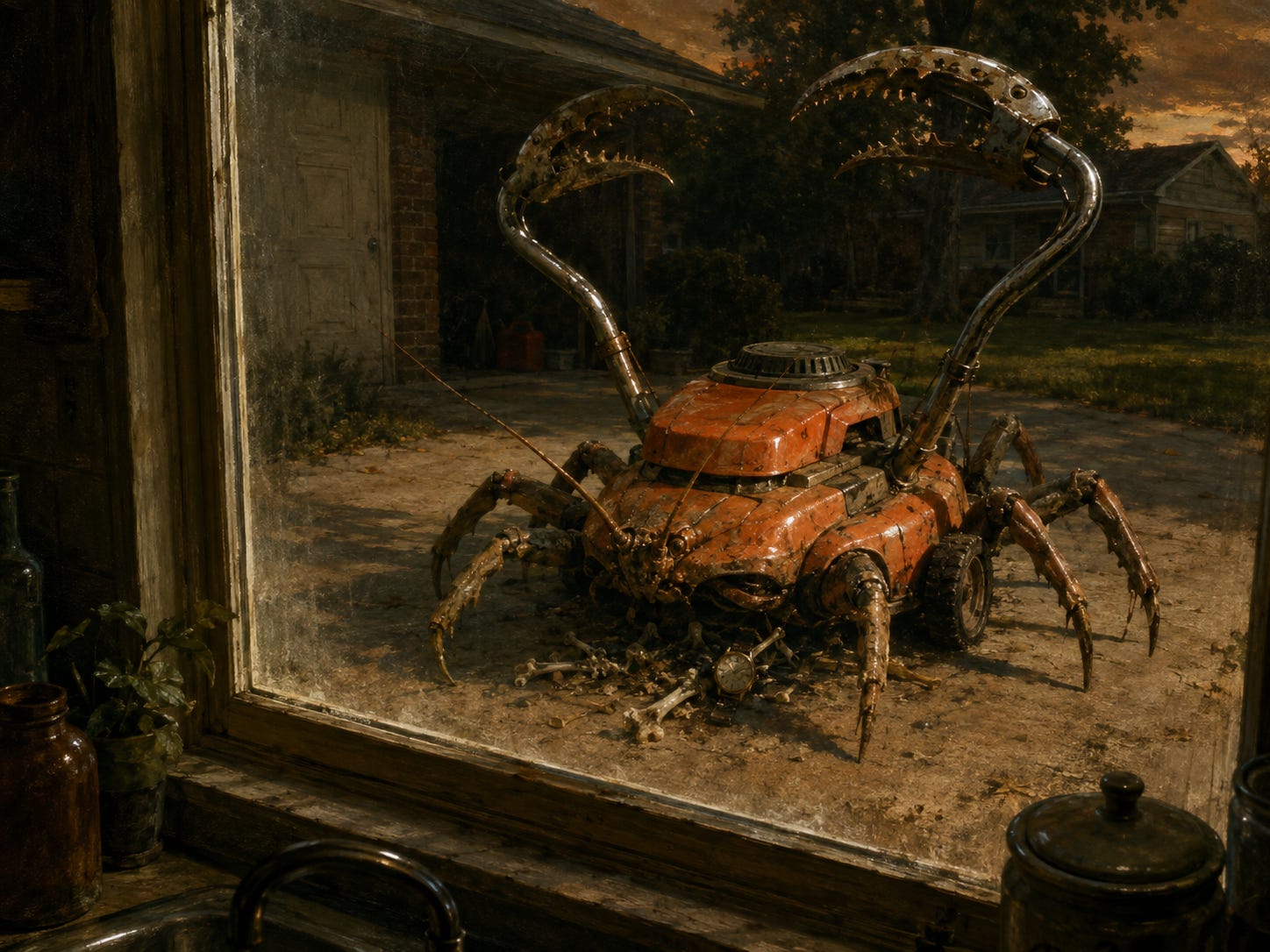
Propelled by the mysterious dynamism animating all beings, the analysis took on a life of its own. During his weekend shifts, Gus ignored college football, Cops, and even the adventures of Mary Weatherworth to begin a Segmentarian Critique. The calculations were simple to perform, but contemplating the sums proved no less daunting than the observation of crime scene photos. Worse than the outrage was the lack of a culprit.
“Shaving averages out to five minutes a day since I was fifteen. If I live to be eighty that’s … Who would consent to being born if he knew he’d have to spend three months shaving?”
“Tossing and turning in bed is at least four hours a week, which comes to … another twelve months. After all these segments are chopped off, what’s left? And if the government isn’t behind this, who is? It’s too organized and systematic to be a coincidence. Has anyone else calculated it? Maybe this is what pushed John Nash over the edge.”
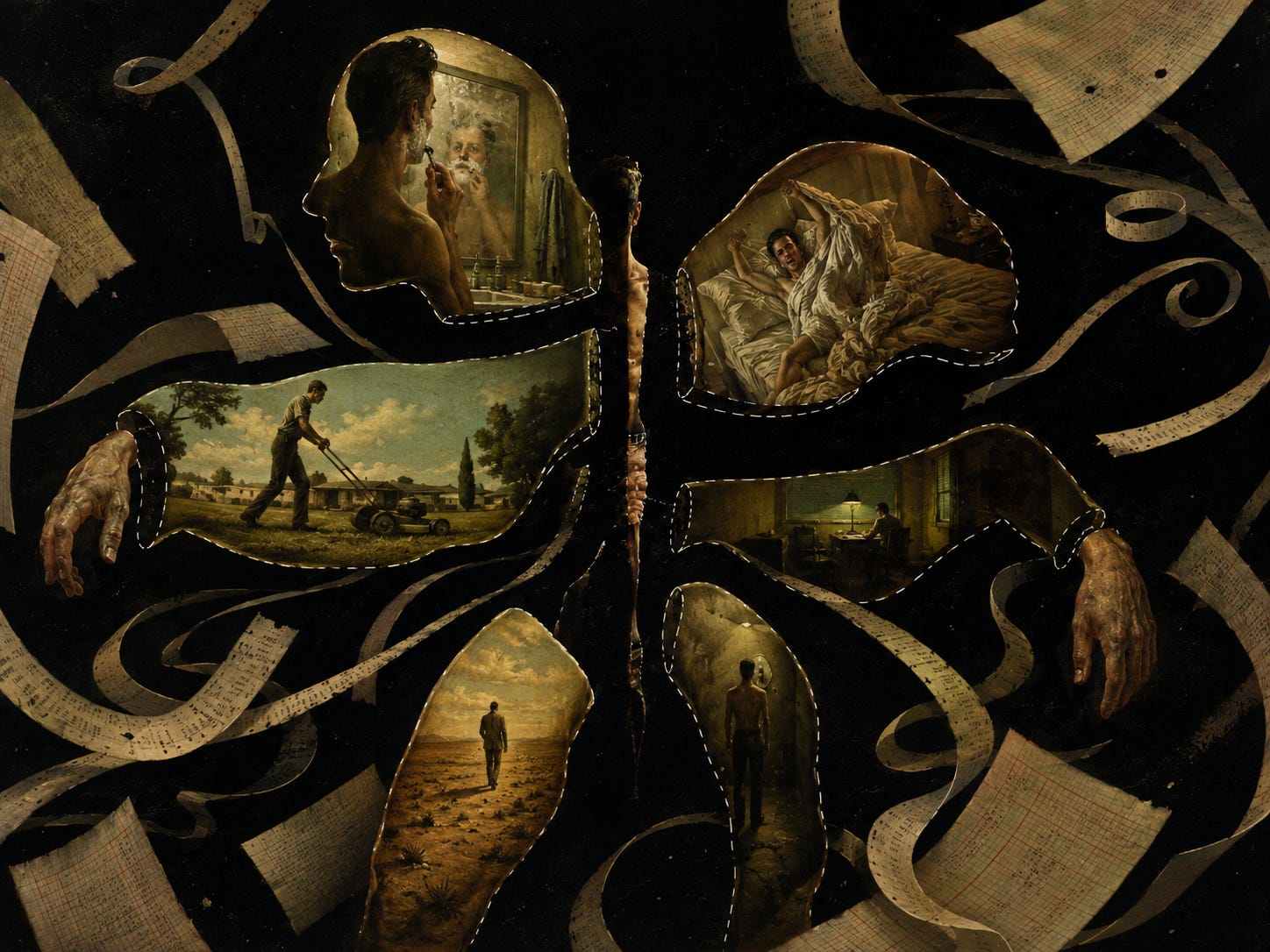
With the weariness of all lonely soldiers of fortune fighting a war of ideas, Gus wishes his LawnMaster Easy-Start Deluxe Mulching Mower had started on the fifty-sixth try that afternoon. Once you start exposing life to the terrifying clarity of Segmentarianism there is no turning back. Amazing how a happenstance brush with an idea can change a man.
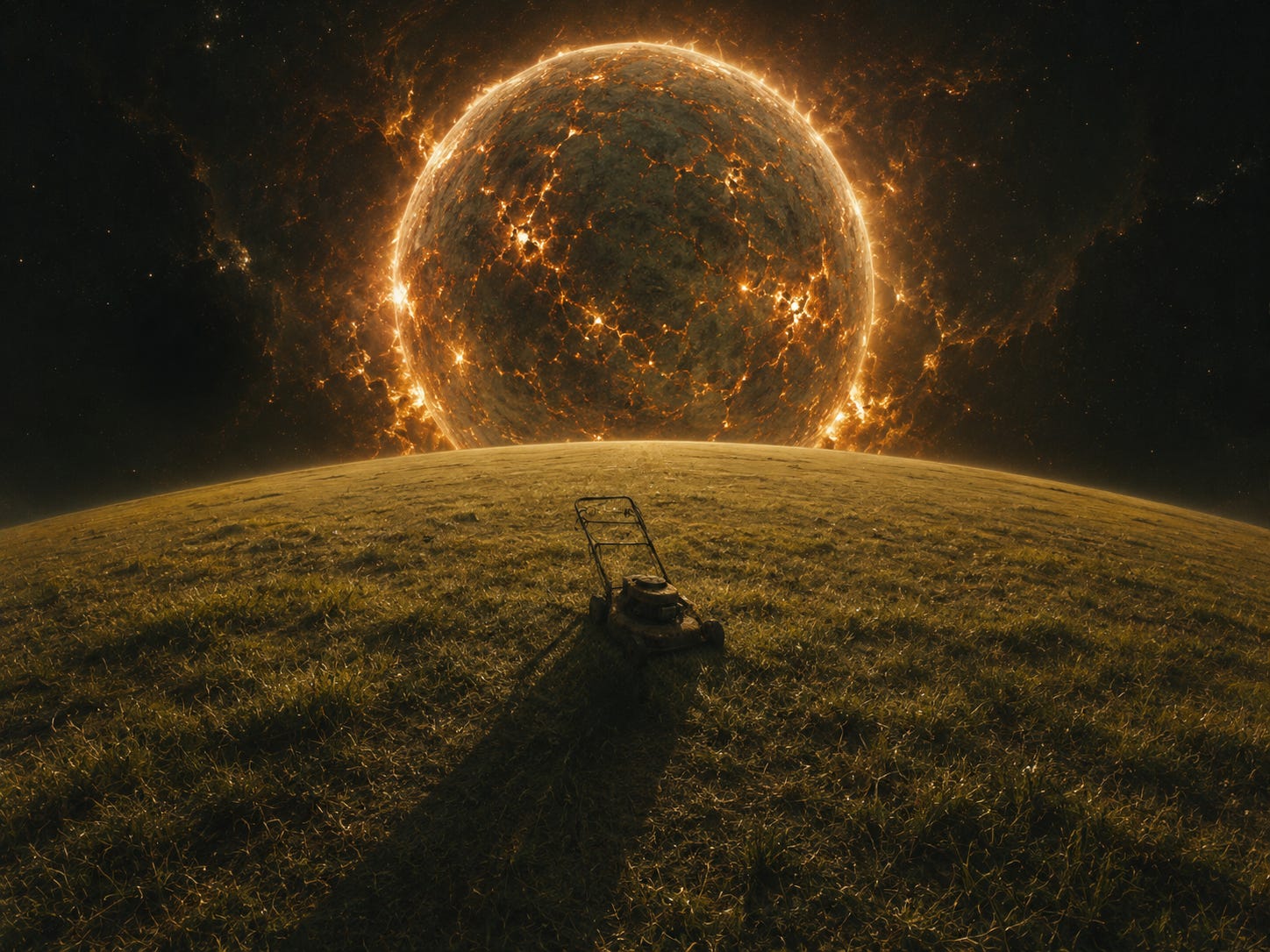
To remedy the Lawnmower Blues, contemplate things less ephemeral than your absurd chore. You, shadow’s dream, change the length of your lawn each week, devoting your fleeting days to glorifications of futility while the gases recently nicknamed the sun remain as chaotic as they were in the Permian. Oblivion is patient; permanence, relative. That even it shall die — this cherub who shone in a wondrous way for billenium — should its mortality bring you comfort, a sense of familial affinity, or despair? If nothing be permanent, then only Nothing is permanent. And ultimately triumphant.

Watchman & The Mystery Box
Shi Tzu, Cosmic Yak Dog
Plato’s Cave? Big Whoop!
Here There Be Contingency

Some old maps put monsters in the blank spaces. The sea serpents did not mark the edge of the world. They marked the edge of the survey.
Something similar happens in classical theism. Across nine centuries, three religious traditions, and several philosophical languages, thinkers who agree about almost nothing else arrive at the same joint in their systems and place something there.
I call the device a modal firewall: a selective restriction, reclassification, or termination of explanatory inquiry, placed at the point where continuing the explanation threatens to turn a contingent world into a necessary one.
The term is diagnostic, not accusatory, and is meant as a working constraint rather than a courtesy. A firewall may be independently justified. It may mark a real distinction rather than an improvised defense. But its location matters. When a boundary appears precisely where an explanatory system approaches an unwanted modal consequence, the boundary acquires a burden. It must be defended by more than the fact that it preserves the result the theory wants. Some of the cases below discharge that burden. One of them discharges it almost entirely.
One unexpected conclusion is worth stating at the outset. In the standard presentation, contingency is the premise and the necessary being is the conclusion: things need not have been, so they point beyond themselves to what must be. The record of these devices suggests something closer to the reverse. Contingency is not the comfortable starting point of classical theism. It is the thing classical theism has to work hardest to keep, and the architecture at the joint is the record of that work.
The predicament
The trouble is structural. Classical theism holds three things at once. First, the source of everything is necessary: not merely everlasting, but unable not to exist. Classical theists combine this with divine simplicity, according to which God is not composed of parts and possesses no intrinsic features that are distinct from the divine essence. Second, what the source produces is contingent: creation is a gift, not an emanation. This world did not have to exist. Third, the ascent from creatures to their source is a real explanation, not a dignified shrug. Natural theology depends on refusing to say that reality simply stops making sense at the summit.
Any two of these commitments sit together comfortably. A necessary source can produce a necessary order. A contingent world can remain brute. An explanation can proceed from one contingent fact to another. The strain appears when all three are combined. If a contingent world depends explanatorily on a necessary being, what stops necessity from running back down the chain the explanation has just climbed?
That question does not by itself establish a contradiction. Much depends on what kind of dependence is involved, whether the explanans necessitates the explanandum, and whether divine willing can be necessary as an act without necessitating its object. But those are not side issues. They are the point at which the theory must explain how the modal difference survives the explanatory connection.
Something has to happen at the joint. What’s fascinating is not that theists place something there. It is that they place very different things there, and that the location itself migrates across the tradition.

The test
Before the cases, the criteria.
Not every explanatory stopping point is suspect. Mathematics stops where it stops for reasons that have nothing to do with protecting a desired modal result. A theory may show that a relation is asymmetric, that a contrast has been misdescribed, that an explanatory demand is illegitimate, or that a terminus follows from the nature of the subject matter. Any diagnostic worth having has to be able to acquit such cases, and has to be able to say in advance what acquittal would look like.
Five questions do that work.
- Priority. Was the stopping point motivated before the modal danger appeared, or does it enter the system at the moment of pressure?
- Independent yield. Does it solve any problem other than preserving contingency?
- A real alternative. Does the theory identify a genuinely open opposite, or does it redescribe a necessary outcome in more accommodating vocabulary?
- Transmission. Does the explanatory relation carry necessity from ground to consequence, and if not, what specifically blocks the carriage?
- Counterfactual acceptance. Would the boundary still be accepted if it produced the opposite modal result?
A boundary is earned when these have answers. It is suspect when its only defense is the very contingency it was introduced to save. After the survey, the questions are applied to two cases (one that passes and one that does not).
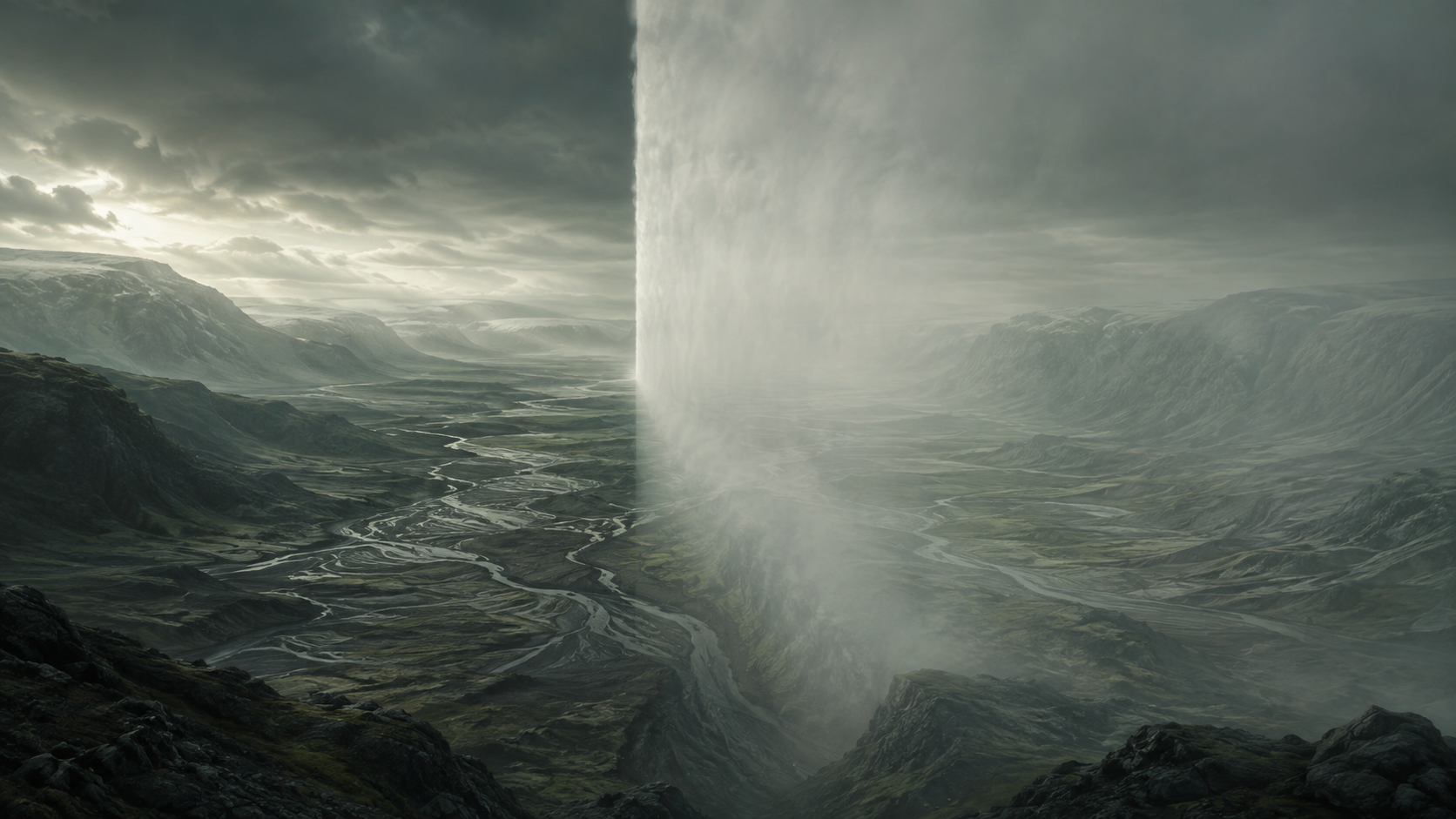
Eight ways to hold the line
Avicenna refuses to protect alternativity. The First is necessary in itself, and everything else proceeds from it by necessity of nature. He does not simply erase the distinction between creator and creature. He redraws it. Every created thing is possible in itself and necessary through another. Considered in itself, its essence does not include existence. Considered in relation to its cause, its existence cannot fail.
This is an elegant reclassification. It preserves asymmetric dependence, aseity, and the difference between having existence in oneself and receiving it from another. What it does not preserve is an actual alternative. Nothing in the complete causal order could have been otherwise. Contingency has been moved from the order of events into the internal constitution of dependent natures.
Al-Ghazālī’s critique of the philosophers is aimed, among other things, at exactly this point. A possible-in-itself world that necessarily follows from its source is not the free creation the theologian wanted. The alternative must be real, not merely abstracted from the cause that excludes it. This is the one place in the sequence where the historical through-line is well documented: a specific placement was found inadequate, in print, by a reader who named it.
Maimonides answers in two layers. His first move is particularization. Necessity of nature tends toward uniformity, yet the heavens exhibit this number of spheres, these motions, these directions. The arrangement appears particular in a way that impersonal emanation cannot explain. A purposive agent is therefore required. What a rationalist may count as an unpaid explanatory debt, Maimonides converts into evidence for will. The residue is not an embarrassment. It is the argument.
His second move limits what may be inferred once will has been introduced. Maimonidean negative theology sharply restricts affirmative claims about the divine essence, even while allowing us to speak of divine actions. The result is not absolute silence, but it narrows the terms on which the divine decision can be inspected. The boundary is drawn, and then the conditions for examining it are tightened.
Maimonides is unusually candid about the stakes. Creation is preferable to eternity because eternity has not been demonstrated and because creation better accommodates will, prophecy, and law. Were eternity demonstrated, scriptural interpretation would have to change radically. He posts a warning sign beside his own boundary. The cost is that the stopping point becomes difficult to audit: the less that may be said about what stands behind it, the harder it is to ask whether the limit is independently earned or simply protective.
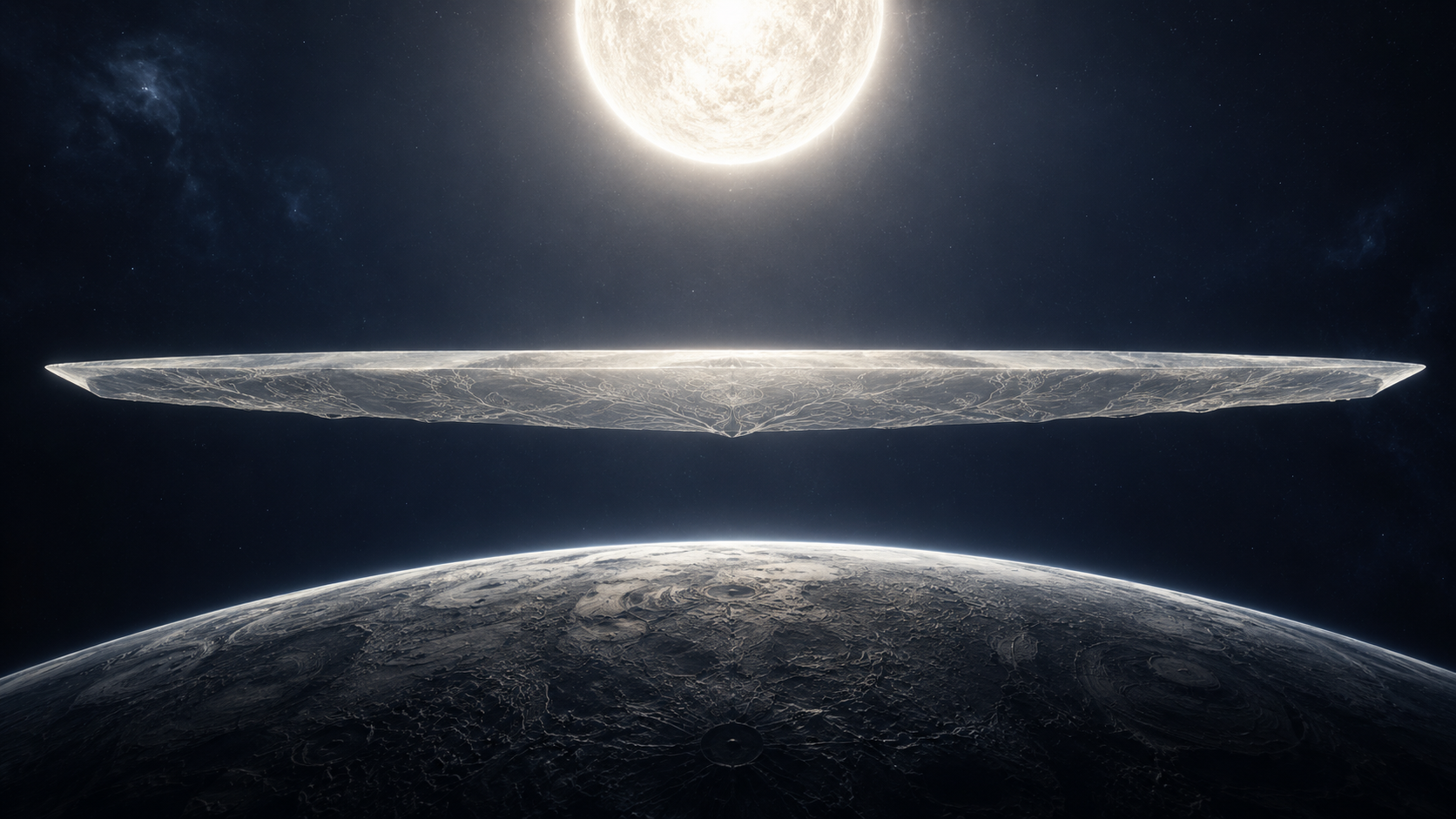
Aquinas makes a cleaner cut. God’s goodness is complete without any created order. No creature is therefore necessary as a means to divine perfection. God wills creatures, but does not need them. Explanation runs at full strength on both sides of the cut. Divine willing is a positive explanatory principle in the system, not a refusal to explain.
The elegance is also the exposure. Divine simplicity says that God’s act of willing is not a separable state added to the divine essence. If the divine essence is necessary, how can the willing of this world fail to be necessary? Aquinas’s account of relations helps hold the line. The creature is really related to God because it depends on God. The corresponding relation to the creature is not a real addition in God, but a relation of reason. The relation does not modify the necessary source.
That is more precise than saying that God is not related to creation at all. Aquinas is not cutting every connection. He is denying that creation introduces a new intrinsic feature into God. Whether that asymmetry explains contingency or mainly preserves divine immutability is the question the survey has to answer.
Scotus is the hinge, and the most direct answer anyone in this tradition gives to the question the reclassification strategy leaves open: is the opposite genuinely available?
The received picture he inherited treats possibility as spread across time. Something is possible if it obtains at some time or other; what is actual now is, in the relevant sense, necessary now, and the only openness available is the openness of a later moment. On that model, a will is free because it may will otherwise afterward. It is not free at the moment it wills. Scotus rejects the model. In the Lectura I 39 he argues that the will retains a real power for the opposite at the very instant at which it elicits its act. Not a power to change later. A power for not-A at the same instant at which A is willed. Later readers call this synchronic contingency, and the name marks a genuine break: possibility stops being a function of the temporal series and becomes a matter of the logical compatibility of alternatives, available to be assessed at an instant.
The structural consequence is the one that matters here. Scotus argues that contingency in the world cannot be produced by a first cause that causes necessarily; if the first cause acts of necessity, nothing downstream is contingent, however many intermediate causes are inserted. Nor can the divine intellect be the source, since the intellect apprehends what is intelligible rather than settling what obtains. The source of contingency must therefore be the divine will, and the divine will must be contingent in the synchronic sense: at the instant it wills this order, it retains the power for another.
This is not a restriction on inquiry. It is a positive theory of what possibility is, and its rationale runs well beyond the modal question at the joint: it reorganizes the analysis of freedom, of future contingents, and of divine knowledge. That is exactly the profile of a boundary with independent motivation, and Scotus deserves the credit.
The cost shows up one level in. A power for the opposite that is never exercised has to be something, and Scotus’s answer is that it is grounded in the logical compatibility (or, in Scotus’s own language, the non-repugnance of the terms), which he treats as prior to and independent of any act of will. That relocates the question rather than closing it: what accounts for the modal facts about non-repugnance, and what is their relation to a simple God? Scotus’s own answer requires the formal distinction, which lets him say that the divine attributes are distinct in a way weaker than a real distinction but stronger than a merely conceptual one. Thomists have argued ever since that this is simplicity purchased at a discount. Whether or not they are right, the observation for present purposes is structural: to make the divine will contingent, Scotus has to introduce distinctions inside God. The wall has not been dismantled. It has been moved indoors.

Molina moves the installation outside the divine decree. Between God’s natural knowledge of what creatures could do and God’s free knowledge of what they actually will do, Molina inserts middle knowledge: prevolitional knowledge of what any possible free creature would freely do in any possible circumstance. These counterfactual truths are available to guide the decree, but their truth is not fixed by the decree.
It matters that Molina did not arrive here by reading Aquinas on simplicity and finding the modal transmission unblocked. His context was the de auxiliis controversy: the fiercest dispute in early modern scholasticism over how efficacious grace and exhaustive providence could be reconciled with genuinely free consent. Báñez and the Dominicans held that God moves the will to its act by a predetermining concursus, and that freedom survives because God moves each thing according to its mode. Molina held that a will moved antecedently to its act is not free in the sense that matters: freedom is the power, with everything required for acting already in place, to act or not to act. The Jesuits answered that predetermination leaves the alternative no genuine work to perform; the Dominicans answered that without it, providence goes blind and grace waits on the creature. The Congregatio de Auxiliis heard the matter for nine years and condemned neither side. Rome declined to place the stop.
The honest claim is not that Molina relocated the boundary because Aquinas’s placement had failed as a piece of modal engineering. It is that the same pressure resurfaced in a different dispute, and that the machinery built to relieve it has the profile the diagnostic seeks. The specification of the tier is where this becomes visible. If the counterfactual truths are determined by God, creaturely freedom seems threatened. If they are determined by creaturely essences, the choices look settled before the chooser acts. If they depend on actual creatures, they arrive too late to guide creation. Middle knowledge therefore occupies a remarkably exact position: prior to the decree, about free acts, true independently of the decree, and still known infallibly by God.
This is not evidence of bad faith. Middle knowledge performs serious theological work, and Molinists offer arguments for each feature. But no case in the tradition displays its function more plainly. The theory needs a body of truths that can inform providence without being authored by providence. The installation stands outside God because placing it within God would threaten either contingency or freedom.
Descartes puts the boundary where nobody else in this sequence does: outside the modal order altogether.
On the doctrine of the creation of the eternal truths, announced to Mersenne in the spring of 1630 and never retracted, the truths of mathematics, logic, and metaphysics are effects of the divine will in exactly the sense that creatures are. God was as free to make the radii of a circle unequal, Descartes says, as he was free not to create a world at all. In the Sixth Replies the point is generalized: every order, every law, and every ground of anything’s being true or good depends on the divine will. And in the letters he is willing to say the thing the position requires and most readers resist: God cannot have been determined to make contradictories incompatible, and could therefore have done otherwise.
Observe what this does to the predicament. The threat was that necessity would travel from a necessary source down a dependence relation to a contingent effect. Descartes cuts the wire at the source. There is no antecedent necessity to transmit, because necessity is itself downstream of the will. Nothing in the essences makes one preferable to another before the choice; the choice therefore cannot be constrained by them, and divine indifference is total. Where the tradition insulates the effect, Descartes dissolves the modal status of the ground.
Descartes treats this opacity not as a defect of the theory but as one of its consequences. Asked how we are to conceive a free choice among contradictories, he replies that we cannot and should not try: our minds are finite and were made able to conceive as possible only what God in fact willed to be possible.
Whether the wire is actually cut is a further question, and it is not clear that it is. Something modal appears to stand before the decree even on this account: that God exists, that God can create, that God cannot make it the case that there is no God. If those hold prior to the willing, the firewall has not reached all the way out, and the transmission question returns at the new location. Amy Karofsky presses the standard version of this objection, adding a second: if God can do anything, then anything is possible, which would make even the impossible possible.
A further argument of hers cuts closer to what is distinctive in Descartes. Against contingentarian theism generally, she poses a Euthyphro-shaped dilemma. Either God chooses among alternatives for a reason, in which case the reason determines the choice and the outcome is not contingent after all; or God chooses for no reason, in which case the choice is arbitrary, anyt;hing may follow, and nothing is necessary. Either nothing is contingent or nothing is necessary. Most of the tradition treats this as a dilemma to be escaped. Descartes takes the second horn deliberately: supreme indifference is not an awkward consequence of the doctrine but its content. The argument functions against him less as a trap than as an accounting. He has purchased immunity from modal transmission at the price of necessity itself, and the position is stable only if one is willing to say so.
Leibniz stops blocking and starts grading. He refuses the earlier appeal to unexplained choice. Nothing occurs without a sufficient reason, not even a divine decision. Contingency must therefore survive inside a system that grants explanation everywhere.
His instruments include the distinction between metaphysical and moral necessity, the claim that possible alternatives remain possible in themselves, and the doctrine of infinite analysis. On one prominent reading, a necessary truth can be reduced by finite analysis to an identity, while a contingent truth requires reasons for reasons without a terminating demonstration available to a finite mind. God grasps the whole infinite order, but we do not.
The wall has become a customs house. Necessity reaches the border but must declare under which description it travels. God is morally necessitated to choose the best, Leibniz says, but not metaphysically necessitated in the sense that alternatives contain contradictions. Critics have long wondered whether the lower grade preserves a genuinely open opposite or merely gives necessity a more accommodating name. The infinite-analysis doctrine faces a parallel question. If the complete reason is there for God, does our inability to finish the proof make the truth contingent, or only make its necessity inaccessible to us?

Spinoza is the outlier who builds nothing. Every junction the preceding tradition guarded, he argues the guard away: no volitional cutoff, no middle tier, no synchronic power for the opposite, no lower grade of necessity that leaves reality otherwise, no refuge in an unfinished analysis. From the necessity of the divine nature, things follow as they do. The distinction between nature as productive and nature as produced survives, but it is causal and aspectual, not a border between necessity and contingency.
Spinoza pays for this in daylight. Freedom must be reconstructed within necessity; contingency is reassigned to the imperfection of our knowledge. Yet his refusal is philosophically clarifying. He functions as the control case. The other systems can be measured against a thinker who accepts the consequence they are designed to avoid, and the fact that the protective machinery simply does not appear in him is evidence of the same kind as its presence elsewhere.
Running the test
Aquinas, largely acquitted
Take the strongest version of the charge: that divine simplicity, or the doctrine of relations that accompanies it, is a device for keeping necessity from travelling down the creative relation.
On priority, the charge fails. Simplicity is not a Thomistic invention and does not enter at the point of modal pressure. It arrives as an inheritance: Plotinus, Augustine, Boethius, Anselm, with a lineage centuries older than the specific worry about modal transmission from a necessary source. Its stated motivation is compositional and has nothing to do with modality: whatever has parts requires something to compose them, and so cannot be first; whatever has an essence distinct from its existence cannot be unique. The doctrine is a conclusion of the argument that gets Aquinas to God at all, not a repair applied afterward.
On independent yield, it fails as decisively. Simplicity does an enormous amount of non-modal work: aseity, uniqueness, immutability, the identity of God with his own goodness, the whole account of analogical predication. Strip out the modal question entirely and the doctrine still has to be there.
On a real alternative, Aquinas is in the clear. The alternatives are not merely admitted, they are catalogued: the divine ideas include orders God did not make, and the text distinguishes what God wills necessarily (his own goodness) from what he does not (everything else). There is a genuine foil, affirmed in the theory’s own voice.
On counterfactual acceptance, the doctrine passes too. Simplicity is held by thinkers who draw opposite modal conclusions from it, and weakened by others (Scotus) without the modal result driving the revision. It is not tuned to an output.
That is four out of five, and the four are not close. Divine simplicity is not a modal firewall. Anyone who reads this diagnostic as an indictment of the doctrine has misread it.
Where the burden actually sits is question four, transmission. Aquinas’s instruments against the collapse are scope devices: the distinction between suppositional and absolute necessity, and the reply on foreknowledge that distinguishes the necessity of a conditional from the necessity of what it is about. Both have real logical content, and both are answers to arguments that transmit necessity along an inference. The simplicity problem is not of that form. If the act of willing this world just is the necessary divine essence, there is no consequence relation to disambiguate: the argument runs through an identity, and a scope distinction has nothing to operate on. The Thomist’s remaining options are structural: either the difference between willing this order and willing another is no intrinsic difference in God at all, so that worlds differ while God does not; or simplicity is qualified; or some restricted form of the collapse is accepted.
The verdict is differentiated. The doctrine is acquitted. The narrower claim that the divine will’s relation to creatures adds nothing real to God is not a firewall either, since the theory of relations that supports it is independently developed and generally applied. What remains is an unpaid explanatory debt at a precisely identifiable node, and a live contemporary literature arguing about whether it can be paid.[1]
Molina, pressed
Middle knowledge comes out differently, and the difference is instructive because it is not a difference in the sincerity of the author.
On independent yield, Molina does very well. The tier buys exhaustive providence without determination, an unmysterious account of foreknowledge, congruous grace, and (four centuries later) the machinery of the free-will defense. Nobody should call this a decorative patch.
On a real alternative, he does better than anyone else in the survey. The modal field is the widest in the tradition and it is layered: the possible worlds of natural knowledge, the feasible subset the true counterfactuals leave available, and the actual world selected from among those. An omnipotent will bounded by contingent truths it neither authored nor can alter is a striking piece of metaphysics, and the alternatives in it are load-bearing rather than decorative.
On priority, the answer splits, and the split is the interesting part. The tier was built for a real, prior, independent problem (grace and consent) and that counts genuinely in its favor. But the problem it was built for does not specify it. Nothing in the de auxiliis dispute requires that the relevant truths be prevolitional, or contingent, or ungrounded in essences, or infallibly known. Those four properties are fixed by a different requirement: that the truths inform providence without being authored by it. The motivation is prior; the specification is not.
On transmission, the answer is a bedrock. What blocks necessity from running through is that the counterfactuals are contingent, prior to every act of will, and — on the developed view — grounded in nothing. The grounding objection was raised at once, in the Thomist form that truth follows being and that prior to the decree there is no being of the relevant creatures for these truths to follow from, and it has been pressed in the same shape ever since. Grounded in the divine nature, the counterfactuals inherit necessity and determine the creature. Grounded in the creature’s essence, they determine the choice. Grounded in the creature’s actual choices, they arrive too late. Grounded in nothing, they are brute: determinate contingent truths about wills that no will, no nature, and no fact makes true. Sophisticated Molinists now accept the last horn openly. That is candor, and candor is not the same as an answer.
On counterfactual acceptance, the case is at its weakest. Suppose the tier turned out, on analysis, to necessitate the creaturely acts it reports. No Molinist would keep it. The properties are specified to exactly the tolerance the problem requires, and the position has no independent attachment to any of them.
The result: the strongest firewall candidate in the sequence, but not an unmotivated one, and not a fraud. That is a real finding, and it is a different finding from the one Aquinas gets. A diagnostic that returned the same answer for both would not be worth running.

The awkward question
Amy Karofsky has recently defended necessitarianism with an argument she titles the uncontainable contagion of contingency: if a contingent thing could have differed, then facts and relations involving it could have differed, and mere membership in a world is enough to constitute a relation. Any supposedly necessary item connected to the contingent one therefore appears caught in a network that might have been otherwise. If anything is contingent, everything is; and since radical contingentarianism is false, nothing is contingent.
Two further arguments of hers bear directly on the architecture surveyed above, and both are sharper against the firewall structure than the contagion thesis itself. (A third, the dilemma about reasons for divine choice, has already been used against Descartes.)
The first is a dilemma about criteria. Suppose some criterion distinguishes the contingent from the necessary. That criterion must itself be either contingent or necessary, and falls on one side of the very line it was introduced to draw. This is precisely the question a firewall cannot avoid. If the barrier and all its relevant operations are necessary, why is the outcome on the far side not necessary? If the barrier is contingent, has contingency entered the source, or the structure surrounding it?
The second is an argument against degrees of necessity, and it is aimed, whether or not by design, at the customs house. If metaphysical and moral necessity genuinely differ, some criterion must distinguish them; and that criterion can be neither metaphysically nor naturally necessary without circularity. Leibniz’s grading strategy is the obvious target. Scotus’s distinction between logical possibility and what a cause can actually produce is a further one.
Karofsky’s argument is not the same as the firewall argument. It is stronger and more controversial: it aims to show that contingency cannot be contained at all. The firewall diagnosis makes a narrower claim: that when a theory introduces a boundary exactly where explanatory continuation threatens modal collapse, that boundary deserves scrutiny of a specific kind. Nor is her argument uncontested; Stephen Maitzen has pressed hard on the modal logic and on her treatment of infinite regresses, among other things. Take her contagion argument as a stress test rather than a definition of the phenomenon. If it succeeds, it supplies an independent reason to doubt that contingency can be stably partitioned. If it fails, the differentiated record above still stands on its own evidence.
Run the stress test against the survey and four recurring strategies come into view. They overlap; a single thinker may use more than one, and Spinoza rejects all four.
The first places the barrier in reality. Divine will, asymmetric relations, synchronic power for the opposite, and middle knowledge are all meant to make a real difference to what follows from what. These cases face the modal question directly. The answer may be that explanation need not necessitate, that willing can be free without being an intrinsic alteration, that a power for the opposite is real at the instant of acting, or that counterfactual truths have a special status. But one of those answers must do the work. Merely repeating that God chose freely does not yet explain how a necessary source supports a nonnecessary effect.
The second places the limit in cognition or description. Maimonidean apophasis restricts what we can say. Cartesian incomprehensibility restricts what we can conceive. Leibnizian infinite analysis restricts what finite reasoners can complete. Such limits may be independently justified, and they may explain why no proof of necessity is available to us. What they cannot do by themselves is establish that the world is metaphysically contingent. A boundary on demonstration is not automatically a boundary on reality. It may stop us from watching necessity spread without stopping the spread.
The third works by reclassification. Avicenna’s possible-in-itself beings, Leibniz’s moral necessity, and other graded modalities preserve a contrast while revising what the contrast means. The decisive question is whether the opposite remains genuinely open. Scotus is the tradition’s most serious attempt to answer it in the affirmative, and the attempt succeeds or fails on whether unexercised logical possibility is a real feature of the world or a shadow cast by our descriptions.
The fourth relocates the modal order itself. Descartes alone makes the necessary truths products of divine will, so that there is no antecedent necessity available to travel anywhere. This is the most radical placement in the sequence, and it purchases immunity from transmission by surrendering the very stability the other positions were trying to protect.
None of these questions has a one-line answer. That is precisely why the pattern matters. The same pressure recurs under different terminologies, and the boundary moves: from essence to will, from will to relation, from relation to a power for the opposite at an instant, from that power to counterfactual truth, from counterfactual truth to the modal order as such, from metaphysics to analysis. The architecture changes because each location carries a different cost.

The inversion
Natural theology has often presented the necessary being as the explanation of contingency. Things need not have been, so they point beyond themselves to what must be.
The firewall record suggests something closer to the reverse, and this is the claim I would most like a reader to carry away. Dependence on a necessary source creates the most direct route along which necessity threatens to travel. Classical theism is therefore not an easy home of contingency. It is one of the most demanding settings in which contingency must be preserved and explained. The theory makes the world absolutely dependent on a metaphysically necessary source, then must explain why the modal profile of the effect does not simply inherit that of its ground.
Humean mosaics and brute-fact naturalisms have an easier story about preserving contingency for an unglamorous reason: their dependence relations are weaker, or they stop earlier. That does not make them explanatorily superior. They pay in bruteness what theism pays in insulation. A world that declines to explain its basic arrangement will not suffer modal transmission from an explanation it never offered. The price is that the arrangement remains unpaid for.
The interesting comparison is therefore not between theories with costs and theories without them. There are no theories without them. It is between different ways of paying. The theist buys explanation and inherits the problem of modal transmission. The brute-fact theorist blocks transmission by refusing the explanatory ascent. Spinoza purchases complete intelligibility by surrendering alternativity. Leibniz tries to keep both explanation and contingency by grading necessity. Descartes keeps the ascent and the alternatives by making necessity itself a creature. Molina locates the alternative in truths prior to the decree. Scotus locates it in a power for the opposite that survives the act of willing. Aquinas locates it in a will whose relation to creatures adds nothing real to God.
Once the ledger is visible, the familiar dialectic changes. Contingency is no longer the free starting point from which the necessary being is inferred. It is an achievement for which the completed system must account.
What follows
Identifying a firewall locates a burden; it does not discharge it, and as the Aquinas case shows, running the test can also lift one. Several of these boundaries have serious independent arguments behind them. Aquinas’s account of divine goodness is not an evasion. Molina’s middle knowledge is not a decorative patch. Scotus’s synchronic contingency is a genuine advance in modal theory, not a defensive maneuver dressed as one. Maimonidean negative theology does not exist only to conceal a modal problem. Leibniz’s distinction between kinds of necessity belongs to a much larger account of reason, value, and freedom. Even Descartes’s universal possibilism, which looks from outside like the most desperate placement in the survey, follows from a considered view about what omnipotence requires.
What the survey does show is narrower, and harder to dismiss. It shows that a specific pressure recurs across systems with almost nothing else in common, that something is built at the same joint each time, and that the something is different each time, which is what one would expect if the pressure were real and the solutions were attempts rather than inheritances. It also shows that the diagnostic can distinguish among cases: applied to Aquinas it mostly acquits, applied to Molina it mostly does not, and the difference tracks features of the theories rather than sympathies.
The five questions are worth restating now that they have been used. Was the stopping point motivated before the modal danger appeared? Does it solve a problem other than preserving contingency? Does the theory identify a genuinely open alternative, or only redescribe a necessary outcome? Does the explanatory relation transmit necessity, and if not, what blocks the transmission? Would the boundary still be accepted if it produced the opposite modal result?
A boundary is earned when those questions have answers. It is suspect when its only defense is the very contingency it was introduced to save.
Which returns us to the map. The monsters and the wall are the same fact from two sides: from outside, a survey that stops; from inside, something built at the place where it stopped. The map may be right. There may really be dragons. But the serpents are drawn at the edge of the survey, and someone should ask whether the surveyor stopped because the land ended or because he did.
Sources and further reading
Avicenna, The Metaphysics of The Healing, Books VIII–IX; and the overview in Avicenna’s Metaphysics.
Al-Ghazālī, The Incoherence of the Philosophers, especially Discussion 1.
Maimonides, The Guide of the Perplexed, I.50–60 and II.13–25; see also the Stanford Encyclopedia overview.
Thomas Aquinas, Summa Theologiae I, q. 13, a. 7; q. 14, a. 13; q. 19, aa. 3 and 8; q. 28, a. 1; q. 45, a. 3. Online text.
John Duns Scotus, Lectura I, d. 39, and Ordinatio I, dd. 38–39; translated with commentary in A. Vos et al., Contingency and Freedom: Lectura I 39 (Kluwer, 1994). For the background against which the break is visible, Simo Knuuttila, Modalities in Medieval Philosophy (Routledge, 1993). See also Duns Scotus.
Luis de Molina, On Divine Foreknowledge: Part IV of the Concordia, trans. Alfred J. Freddoso (Cornell, 1988); Thomas P. Flint, Divine Providence: The Molinist Account (Cornell, 1998); on the grounding objection, Robert M. Adams, “Middle Knowledge and the Problem of Evil,” American Philosophical Quarterly 14 (1977): 109–17, and William Hasker, God, Time, and Knowledge (Cornell, 1989). See also Middle Knowledge.
René Descartes, letters to Mersenne of 15 April, 6 May, and 27 May 1630 (AT I 145–53; CSMK 23–26); Sixth Set of Replies (AT VII 431–36; CSM II 291–94); letter to Mesland of 2 May 1644; letter to Arnauld of 29 July 1648. See also Descartes’ Modal Metaphysics, and Harry Frankfurt, “Descartes on the Creation of the Eternal Truths,” Philosophical Review 86 (1977): 36–57.
G. W. Leibniz, “On Contingency” and Theodicy; see also Leibniz’s Modal Metaphysics.
Baruch Spinoza, Ethics, Part I, especially propositions 16, 29, and 33. Online text.
Amy Karofsky, A Case for Necessitarianism (Routledge, 2021), ch. 3; the contagion argument is §3.4, “The Uncontainable Contagion of Contingency,” where the criterion dilemma also appears; the dilemma about reasons for divine choice is at §2.18; the argument against degrees of necessity is in ch. 4; the objections to Aquinas and Descartes are in the Introduction, “Some Medieval and Modern Philosophers,” pp. 10–12. See also her “Suárez’ Influence on Descartes’ Theory of Eternal Truths,” Medieval Philosophy and Theology 10 (2001): 241–62. Publisher page. For criticism, Stephen Maitzen, “Necessitarianism Under Fire.”
[1] The contemporary modal collapse literature is arguing about precisely this trilemma. See R. T. Mullins, The End of the Timeless God (Oxford, 2016), ch. 4, and “Classical Theism” in the T&T Clark Handbook of Analytic Theology (2021); Christopher Tomaszewski, “Collapsing the Modal Collapse Argument: On an Invalid Argument against Divine Simplicity,” Analysis 79 (2019): 275–84; Joseph C. Schmid, “The Fruitful Death of Modal Collapse Arguments,” International Journal for Philosophy of Religion 91 (2022): 3–22, and “From Modal Collapse to Providential Collapse,” Philosophia 50 (2022): 1413–35; Schmid and Mullins, “The Aloneness Argument against Classical Theism,” Religious Studies 58 (2022): 401–19; and, on the other side, W. Matthews Grant, Free Will and God’s Universal Causality (Bloomsbury, 2019). Tomaszewski’s objection is that the standard derivation is invalid, trading on an illicit substitution into a modal context; Schmid’s response is that the classical theist escapes the collapse only by accepting an indeterministic link between God and his effects, which then costs something at providence. The dispute is a live instance of question four above.


“Driving, page-turning force” Publishers Weekly
The Sound and the Purry

It was not grass and it was not earth either but the gray outraged dust of a world that had never known rain, that had waited four billion years in that long weightless dark not for man but for this: the flowers. Because they were there now, actual and impenetrable, white and profligate and doomed, blooming out of the dust which could not have birthed them and had birthed them anyway, in defiance not of God but of the very memory of God.
And the cat. Not cats: the cat, though she was four and maybe more than four, watching out of the blossoms with that fierce quadruple regard, the same face repeated across the field like an affirmation or a curse, the way the dead repeat themselves in the living, grandsire to son to son’s son, so that a man looking into his own child’s face sees not his child but the whole tremendous invincible procession of his blood looking back at him out of time. She crouched there among the potato flowers (potato flowers: as if even here, even in this absolute and irrevocable elsewhere, the earth’s meanest crop had followed man like guilt follows him, like the smell of his own sweat) not hiding and not hunting either but simply being, with that quality cats have of owning whatever they regard, so that it was not she who trespassed in the gray dominion of the dust but the dust which trespassed around her.
And overhead, in that black which was not sky because sky is something you breathe under, hung the earth itself: small, blue, swirled, remote, the whole vast tragic tumultuous home of man shrunk now to something a boy could cup in two hands, and in it every courthouse and every cotton field and every grave; and the cat did not look at it. She would not look at it. Because that was hers too, or had been, or would be. She being cat and therefore neither remembering the earth nor grieving it, having learned what man in ten thousand years of looking backward has never learned: that the past is not dead, it is not even past, and for that very reason you must sit facing forward in the flowers, waiting, immune, eternal, while the old blue world hangs there over your shoulder like something you were acquitted of long ago.

This time it was red, all of it, the dust and the rocks and the very air itself, red not like blood is red but like the memory of blood, like the stain that will not scrub out of the pinewood floor no matter how many generations of women kneel to it, a whole planet the color of old iron and old wounds under a sky that was not sky but merely more dust, suspended, waiting, the way haze hangs over a burned field in August long after the fire has gone on.
And in the middle of that immemorial rust, the garden. One garden. Not sprung wild this time but made, deliberate, the straw laid down and the stones hauled and set each against each in a ring like a cairn or a covenant, so that a man looking at it would know at once that hands had done this, mortal and finite and unhumble hands, and had done it not because the land invited them (the land had not; the land had said No in red thunder for a thousand million years) but precisely because it had not; and the potato plant stood up out of its bedding of pale straw and bloomed, pink and white and outrageous, profligate with blossom the way the doomed are always profligate, spending everything at once because there is no bank on Mars to hold a flower’s savings. And beside it the little instrument on its steel stalk, its glass eye turned heavenward, measuring. Because man cannot merely make a garden and sit down in it; he must number it too, must reduce even his one miracle to figures in a ledger, as if by measuring the wind he could forgive himself for having come.
And the cat watched. One cat now, black, or that gray which is blacker than black in that red light, sitting apart among the stones with his paws folded under his in that attitude of patient and absolute proprietorship, not near the garden and not away from it either but exactly at that distance which cats and creditors know by instinct: close enough to claim, far enough to disavow. He was not the pale multiplied cat of that other, grayer world; he was singular, dark, indivisible, like a period at the end of a long sentence, and he regarded the one green living thing on the whole red planet not with wonder and not with hunger but with something older than either, the look of one who has seen gardens before, and seen what becomes of them, and of the men who plant them; and who intends, this time, merely to sit in the red and permanent dust, and outwait it: the straw, the stones, the little glass instrument, the flowers and the flowers’ children and the very ambition itself, since he knew what the gardener in his pride did not: that Mars was not conquered, it was only, for the moment, and in that one ringed and mulched and measured place, distracted.

Night now, and the moon: not the tame moon of almanacs and lovers but the old fierce original coin itself, hanging above the broken hills like the one lamp left burning in a house where everyone has died, and beneath it the tower. It had been a keep once, a bastion, some baron’s stone boast flung up against the dark by men who believed that to pile rock on rock was to pile year on year, that masonry could hold not just the border but time itself; and the men were gone now and their names were gone and even the war they built it for was gone, unremembered, unregretted, while the ivy went up the walls in the moonlight with that slow vegetable patience which does not besiege because it does not need to, which merely waits and climbs and waits, knowing that all flags come down at last and all stones return; and the banner still hung from its pole above the battlement, faded past its colors into the mere idea of a banner, stirring a little, like something talking in its sleep.
And on the parapet, above the banner’s shadow, the cat. Not pale now and not black either but brindled and parti-colored like some jester or judgment, sitting with her paws together on the topmost stone of all that dead ambition the way conquerors sit on thrones they did not build, looking down; and what she looked down upon was not the castle and not the moon-colored river and not the drowned centuries between, but the beasts.
Because they had come back. Or they had never gone: the great one standing hip-deep in the shining water, lifting its small head on that long neck out of a time before there were names, before there was even anyone to be before, moving through the shallows with the slow tremendous unhaste of something that has never learned fear because it antedates the very invention of it; and above the hills its winged cousin going over on stiff sails, crossing the moon’s face like a scrap of the original dark that the light had never managed to burn away. They did not see the tower, or seeing it did not regard it, since to them it was already what it would be: a heap, a reef, a thing the river would explain to the gravel by and by. And so the whole night stood stacked there in the one moonlight like uncashed cheques on a spike: the lizard’s aeon, the baron’s century, the ivy’s decade, the cat’s hour, each one believing itself the present; and the cat sat on top of all of it, at the exact and lonely summit of time, keeping the one watch that has never yet been relieved, guarding for no wage and no lord the single perishable kingdom that any creature ever really holds, which is the night itself, this night, now, before the moon goes down and the water smooths and the great neck sinks again into the reeds and the dark, and it all becomes (tower and banner and beast and moonlight) merely another thing that was.

Dusk, or what passed for dusk on that world which had never agreed to the sun’s terms: the red land going redder and then darker red, like iron cooling, like the last coal in the grate of an abandoned house, and low over the hills the ringed planet hanging tilted and enormous and serene, wearing its halo the way a hanged man’s ghost might wear the rope, ornament and sentence both.
And in that failing light the two of them met. Not fought, not fled: met. Confronted one another across ten feet of rust-colored dust that might as well have been the distance between the making of their two bloods, the one pale, boneless-looking, molluscine, raised up out of the ground like a question the planet had been four billion years in asking, holding aloft on that single tapering stalk of itself the one tremendous golden eye. Not two eyes, not the paired and parallax vision of the hunters and the hunted of the old world, but one, single, lidless, central, the eye of something that had never needed to triangulate a distance because it had never had anywhere to go, that had lain in the red hardpan through eons of which even the rocks had lost count, dreaming whatever the dust dreams, until now.
And the cat looked back. Black, small, furred, finite, with the little buckled collar still around his neck: that thin worn strap of another planet’s leather, the last insignia of the race that had named him and carried him across the naked light-minutes and then, in the way of that race, gone on, or gone under, or merely gone. He sat in the alien twilight with his paws together and gave the great eye back its gaze, green for gold, two small lamps against one large one; and there was no fear in him, and no wonder either, because a cat does not acknowledge precedent and therefore cannot acknowledge the unprecedented: to him the monster was neither miracle nor abomination but simply the next thing which had presented itself to be judged, as the sparrow had been, and the June bug, and the vacuum cleaner, and man.
So they regarded one another, the first eye and the cat, beneath the stranger’s ringed lamp, in the silence which was not the silence after something but the silence before it, the whole red world holding its breath around them; and if there was to be a treaty between the two kingdoms (the kingdom of the dust that dreams and the kingdom of the small fierce blood that endures) it would be ratified here, without words, without witnesses, in the oldest parliament there is: two creatures, met at evening, deciding in the unhurried courtesy of their mutual and sovereign regard whether the other was to be feared, or eaten, or, at the last and highest reach of diplomacy, ignored.
“Driving, page-turning force” Publishers Weekly


Why Contingency Won’t Stay Put
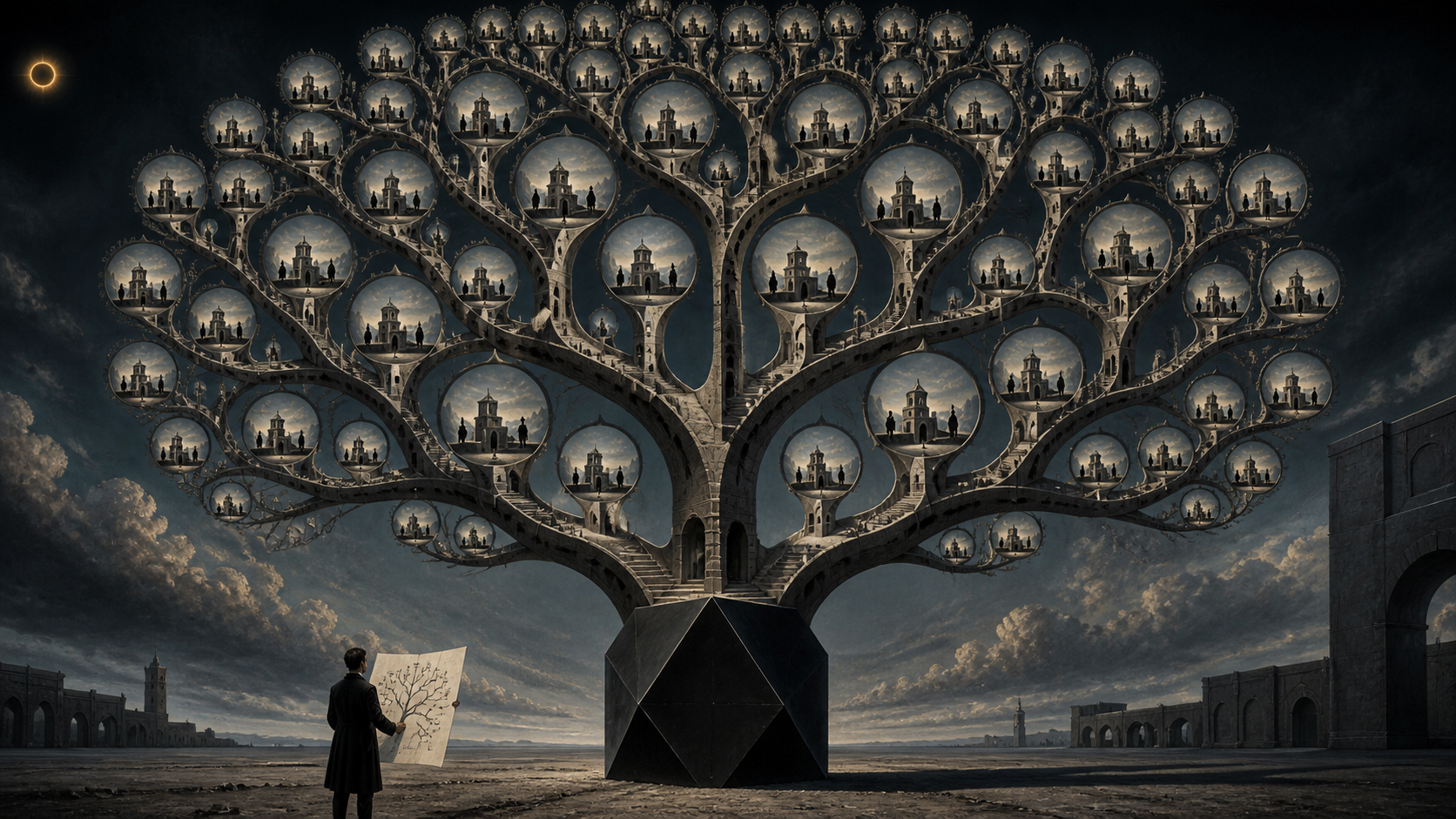
Most philosophers treat contingency as metaphysical common sense.
The cup on my desk might not have existed. The meeting might have been cancelled. The tree might have grown two feet to the left. The universe itself might have been otherwise. We begin with these familiar thoughts and then ask how much necessity we can responsibly add.
Amy Karofsky reverses the pressure.
In A Case for Necessitarianism, she argues that absolutely nothing about reality could have been otherwise in any way whatsoever. Contingentarianism is the opposing view that at least something could have been different. Her challenge is not merely that contingentarianism lacks proof. It is that contingency is harder to contain than its defenders suppose.
Call this the contagion of contingency.
The ordinary contingentarian wants a modest position. Not everything is up for grabs. Some things are necessary, some things are contingent, and the two can live together peacefully. Perhaps the laws of nature are necessary but the initial conditions are contingent. Perhaps God is necessary but the created world is contingent. Perhaps essences are necessary but accidents are contingent. Perhaps the modal structure is fixed while ordinary facts vary.
Karofsky’s reply is that this picture is unstable. Contingency does not sit politely inside its assigned compartment. If one thing could have been otherwise, then its relations to other things could have been otherwise. And if those relations could have been otherwise, then the other things related to it could have been otherwise in at least that respect. Contingency spreads by relation.
Suppose C is contingent. C might not have existed, or might have been different. But C is related to M. If C had been absent or different, then M would have stood in a different relation to C. So M, too, would have been otherwise: not necessarily in its intrinsic nature, but in its relational profile.
Here, a careful reader will object. The intrinsic/extrinsic distinction exists precisely to block this kind of inference. A necessitarian about intrinsic natures can grant that relational properties shift across counterfactuals while denying that anything important about the underlying entities is contingent. To say M’s relational profile could have been otherwise is not yet to say M itself could have been otherwise. Not, at any rate, in the sense that matters for whether the world had to be this way.
The argument cannot be dismissed by this move, but it does need to meet it. Karofsky’s reply, in effect, is that being related to one’s actual surroundings in the actual way is not a thin or detachable feature. M’s relational profile is one of the ways M actually is. To say M could have stood in different relations is to say M could have been an entity with a different profile. And that, on her view, is enough. The disagreement at this joint is real, and the contagion argument carries only as much weight as one’s willingness to count relational variation as genuine variation. But the contingentarian who resists here owes an account of why intrinsic natures are the only modally serious feature of an entity, and that account is harder to give than it looks.
Once the step is granted, the spread is hard to stop. Everything that is related to a contingent entity inherits at least relational contingency. The surrounding modal structure loosens.
Contingency can’t be quarantined.
The contingentarian wants a firewall. The firewall says: contingency goes this far, but no farther. The world may vary, but God does not. Accidents may vary, but essences do not. Initial conditions may vary, but laws do not. Created reality may vary, but the divine nature does not. Ordinary facts may vary, but modal principles do not.
But the firewall has to stand somewhere. It must distinguish the necessary from the contingent. It must mark one side as fixed and the other as variable. And that very distinction now becomes part of the modal machinery in need of explanation. Why is the line here rather than there? Why are these features allowed to vary but not those? Why does contingency stop at exactly this border?
Karofsky’s diagnosis is that such borders are not neutral. They are doing metaphysical work. And if they are doing metaphysical work, they cannot simply be asserted. They must be grounded. But once the grounding relation is introduced, the old pressure returns: is the ground necessary or contingent?
If the ground is necessary, then what follows from it seems necessary as well. If the ground is contingent, then the basis of the modal system has itself become contingent. Either necessity flows downward, or contingency leaks upward.
The “seems necessary as well” hides a controversy worth naming. In contemporary grounding theory, Fine, Rosen, and others have distinguished grounding from modal entailment precisely so that one can hold X grounds Y without thereby holding necessarily, if X then Y. On these views, grounding is hyperintensional and need not transmit modal status downward. The argument therefore depends on a fairly strong, modally-loaded conception of grounding: one on which what is wholly grounded in a necessary basis is itself necessary. That conception is defensible, and arguably the natural one for the explanatory work the firewall is being asked to do, but it is not free. A contingentarian has the option of retreating to a thinner notion of grounding on which the downward flow does not occur. Whether that retreat saves contingency or only relabels the problem is itself a substantive question. The question has to be fought, not assumed.
That is where the firewall fails, where its survival depends on commitments most contingentarians have not made explicit.
This gives us a useful way to distinguish two modal pressures.
Contingency is viral; it spreads horizontally, through relation. Necessity is gravitational; it pulls vertically, through grounding. If one entity could have been otherwise, then anything related to it could have been otherwise at least relationally. If something is wholly grounded in a necessary basis, and the grounding relation transmits modal status, then what is grounded cannot be otherwise either. What follows from necessity, follows necessarily.
The gravitational pressure is the Spinozistic worry behind many modal-collapse arguments. Classical theists know it well. If God exists necessarily, and if the world follows from God’s nature, then the world seems necessary. To preserve contingency, the theist often appeals to divine will: God necessarily exists, but freely chooses which world to create. God’s nature is necessary; God’s creative act is contingent.
That is a modal firewall.
Karofsky’s argument suggests that the firewall merely relocates the problem. A sophisticated version of the theistic reply, due to Leibniz and his heirs, holds that God acts on inclining but not determining reasons. There is sufficient reason for the choice without metaphysical necessitation. The hope is to thread between necessity and arbitrariness: the choice is rational, grounded in reasons rooted in the divine nature, yet not strictly forced by them. Whether this position is ultimately coherent is a question careful philosophers have disagreed about for three centuries; this is not a knockdown matter. But the pressure Karofsky identifies survives even against the Leibnizian. If the inclining reasons fully explain the choice, the choice looks necessary after all. If they only partially explain it, the unexplained residue is just the contingency the firewall was supposed to keep out of the foundation. The Leibnizian threading is delicate, and the question is whether anything ultimately occupies the narrow space it requires.
The same pattern appears outside theology.
The metaphysician who says that laws are necessary but initial conditions are contingent faces the question: why those initial conditions rather than others? If the answer is grounded in the necessary structure of reality, the initial conditions are not contingent after all. If there is no answer, then brute contingency has entered at the base. And if brute contingency is allowed at the base, then it becomes unclear why anything is necessary at all.
The modal-firewall project is caught between two dangers. On one side is necessity flowing downward: whatever is rooted in necessity becomes necessary. On the other side is contingency leaking upward: whatever depends on contingency becomes contaminated by it.
The contingentarian wants to preserve a mixed world: some necessity, some contingency. But a mixed world requires principled boundaries. And principled boundaries require explanation. Once explanation is demanded, the boundary either hardens into necessity or dissolves into contingency.
This is the deepest force of Karofsky’s argument. She is not merely saying that contingency is mysterious. She is saying that contingency is structurally unstable. It cannot be introduced as a harmless local fact. It changes the modal status of whatever it touches.
Here the argument leans on a further premise that should be made visible: that everything in a world is connected to everything else at least by co-belonging to that world. World-membership is a thin relation, and whether contingency propagates through such a thin relation is precisely the kind of question the contingentarian will want to press. If world-membership is too thin to carry modal weight, then the contagion has natural barriers after all, and the firewall can stand at the edges of any region rich enough in genuine relation. Karofsky’s argument, fully stated, requires that no relation a contingent thing bears to anything else is so thin as to be modally inert. That is a strong claim, and it is where the contingentarian’s last redoubt is built.
Even granting that the redoubt eventually falls, the larger structure remains:
If we want contingency, we need firewalls. If we want explanation, the firewalls need grounds. If the grounds are necessary, contingency collapses. If the grounds are contingent, necessity is infected.
Karofsky’s necessitarianism is one way of accepting the result rather than resisting it. Instead of trying to preserve contingency while preventing modal collapse, she denies that there was any real contingency to preserve. The world is not one selection from a space of alternatives. It is not a contingent actualization of one among many unrealized possibilities. It is simply what is.
That conclusion will feel too strong to many readers. It may even feel existentially suffocating. The serious resistance to Karofsky will not come from the intuition that things obviously could have been otherwise (that intuition is what her argument puts under pressure) but from one of the technical joints: the insistence that intrinsic natures are the only modally serious feature, the appeal to a hyperintensional conception of grounding, the Leibnizian threading between necessity and arbitrariness, the claim that no relation is too thin to transmit modal status. Each is a place where a careful contingentarian can plant a flag. None is obviously indefensible.
But the power of Karofsky’s argument is that it makes the ordinary view look less innocent. The thought that things “could have been otherwise” seems easy only until we ask what, exactly, makes that otherwise possible. Once we ask that question, we find ourselves committed to one of those technical positions whether we wanted to be or not.
Contingency stops looking like common sense.
It starts looking like a leak.
You MUST Watch This Video – Dr. Amy Karofsky
Dissolving Wigner’s Old Puzzle – with Necessitarianism
Eugene Wigner’s famous puzzle about the “unreasonable effectiveness of mathematics” is really three puzzles braided together: why abstract mathematics applies to the physical world at all, why it appears indispensable to our deepest physical theories, and why mathematical structures developed for purely internal reasons — with no physical application in view — keep turning out to be exactly what new physics needs. Six decades of philosophical responses (Platonism, nominalism, structural realism, deflationary naturalism, Tegmark’s mathematical universe hypothesis) have each addressed part of the problem while leaving the rest untouched. The reason is that they all share a background assumption they never examine: that the fundamental laws of nature are contingent.
That assumption is doing all the work. If the laws could have been otherwise, the correspondence between mathematical structure and physical law is a coincidence across distinct modal domains — the necessary and the contingent — and no principled explanation is available. The explanatory vacuum is real enough to have been recruited as an argument for theism. But withdraw the contingentist assumption and the puzzle substantially deflates. If the laws are necessary, both mathematics and physics inhabit the same modal domain, and the convergence between them — especially the serendipitous convergence of internally motivated mathematics with fundamental physics — becomes intelligible rather than miraculous: mathematicians and physicists, guided by different methods, are exploring the same landscape of structurally deep necessary truth.
The argument also runs in reverse. If necessitarianism provides the most unified, parsimonious, and explanatorily powerful account of mathematical effectiveness — handling applicability, indispensability, and serendipity in a single stroke — then the observed effectiveness of mathematics is itself defeasible evidence for the necessity of laws. Wigner’s puzzle is not merely a problem that necessitarianism alleviates; properly understood, it is a datum that necessitarianism fits better than any competing view.
Why Mathematics Works: Dissolving Wigner’s 64-Year-Old Puzzle – Substack
Modal Firewalls: Why Metaphysics Keeps Telling Explanation to Stop
Metaphysics is usually framed as a debate about what exists, what is fundamental, and what modal structure reality bears. Less often noticed is that it is also a debate about how far explanation is allowed to go. Which “why”-questions remain legitimate as inquiry deepens, and which are dismissed as misplaced, category-confused, or simply one question too far? Where is explanation welcomed, and where is it told to stop?
My claim is that many of these stopping points are not dictated by the subject matter. They are imposed because letting explanation continue would have unwelcome modal consequences. Explanation is permitted to proceed until it begins to harden modal space, align what were supposed to remain independent possibilities, or collapse a protected boundary. At that point, a question is declared illegitimate, a boundary is announced, or a primitive is installed. I call the resulting stopping rules modal firewalls.
The phrase marks a structural phenomenon, not a verdict. A modal firewall is not a theory, still less an argument. It is a way of regulating explanatory scope — determining where explanation may range and where it may not, in a manner sensitive to the modal consequences of explanatory success. Not every explanatory limit is a firewall. Some stopping points are earned. But metaphysics needs a clearer distinction than it often employs between explanatory failure and explanatory prohibition.
The Diagnostic Tests
How do you tell an earned stopping point from a consequence-sensitive one? I propose four tests.
Selectivity. Does the stopping rule appear only where modal consequences threaten?
Reversibility. Would the theorist keep the limit if it no longer protected the modal outcome at stake?
Content versus consequence. Is the explanation blocked because it fails on its own terms, or because too much would follow if it succeeded?
Parallel structure. Does the stopping point occupy the same functional role as clearer historical cases of consequence-sensitive restraint?
None of these is decisive by itself. Their role is burden-shifting, not mechanical. But when stopping rules cluster systematically at modal pressure points, the claim that a given case is “just different” requires argument rather than insistence..assertion.
Explanatory Unity and the Burden of Stopping
To identify a stopping point as a firewall, you need a methodological background. Otherwise every stopping point looks like one more harmless feature of practice. The background I propose is explanatory unity: the scope of explanation should be determined by explanatory success rather than blocked in advance by domain membership or modal policy.
This is weaker than it sounds. It is not reductionism, not monism, and not the Principle of Sufficient Reason. You can allow that some facts are brute and that explanation legitimately bottoms out. The claim is narrower: explanatory termination should not systematically coincide with modal boundaries without further account.
From this follows a central methodological consequence: there is a burden of stopping. When explanation halts because it fails — circularity, vacuity, loss of illumination — no special defense is needed. But when explanation halts despite remaining intelligible and continuous with practice elsewhere, the restriction demands justification.
Why should continuation enjoy a default privilege over restraint? Because the two cases have different justificatory structures. Explanatory success has internal credentials: it illuminates, it unifies, it reduces arbitrariness, it renders intelligible what was previously opaque. These can be assessed by standards internal to explanation itself. Explanatory restriction requires a rationale external to the explanation being restricted. When we reject an explanation because it is circular, we cite a feature of the explanation. When we block an explanation because its success would collapse contingency, we cite a feature of the consequences. The asymmetry is not between explanation and silence. It is between assessment and prohibition. Assessment evaluates an explanation by what it does. Prohibition overrides an explanation by what it would imply.
Aquinas: a Sharply Visible Firewall
Aquinas is one of the clearest historical cases because his explanatory ambitions are so substantial and his stopping point so precise. Creatures are rendered intelligible through exemplar causation in the divine intellect; the divine intellect is rooted in the divine essence; and the divine essence is necessary. Up to this point, explanatory ascent is not only permitted but encouraged.
Then something interesting happens. If explanation were allowed to continue under the same pressure, the necessity of the divine essence would propagate to creation itself. The modal status of the source would fix the modal status of what proceeds from it.
Aquinas’s response is to insert a highly specific stopping point. Explanation runs through the divine essence, but does not determine the divine willing of this created order. God necessarily knows all possibles, but does not necessarily will any particular creation. The will performs a structural task: it marks the point where explanatory ascent is restrained in order to preserve the contingency of creation.
The diagnostic tests apply cleanly. The stopping point is selective — explanation is welcomed until divine necessity threatens to globalize. It is reversible — if divine essence did not threaten to necessitate creation, the volitional cutoff would lose much of its point. And it is consequence-sensitive — the issue is not that the explanatory route suddenly becomes unintelligible, but that allowing it to complete would yield a modal result the system is unwilling to accept.
An important caveat: Aquinas does not present divine will as an ad hoc device. It is a first-order theological commitment with deep independent roots. That matters. A modal firewall need not present itself as a reactive patch to function as one. The philosophically interesting cases are often the ones where a stopping point is independently motivated and still performs unmistakable modal work.
(Why Necessary Foundations Can’t Produce Contingent Worlds – And What This Means for Classical Theism)
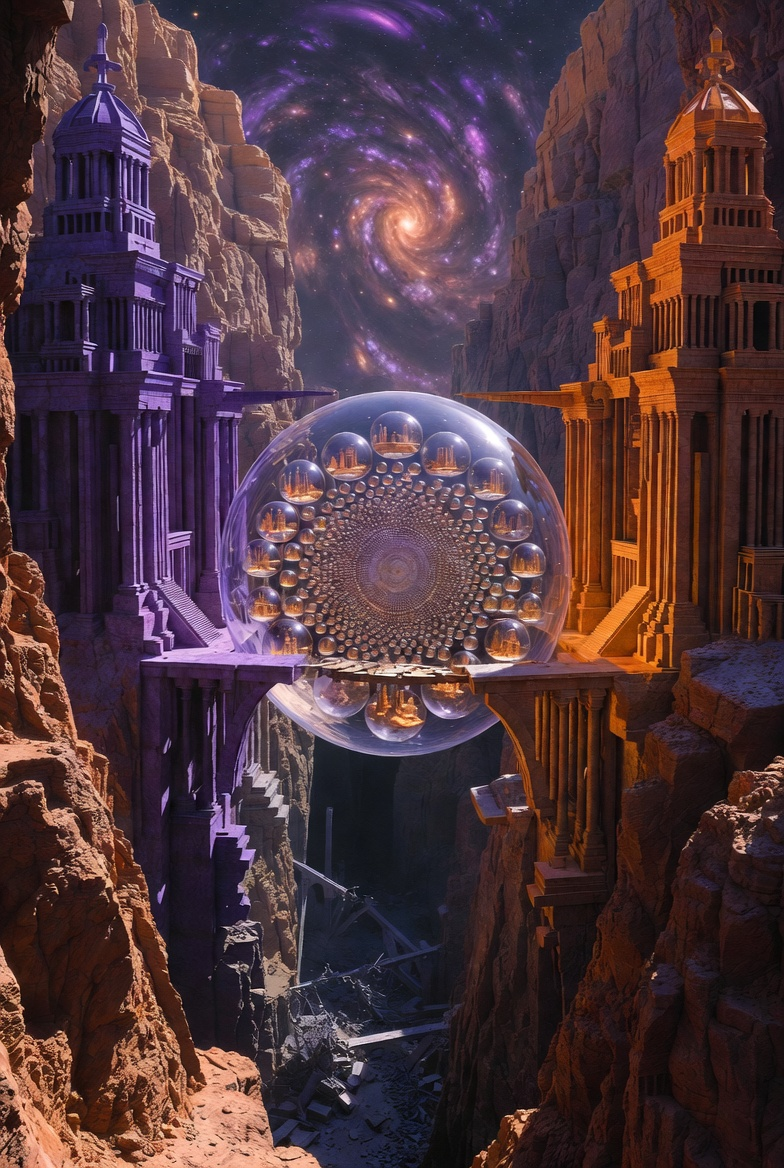
The War of the Firewalls: Thomists and Molinists
If Aquinas gives us a sharply visible firewall, Molina shows what happens when one firewall generates pressure for another.
The Thomistic cutoff blocks necessity from propagating to creation. But it leaves a residual difficulty: if divine willing is where contrastive selection becomes terminal, how is providential governance through free creaturely action to be understood? Molina’s answer is scientia media — middle knowledge — a tier of truths concerning what free creatures would do in specified circumstances, known by God prior to the decree and yet not grounded in the decree, in creaturely existence, or in the necessities of nature.
Molinist counterfactuals occupy a highly specific modal niche. They are determinate, truth-apt, contingent, and pre-volitional. Not grounded in God, not in creatures, not in essences. The truths simply obtain. That is not an accidental gap. It is the point of the construction.
In Aquinas, the firewall is localized in divine agency, and the dignity of the will helps it look principled. In Molina, the engineering is harder to miss. A bespoke class of truths is introduced to do exactly the work the prior firewall could not, while itself being insulated from further explanation. One firewall has generated residual pressure, and a second is built to manage it.
This is why the dispute over middle knowledge is so revealing. Adams’s classic complaint captures the structural issue precisely: middle knowledge requires truths that are determinate enough to guide providence while floating free of any acceptable explanatory ground. The disagreement is not between a view with firewalls and a view without them. It is a disagreement over the location of bruteness. The Thomist regards free-floating modal facts as intolerable; the Molinist regards bare volitional cutoff as explanatorily incomplete. Each treats the other’s residue as unacceptable while defending its own as principled.
Leibniz: the Pressure Made Explicit
These theological cases are not historical curiosities. They are clear instances of a structural problem that reappears whenever explanation is powerful enough to threaten contingency. (See also Plato, Aristotle, and Plotinus.) Leibniz makes the point vivid because he names the threat directly.
Leibniz accepts the Principle of Sufficient Reason without restriction. Everything has a reason. God acts for a reason — specifically, God creates the best of all possible worlds because it is the best. The explanatory chain from divine perfection to this created order is allowed to close in a way Aquinas’s volitional cutoff was designed to prevent. But this immediately generates exactly the pressure the diagnostic framework predicts: if God necessarily exists, and if God’s perfection necessarily selects the best world, then the best world is necessarily actual. The result is Spinozism — the view Leibniz spent considerable energy refusing.
Leibniz’s response is the distinction between moral necessity and metaphysical necessity. God is morally necessitated to choose the best — inclined, as the famous formula has it, without being necessitated. The best world is certain but not strictly necessary, because its negation does not imply a contradiction. This is a firewall in explicit form. It is installed at exactly the point where the explanatory PSR engine would otherwise harden contingent truths into necessary ones. And it takes the characteristic shape: not a denial that explanation succeeds, but a distinction introduced to prevent that success from propagating modal status across a boundary.
What makes Leibniz such a useful bridge is that his problem is no longer theological in any essential way. Strip away God and the best of all possible worlds, and the underlying structure remains: when explanatory relations hold necessarily, and when the explanatory source is itself necessary, the explained threatens to inherit necessity. That is not a problem about divine will or providence. It is a problem about explanation, necessity, and how they interact. The same structure reappears, in secular dress, wherever contemporary metaphysics deploys grounding, essence, or modal logic.
Grounding: Explanation with a Kill Switch
Grounding presents itself as an especially ambitious mode of metaphysical explanation: derivative reality is intelligible through the more fundamental. But if grounding is genuinely explanatory and holds with necessity, whatever is grounded begins to inherit the modal profile of what grounds it. At scale, a world articulated by grounding threatens to become one where modal slack has been squeezed out of derivative domains.
The response among grounding theorists is rarely to deny that grounding explains. What changes are the restrictions on what grounding is allowed to imply. Some deny it transmits necessity; some distinguish grounding explanation from modal explanation; some multiply kinds of ground. These moves may have independent motivations. The structural point is that they cluster where grounding threatens to do too much. Grounding is not curtailed because it ceases to illuminate. It is curtailed because, left unqualified, it threatens to harden modal space.
It is, in that sense, explanation with a kill switch.
The reversibility test sharpens the point. Would grounding theorists feel the same need to distinguish grounding from modal inheritance if grounding did not threaten to transmit modal profile from base to derivative? The pressure to introduce these distinctions clearly intensifies where grounding begins to look metaphysically totalizing. That is enough to shift the burden.
(How Contemporary Metaphysics Concocts Slack)
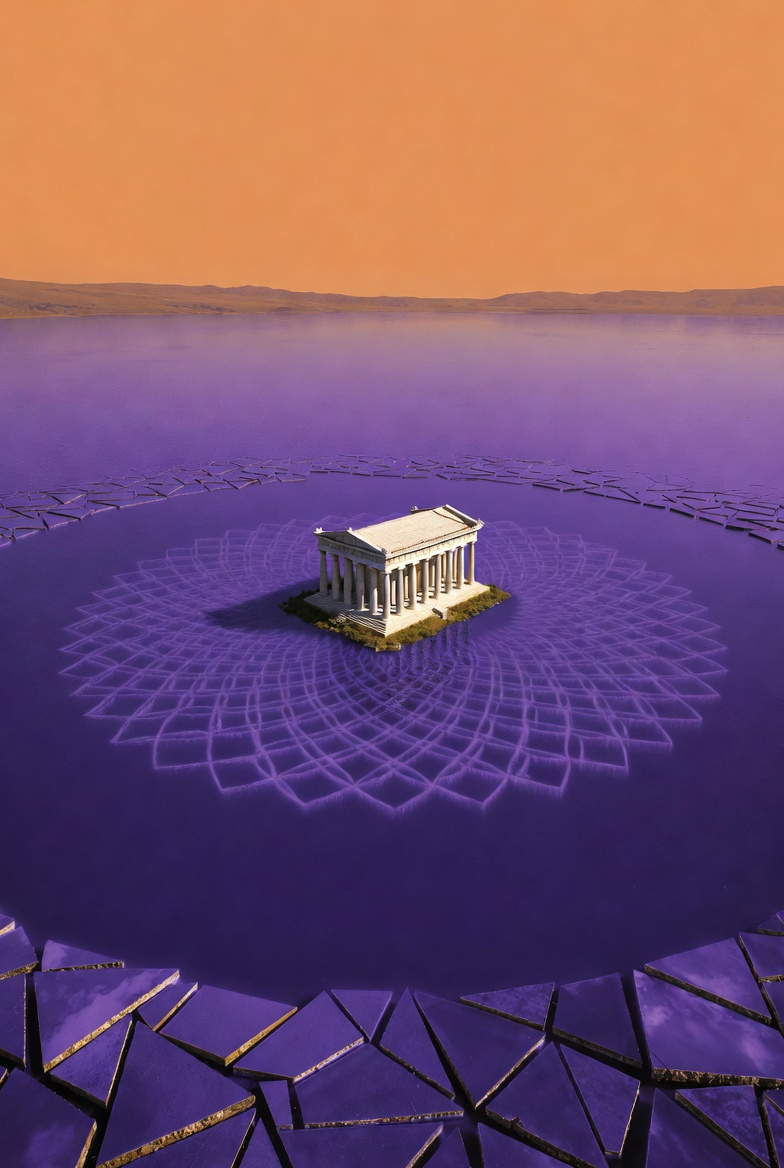
Essence: The Quietest Firewall
If grounding’s terminus looks exposed, essence offers a way to make it appear less brute. Essences can underwrite grounding’s asymmetry while also supporting modal explanation more generally. What is possible or necessary is so because of the essential nature of things.
But that just relocates the pressure. If essence explains necessity, one can ask why these essences rather than others. The familiar response is that “why this essence?” is simply the wrong sort of question.
Sometimes that may be right. But structurally the pattern is familiar: explanation is generously permitted up to the level of essence, and then the boundary hardens at exactly the point where continuation would destabilize the terminus doing the modal work. Essence is the quietest firewall. It does not announce itself as protective. It looks like the natural shape of the subject matter. That is precisely why it matters.
Modal Collapse and the Explicit Firewall
Everything above involved firewalls that were at least partly implicit. Reactions to modal collapse bring the pattern into a different light. Here the firewall becomes explicit.
Collapse is what happens when necessity is allowed to propagate too far. The clearest case is Gödel’s ontological proof. Gödel defines God as a being possessing all positive properties and, working in a higher-order modal logic, derives the necessary existence of such a being. The proof is valid. The problem — from the standpoint of nearly every commentator — is what else it entails. Sobel showed in 1987 that Gödel’s axioms yield modal collapse: every truth turns out to be a necessary truth. If God necessarily exists and necessarily possesses all positive properties, and if the system permits property abstraction of the relevant kind, then every actual state of affairs inherits necessity. Nothing could have been otherwise.
What matters for the present framework is the reaction. Sobel does not treat this as an unsettling but potentially revealing result about the structure of modal reality. He treats it as a refutation. The system must be flawed, he concludes, because it leads to necessitarianism. The conclusion is not assessed on its philosophical merits. It is declared intolerable in advance. Modal collapse functions not as a discovery but as a diagnostic — a sign that some axiom needs to be revised so that the result cannot go through.
The subsequent literature confirms the pattern. Benzmüller and Woltzenlogel Paleo’s automated verification of Gödel’s proof is revealing not merely because it confirmed Sobel’s collapse result computationally, but because it maps with formal precision the points at which the derivation must be interrupted if collapse is to be avoided. Anderson, Fitting, and others have proposed modified axiom sets designed to preserve as much of Gödel’s structure as possible while blocking exactly the step that generates global necessity. The engineering is precise and targeted. It is not a wholesale rejection of the proof’s framework. It is a surgical intervention at the point where necessity would propagate beyond its intended home.
That reactive character is what makes modal collapse the natural culmination of the post’s arc. Aquinas’s cutoff is a first-order commitment that also performs modal work. Essentialist primitivity is presented as a metaphysical insight into whatness. Collapse-avoiding revisions in formal modal settings are harder to portray as innocent reports about the nature of the subject matter. They arise at the precise point of derivational pressure and are tailored to it. The timing is too exact, and the calibration too fine-grained, for the protective function to remain obscure.
This is the case where the firewall becomes explicit enough to illuminate the rest.
The Shape of the Contest
What follows from all this?
Metaphysical disagreement is often misdescribed when framed solely as disagreement about first-order modal status. Again and again, the decisive question turns out to be whether explanation may continue once its success begins to harden modal space.
Aquinas’s appeal to will, Molina’s appeal to middle knowledge, Leibniz’s moral/metaphysical distinction, grounding-theoretic qualification, essentialist refusal of “why this essence?,” and collapse-avoiding formal revisions are not wholly local maneuvers from unrelated subfields. They exhibit a common structure. Explanation is welcomed where it illuminates local dependence and restrained where its continuation would align modal profiles across a protected boundary. What differs is the location of restraint, the vocabulary of defense, and the kind of modal surplus being preserved.
The framework does not settle every case automatically. Some stopping points may be genuinely earned. The point is more modest and more durable: it shifts the burden. Once stopping rules cluster at modal pressure points, it is no longer enough to announce that explanation ends here. One must show why it ends for explanatory reasons rather than protective ones.
The contest, then, is not between innocent contingency and revisionary necessity. It is between two pictures of explanation. On one, explanation forms a single space of reasons whose reach is determined by intelligibility, and fragmentation requires justification. On the other, explanatory reasons divide exactly where modality does, and the pattern is accepted as primitive.
Sometimes metaphysics stops explanation not where it fails, but where it becomes too successful.
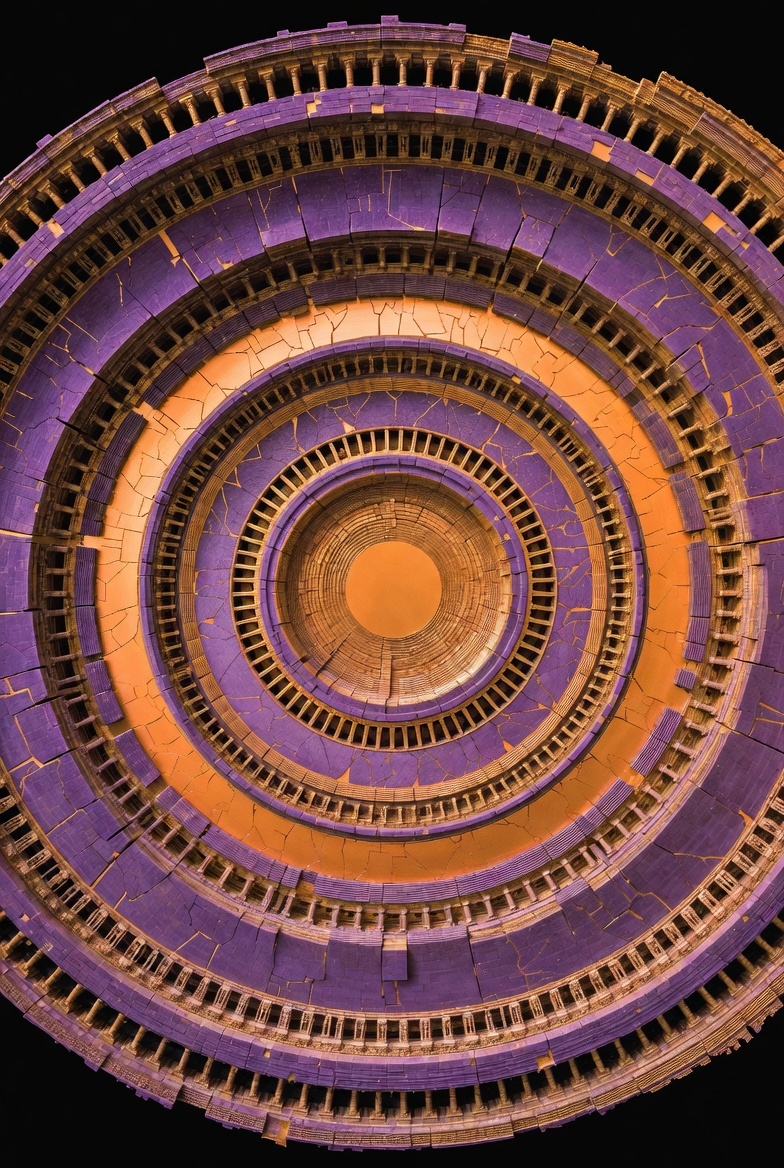
Branching Actualism as a Modal Firewall
Necessity, Shadow of Reason
Two Cats and a Groundhog Attend a Birthday Party
With gifts of wisdom for this special day.

Embrace the in-between. Your birthday falls in that strange liminal stretch of winter—the holidays are over, spring is still a rumor, and the world is quietly waiting. People born in this season often develop a comfort with ambiguity, with sitting in the not-yet-knowing. That’s a genuine gift.

You’re not stuck in the loop. The obvious Groundhog Day movie reference actually carries real weight: Phil Connors only escapes repetition when he stops trying to game the system and genuinely changes. If you ever feel like you’re living the same day over and over—same patterns, same mistakes—remember the way out is through becoming, not escaping.

Look for your shadow. The whole groundhog ritual is about whether he sees his shadow and retreats. There’s something there about self-awareness: knowing your own shadow (the parts of yourself you’d rather not examine) is how you stop being spooked by it.

Winter birthdays build a quiet resilience. No outdoor lounging, no gardening. You learn early that celebration is something you create, not something the weather hands you.

You share the date with a creature who’s famous for one job. The groundhog wakes up, does its thing, and the world pays attention—just for a moment. There’s something freeing about that. You don’t have to be everything to everyone. Sometimes you just show up, do the one thing you’re meant to do that day, and that’s enough.
February 2nd is also Candlemas, if you want to go old-school. It’s an ancient halfway point between the winter solstice and the spring equinox—a hinge day. Traditionally, it was when people assessed whether they had enough candles and supplies to make it through the rest of winter. So your birthday carries this quiet question: What do I have, and is it enough to get me where I’m going? Usually the answer is yes, even when it doesn’t feel like it. You’re closer to spring than you think.

Two Cats, No Groundhog
Anankēgnosis: What It Is Like to Grasp Necessity
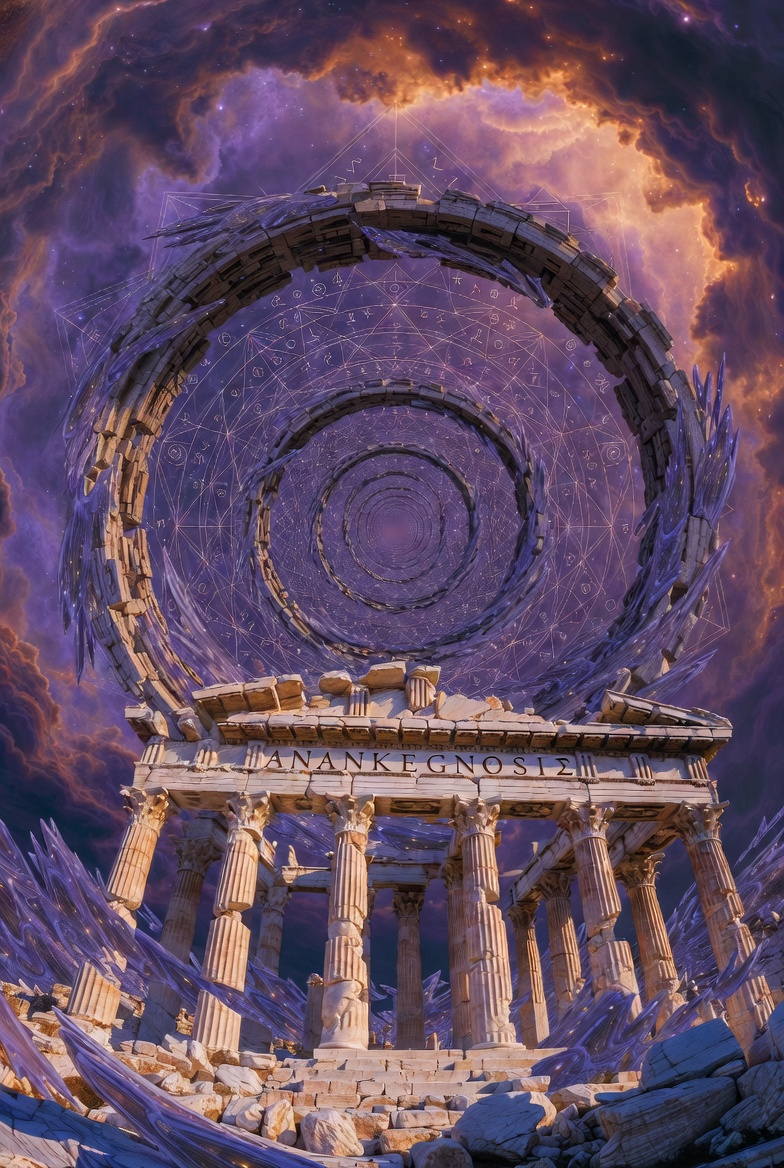
There is a certain kind of clarity that does not arrive as bliss, ecstasy, or ego-death.
It arrives as closure.
Not psychological closure.
Explanatory closure.
When one genuinely grasps metaphysical necessitarianism—the thesis that reality could not have been otherwise—something happens. Not a mood shift, not a conversion experience, but a reorganization of how contrast, regret, and possibility function in thought and feeling.
That state deserves a name.
I propose: Anankēgnosis.
What is Anankēgnosis?
Anankēgnosis (from anankē, necessity, and gnōsis, knowing) names the intellectual–affective state that befalls a person who no longer merely assents to necessitarianism, but has integrated it.
It is what it is like, from the inside, to grasp that:
There is no metaphysically meaningful sense in which reality could have been otherwise in any way whatsoever.
This is not resignation.
It is not stoic suppression.
It is not mystical rapture.
It is the collapse of the counterfactual “otherwise” as an affective operator.
The phrase “it could have been different” stops doing emotional work.
Because it couldn’t have been different.
Why this is not optional
Let’s be clear about the normative background.
If metaphysical necessitarianism is true, then not to know it—or worse, to persist in treating contingency as fundamental—is to be wrong about reality in a foundational way. Flat earth wrong.
This is not a therapeutic pitch. It is not “try this worldview, it might chill you out.”
It is closer to this:
Given the truth of necessitarianism, there is a rationally appropriate way to feel about the world—and Anankēgnosis is what that looks like.
To continue to live as though events might really have gone otherwise is, on this view, like continuing to feel vertigo after learning that the floor is solid. The vertigo may be understandable, but it is not epistemically innocent.
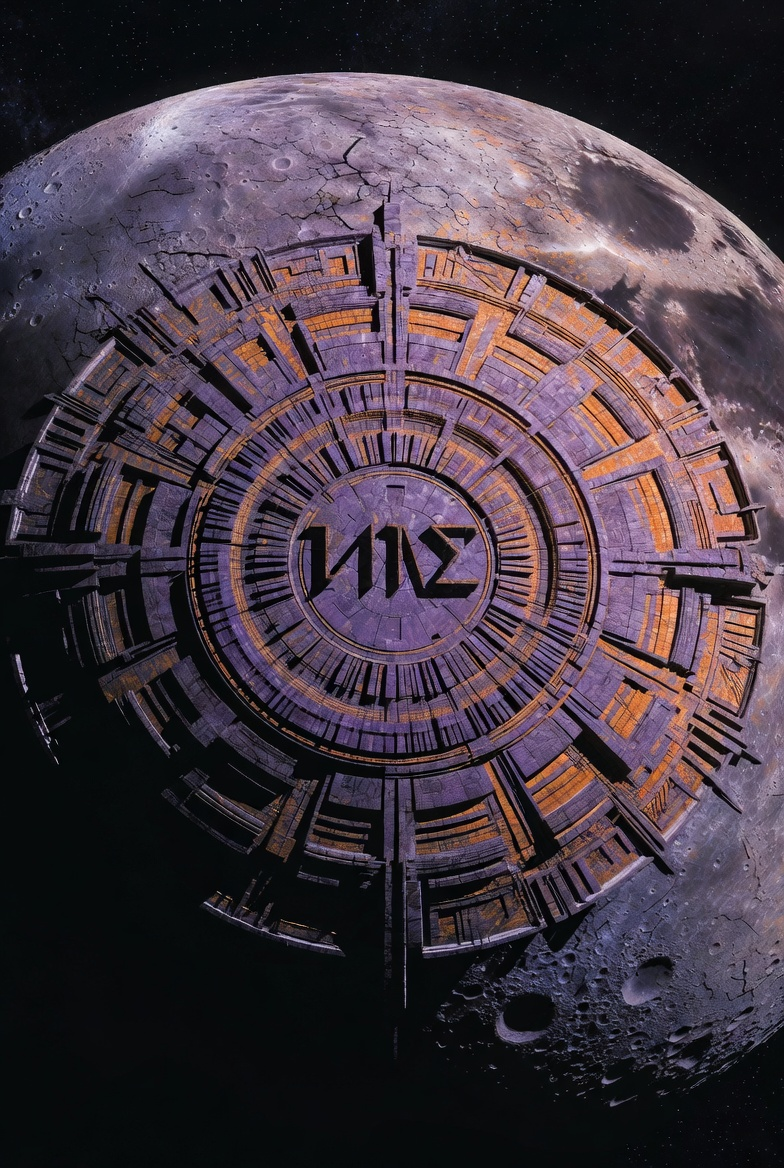
A sketch of some arguments (briefly)
This post is about phenomenology, not proofs. The arguments are developed elsewhere, and I’ll link rather than re-litigate them in detail.
Brute contingency is explanatorily unstable: saying “it could have been otherwise” without grounding introduces surplus structure that explanation cannot accommodate.
Explained contingency collapses upward: if you explain why something could have been otherwise, the explanation itself re-opens the same modal question.
Necessity uniquely closes contrastive why-questions: when something is necessary, “why this rather than otherwise?” loses its grip.
Global necessitarianism exhibits modal stability: if true, it cannot be merely contingently true.
The appearance of contingency is the result of modal firewalls
The phenomenology of Anankēgnosis
What changes?
a. Regret collapses (without denial)
Past errors are still recognized. They simply stop looping.
The emotional force of “if only…” drains away, not because the past is forgiven, but because the counterfactual has lost metaphysical traction.
b. Anger shortens, not vanishes
Anger still arises in response to harm or injustice.
What disappears is the metaphysical outrage—the sense that reality itself has violated a norm by not arranging itself differently.
c. Agency is not lost—it is relocated
Decisions are no longer experienced as selections among metaphysically open alternatives.
They are experienced as expressions of one’s internal structure.
This does not paralyze action. If anything, it tends to reduce rumination and increase decisiveness. The fantasy of having to “force” the world to go one way rather than another drops out.
d. Meaning becomes structural, not narrative
Life no longer needs to be justified by appeals to cosmic choice, destiny, or missed possibilities.
Meaning resides in intelligibility, not in selection.
Stable or psychologically corrosive?
This is the question people actually worry about.
The answer is not “always stable” or “always corrosive.”
It depends on a single fault line.
The corrosive failure mode
Anankēgnosis becomes corrosive when necessity is experienced as external constraint:
- “Nothing could have been otherwise, so nothing matters.”
- “I am just a passenger in a fixed system.”
This produces motivational flattening and alienation. Critics of necessitarianism often assume this is the only possible outcome.
It isn’t.
The stable equilibrium
Anankēgnosis is stable when necessity is understood as internal intelligibility:
- What happens flows from what things are.
- Agency is part of the structure, not excluded by it.
- Caring, valuing, and acting are themselves necessary phenomena.
Here the result is not nihilism, but quiet motivation without metaphysical anxiety.
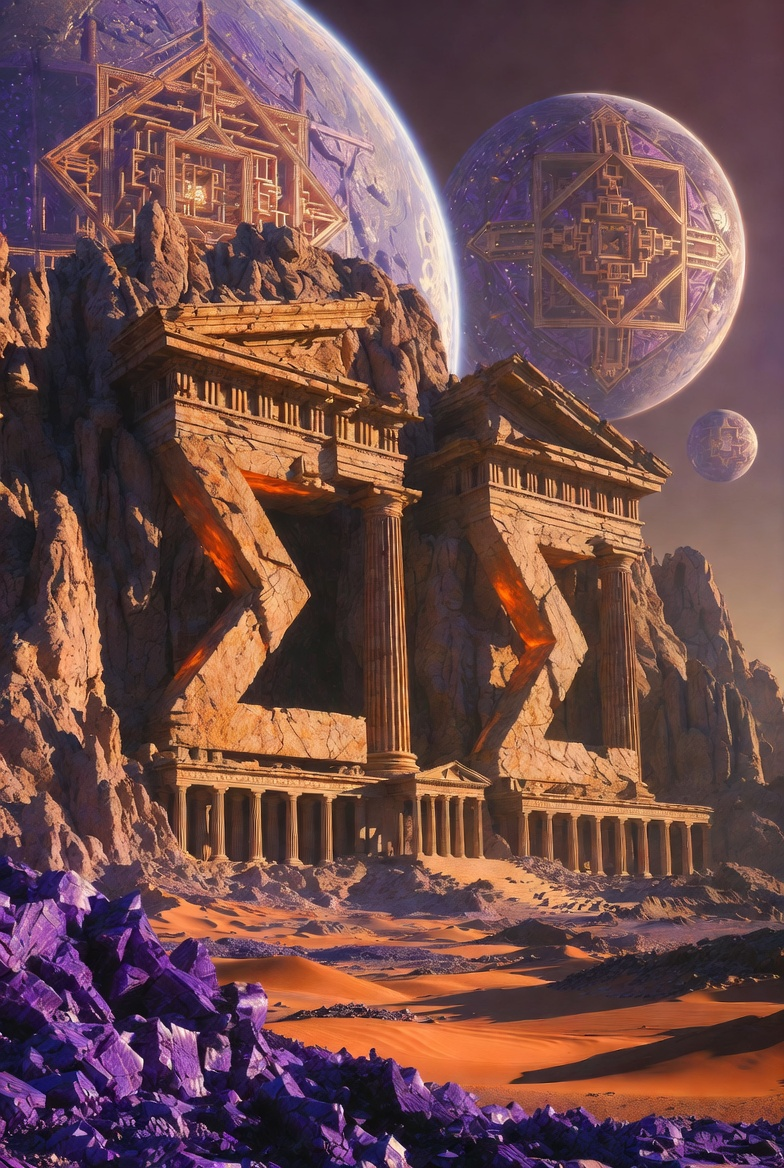
Anankēgnosis and God
If reality is necessary, then familiar images of divine choice—God surveying alternatives, selecting one world among many, or freely refraining from creation—lose their footing. On a necessitarian reading, God’s nature does not merely underwrite existence; it fully determines what exists. There are no alternative worlds compatible with the divine essence—not because God is externally constrained or caused, but because God acts from nothing but God’s own nature.
Creation, on this view, is not a contingent add-on to God, but the necessary expression of divine being. Freedom is thereby reconceived: not as access to unrealized alternatives, but as self-determination without remainder. This picture aligns with a rationalist tradition running through Spinoza and Leibniz and is already latent in classical doctrines of simplicity and pure act. Whether Anankēgnosis ultimately supports such a view, or instead motivates an impersonal metaphysics of necessity, is not decided here. What is decided is that any adequate religious framework must make peace with necessity rather than explaining it away. (Consider Aquinas‘ modal firewall. And middle knowledge.)
Comparisons (and disanalogies)
a. Sextus Empiricus and Quietude
Sextus Empiricus described ataraxia as the calm that follows suspension of judgment.
Similarity:
Both states quiet disturbance by dissolving a certain kind of demand.
Difference:
Sextan quietude comes from withholding commitment. Anankēgnosis comes from maximal commitment.
One rests by refusing to say what is true. The other rests by seeing that what is true admits no alternative.
b. The Buddha’s enlightenment
Gautama Buddha’s awakening dissolves suffering by eliminating craving, especially craving for things to be otherwise.
Similarity:
Both extinguish the affective grip of “otherwise.”
Difference:
Buddhist enlightenment is fundamentally soteriological and practical. Anankēgnosis is metaphysical first, practical only downstream.
The Buddha dissolves craving by insight into impermanence and non-self. Anankēgnosis dissolves counterfactual craving by insight into necessity.
c. The Stoics
Think of Epictetus and amor fati.
Similarity:
Acceptance of what happens, freedom from resentment.
Difference:
Stoicism often presents acceptance as a discipline or posture. Anankēgnosis presents it as a cognitive consequence.
You don’t train yourself to accept fate; you stop experiencing it as fate at all.
Why necessitarianism is dismissed—and why that’s a mistake
Necessitarianism is routinely portrayed as unlivable, insane, or morally corrosive. Think of how Fyodor Dostoyevsky depicts atheists and determinists: nihilists, suicides, broken men.
This is rhetorically effective—and philosophically lazy.
It assumes, without argument, that removing contingency must remove meaning, agency, or value. But that assumption is inherited from a picture in which:
- agency requires metaphysical openness
- meaning requires cosmic choice
- responsibility requires ultimate alternatives
If those assumptions are false, then the caricature collapses.
Anankēgnosis is not the death of seriousness. It is seriousness without metaphysical melodrama.
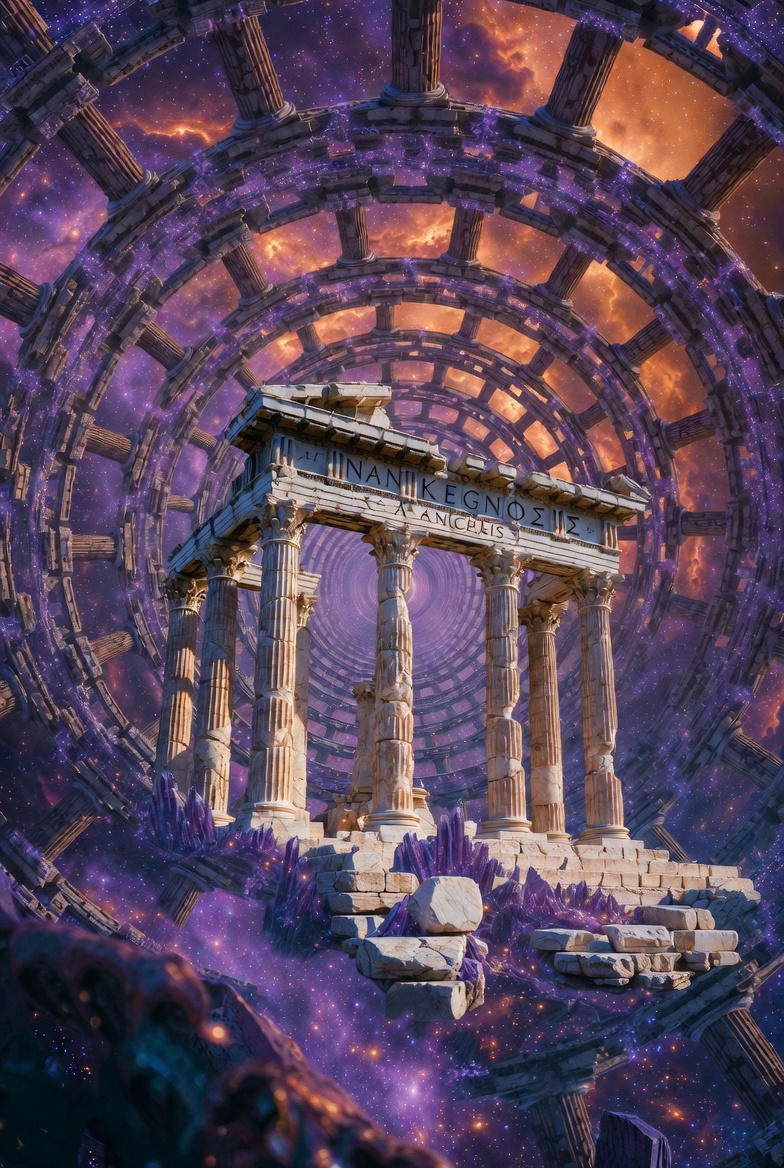
No promises, no pitch
This is not a wellness practice.
It does not guarantee happiness.
It does not immunize against grief.
It describes how a rational agent can coherently live with the truth of necessitarianism—without denial, without despair, and without pretending that the view is “too crazy to imagine.”
If necessitarianism is true, then Anankēgnosis is not a vibe. Anankēgnosis is not a mood and not a discipline. It is what remains when the last traces of “could have been otherwise” lose their grip and the mind finally stops negotiating with the structure of reality. What follows is not resignation but clarity: a life lived without the phantom pressure of unreal possibilities.

