Ontology

Modal Firewalls: How Contemporary Metaphysics Manufactures Slack

Why theories of explanation stop where necessity begins.

Contemporary metaphysics prides itself on explanation. We are encouraged to ask what depends on what, what grounds what, what explains what—and to keep climbing until the structure of reality comes into view. But something curious happens as that ascent continues. Again and again, explanation is welcomed right up to the point where it would begin to suggest necessity. At that moment, the climb stops.

These stopping points are not accidental. They recur across otherwise very different theories, and they appear in strikingly similar places. Explanation is allowed to run—sometimes impressively far—so long as it does not threaten contingency. When it does, constraints quietly appear. I call these constraints modal firewalls: principled-sounding limits on explanation that permit local intelligibility while preventing explanatory ascent from spilling over into necessity.

These firewalls shape vast regions of contemporary philosophy. They don’t just mark the limits of explanation; they reveal where the discipline becomes strategically protective. And the question is whether those limits are principled—or simply installed to keep necessity at bay.

Grounding: Explanation with a Controlled Burn

No contemporary tool has shaped metaphysics more than grounding. It promises dependence without reduction, explanation without elimination, structure without collapse. And it offers one of the cleanest illustrations of firewall logic.

The basic picture is familiar: some facts obtain in virtue of others. A set exists in virtue of its members; a disjunction is true in virtue of a true disjunct; an act is wrong (perhaps) in virtue of harm or lack of consent. So far, grounding behaves exactly as advertised.

The tension appears when we ask how far grounding extends.

If grounding is unrestricted, explanatory ascent becomes hard to contain. Once the base is fixed, explanation propagates upward—and with it, modality. Necessary grounds yield necessary grounded facts. Iterate the structure, and necessity spreads like fire through dry brush.

This is the moment grounding theory reaches for the firebreak.

We are told that grounding must be restricted. It bottoms out. It is asymmetric. It does not range across all domains. It does not ground everything that looks groundable. Crucially, these limits are not themselves grounded or explained by the relata. They are imposed to preserve a desired modal profile—to stop the spread.

This is not a complaint about any particular theorist. It is a structural observation. Grounding is permitted to burn hot within carefully cleared perimeters, but when it threatens to carry us from intelligibility into necessity, the line is drawn.

That is why grounding is the paradigmatic modern firewall: explicitly explanatory, explicitly metaphysical, and explicitly curtailed for modal reasons.

(Representative figures include Kit Fine, Jonathan Schaffer, and Shamik Dasgupta.)

Essence: Explanation That Must Not Explain Itself

Essence is often presented as grounding’s metaphysical backbone. Where grounding explains dependence, essence explains necessity. A thing has the modal profile it does because of what it is.

This looks like genuine explanatory progress—up to a point.

Essence is allowed to tell us why certain facts are necessary: why Socrates is necessarily human, why water is necessarily H₂O, why some identities could not have failed. But the moment we ask the next question—why this essence rather than another—the ladder is pulled away.

Essences, we are told, are not explained. They are not grounded. They are not fixed by anything deeper. To demand an explanation of an essence is, on this view, to misunderstand the very idea of essence.

This is not an accidental silence. It is a deliberate stopping rule. If essences themselves were open to explanation, modal ascent would resume: the explanation of an essence would inherit modal force, and the pressure toward necessity would reappear at a higher level.

Essence thus functions as an explanatory stop‑sign. It secures necessity, but it must not itself be explained. The firewall is clean, principled‑sounding, and structurally indispensable for anyone who wants contingency preserved at the level of kinds and individuals.

Normative Autonomy: A Softer Firewall

In contemporary metaethics—especially among non-naturalists—it is standard to insist on the autonomy of the normative. Normative facts are explained by reasons, not by natural or metaphysical facts. What one ought to do is determined by reasons; what reasons there are is not settled by physics, chemistry, or ontology.

This autonomy is often motivated by familiar considerations. Even if all the natural facts are fixed—who suffered, who consented, who benefited—it can still seem an open question whether an action was wrong. Moral properties are therefore taken to resist reduction to natural or metaphysical ones.

So far, this may sound like a familiar dialectical stalemate. But the explanatory structure deserves closer attention.

Consider a simple case. An action causes intense, unnecessary suffering to a conscious being. Most moral theories agree that this fact counts strongly against the action. But now ask the next question: why does suffering generate reasons at all? Why does it have normative force rather than merely describing a state of the world?

At this point, explanation reliably stops. We are told that suffering just is reason-giving, or that normativity is sui generis, or that reasons are primitive features of practical reality. Attempts to explain normative force in terms of metaphysical structure, rational agency, or the nature of value are treated with suspicion—often dismissed as category mistakes.

This is not because such explanations are incoherent. It is because allowing them would invite explanatory unification across domains. If facts about suffering had their normative force in virtue of deeper metaphysical facts, then normative necessity would begin to track metaphysical necessity. The space between “how things are” and “how one ought to act” would narrow.

Normative autonomy functions here as a firewall. It permits rich internal explanation—reasons explain obligations, values explain reasons—while blocking explanatory ascent into metaphysics or ontology. The restriction is not arbitrary, but it is strategic. It preserves the distinctness of the normative domain by preventing necessity from spreading across it.

Unlike grounding or essence, this firewall is rhetorically gentle. It presents itself as respect rather than restraint. But structurally, it serves the same role: explanation is allowed to operate, but only so far as it does not threaten modal unification.

Primitive Modality: The Firewall Without Apology

Some philosophers dispense with all explanatory machinery and say, simply: modality is primitive. Necessity and possibility are basic features of reality. They do not require explanation.

This view—associated with figures like Timothy Williamson—is often presented as anti‑reductionist and theoretically modest. But in the present context, its significance is different.

Primitive modality is the most forthright firewall available. It does not suggest that explanation almost continues but must be stopped. It denies that explanatory ascent even begins. Modal structure is taken as given. Full stop.

The virtue of this stance is its honesty. The cost is bruteness. Why these modal facts rather than others? Why this logic, this accessibility relation, this space of possibilities? There is no answer—and the view insists that none is needed.

If unexplained modality already feels acceptable, this will seem unproblematic. But it is a paradigmatic case of explanation being blocked at the base to prevent further questions from arising.

Laws of Nature: Contingency at the Base of Physics

A parallel structure appears in philosophy of science.

On Humean views, laws of nature do not govern the world; they summarize patterns in the distribution of particular facts. The laws could have been otherwise because the mosaic could have been otherwise.

This secures contingency at the fundamental level. Even a complete account of the actual laws does not explain why those laws obtain rather than others.

But this result is purchased by treating the base distribution of qualities as brute. There is no explanation of why the mosaic has the structure it does—any such explanation would threaten to propagate modal force upward.

Once again, explanation is permitted locally—laws explain counterfactuals—but prohibited globally. The firewall preserves contingency by denying that explanation can reach the base.

The Contingentist’s Best Reply

At this point, a sophisticated contingentist will object.

Of course explanation has limits. Demanding that everything be explained is itself a substantive metaphysical commitment—often associated with the Principle of Sufficient Reason. One can reject that commitment without inconsistency. Explanation ends where it ends. There is no obligation to keep pushing, and no reason to treat unexplained stopping points as philosophically suspect by default.

This is a serious reply, and it deserves to be taken seriously.

Contingentists do not reject explanation wholesale. On the contrary, they rely on it extensively. Grounding is invoked to illuminate dependence, essence to explain modal profiles, laws to support counterfactuals, and reasons to structure normativity. Explanation is not treated as a fragile practice that must be carefully rationed. It is allowed to run—often aggressively—when it delivers intelligibility without threatening core commitments.

Nowhere is this clearer than in the natural sciences. Few philosophers resist explanatory descent from chemistry to physics, or from thermodynamics to microstructure. We routinely explain why chemical regularities hold by appeal to molecular structure, why macroscopic behavior emerges by appeal to underlying distributions, and why apparent alternatives disappear once deeper structure is revealed. These explanations are welcomed even when they eliminate intuitive possibilities. No one insists that chemical laws must remain explanatorily autonomous lest they collapse into physical necessity. The explanatory ascent is permitted to continue precisely because no threat of modal collapse is perceived.

What distinguishes the earlier cases is not a general discomfort with explanation, but the specific fact that further explanation would begin to align necessity across domains. Grounding is curtailed when it would transmit necessity upward. Essence is declared inexplicable when explaining it would threaten contingency. Normativity is insulated when metaphysical explanation would collapse moral necessity into metaphysical necessity. Primitive modality is invoked when further explanation would reopen the ascent entirely.

The stopping points are therefore not random. They cluster at precisely those locations where explanation would begin to erode modal slack. This does not show that the stopping points are illegitimate. But it does undermine the idea that they are merely neutral denials of explanatory ambition. They look instead like targeted restraints—introduced not because explanation has gone too far in general, but because it has begun to point in a particular direction.

That is where the real dialectical pressure lies.

Connecting the Dots

Modal firewalls are not philosophical mistakes. They are pressure points—places where our explanatory practices strain against a background commitment to contingency. They reveal how much of contemporary metaphysics is already organized around allowing explanation to proceed up to necessity, and no further.

Recognizing this does not by itself refute contingentism. But it reframes the debate. If explanation is already trusted across domains whenever it increases intelligibility, then resistance at the point where necessity comes into view requires special justification. Appeals to autonomy, primitivity, or brute stopping points may be defensible—but they are not cost-free. They represent decisions about where explanation must be halted, and why.

Arguments for necessitarianism do not impose alien standards on metaphysics. They ask us to take our existing explanatory ambitions seriously, and to follow them without installing outcome-driven restraints. Whether one ultimately accepts that invitation remains an open question. But the terrain on which the question is decided looks different once the firewalls come into view.

Parmenides is not refuted. He is managed.


Papers defending modal firewalls, the modal ontological argument for necessitarianism (MOAN), the dilemma of contingency, and a transcendental argument for necessitarianism are under review.


Related Essays

Ancient Modal Firewalls

Aquinas and the Modal Firewall

Middle Knowledge: Anatomy of a Modal Firewall

Standard
Schrodinger's Dachshund

Why Explanation Always Wins: Necessity as the Shadow of Reason

There is a recurring mistake in metaphysics: treating explanation as one theoretical option among others, rather than as a pressure that any theory must answer to. Views are compared, virtues tallied, intuitions balanced. But explanation is not a preference. It is a constraint. And over time, it always asserts itself.

This is why explanation “wins.” Not because it settles every dispute, but because anything that refuses to answer to it gradually loses its grip on intelligibility.

From the beginning, philosophy has been animated by a simple demand: Why this rather than that? Once that question is taken seriously, it does not stay politely confined. It propagates. Each explanation invites another. Each stopping point calls attention to itself. And every attempt to halt the process leaves a residue that demands justification.

That residue is where contingency lives.

Contingency as unfinished business

Contingency is often presented as the natural state of affairs. The world could have been otherwise; some things just happen to be the way they are. Necessity, by contrast, is treated as an imposition: something that needs special argument, theological backing, or modal machinery.

This picture reverses the actual dialectic.

Contingency is not what remains when explanation is complete. It is what remains when explanation is interrupted. To say that something could have been otherwise is not to explain why it is as it is. It is to gesture at an absence of explanation and treat that absence as a feature of reality rather than as a task left undone.

This is why contingency so often travels with words like brute, primitive, or basic. These are not explanations. They are labels we attach to places where explanation has been asked to stop.

The persistence of explanatory pressure

The pressure to explain does not disappear when it is resisted. It goes underground.

When metaphysical systems install stopping points—whether in the form of brute facts, domain restrictions, grounding termini, or weakened modal principles—they do not dissolve the explanatory demand. They defer it. The question “why this rather than that?” is not answered; it is declared inadmissible.

Declaring a question inadmissible is not the same as making it irrelevant.

This is why philosophical debates keep returning to the same fault lines. Why these laws? Why this structure? Why this fundamental base rather than another? Each time, the temptation is to say: because that is where explanation ends. And each time, the reply is the same: why there?

Explanation keeps pushing. Not because philosophers are obstinate, but because intelligibility is unstable. Once it is introduced, it spreads.

Firewalls and their fate

Modal firewalls are the devices by which this spread is managed. They are not mistakes. They are coping strategies.

Ancient metaphysics built firewalls out of levels, substances, and emanations. Modern metaphysics builds them out of methods, domains, and formal distinctions. In both cases, the goal is the same: to preserve intelligibility without allowing it to collapse into necessity.

The reason these devices proliferate is not that explanation is weak, but that it is strong. If explanation were harmless, it would not need to be disciplined. Firewalls are installed precisely because explanation threatens to do too much.

And yet, firewalls are always temporary. They require constant maintenance. They generate boundary disputes. They invite exceptions, refinements, and ever more careful statements of scope. Over time, the structure becomes baroque—not because philosophers enjoy complexity, but because the pressure they are resisting does not go away.

Explanation keeps finding ways around the barriers.

Why necessity keeps returning

This is why necessity has such a stubborn afterlife in metaphysics. It is not smuggled in by theologians or rationalists. It reappears whenever explanation is allowed to run without restraint.

If something is fully explained—if nothing about it is left hanging—then no intelligible reason remains for it to be otherwise. Necessity is not added at the end; it is what explanation leaves behind when it finishes.

This does not mean that necessity is obvious or comforting. On the contrary, it is often unsettling. It threatens freedom, variety, and the sense that things might have gone differently. That threat is real. But it is not a refutation. It is a consequence.

And consequences do not disappear because we dislike them.

The real choice

Once this is clear, the landscape shifts.

The fundamental choice in metaphysics is not between necessity and contingency. It is between two attitudes toward explanation:

  • Allow it to finish, and accept where it leads.
  • Stop it deliberately, and explain why stopping there is justified.

The first path leads, again and again, toward necessity. The second leads to firewalls, pluralisms, and a carefully managed ignorance.

They are not on equal footing.

Explanation does not need permission to continue. It needs a reason to stop.

Until such reasons are given—rather than assumed—necessity will continue to reassert itself, not as a dogma, but as the shadow cast by intelligibility taken seriously.

Explanation always wins because it never gives up. It can be delayed, redirected, or constrained, but not neutralized. Every attempt to contain it testifies to its force. And every generation that rediscovers that force finds itself facing the same uncomfortable realization:

If explanation is allowed to finish its work, contingency does not survive.

That is not a failure of metaphysics.

It is its oldest result.

Papers defending modal firewalls, the modal ontological argument for necessitarianism (MOAN), the dilemma of contingency, and a transcendental argument for necessitarianism are under review.

Ancient Modal Firewalls

Aquinas and the Modal Firewall

The Modal Firewall Around Gödel

Standard
Ontology, philosophy

Aquinas and the Modal Firewall

Arthur Lovejoy’s The Great Chain of Being is often read as a history of metaphysical exuberance: plenitude, overflow, and the slow erosion of contingency under explanatory pressure. What’s easier to miss is that Lovejoy also gives us a sharp diagnostic lens for understanding how philosophers attempt to contain that pressure.

What that lens reveals is a recurring structural move. I call it a modal firewall.

A modal firewall is a principled restriction on explanatory reach: a point at which intelligible reasons are permitted to explain structure, value, or possibility, but are forbidden from determining actuality. The firewall does not reject explanation. It commands it, then tells it where it must stop.

Seen through this lens, Thomas Aquinas becomes a revealing case—not because he invents the maneuver, but because Lovejoy’s framing makes its structure unusually clear.

The pressure Aquinas accepts

Lovejoy emphasizes that Aquinas fully accepts the rationalist pressures that make necessitarianism tempting. God is pure actuality. God is perfect goodness. God’s intellect contains the complete intelligible structure of all possible beings. Explanation is not optional; it is constitutive of intelligibility itself.

Given that package, a familiar question presses itself: if goodness is fully intelligible, why would a perfectly good being fail to actualize what is good? Why would possibility outrun actuality?

This is not yet Spinoza speaking. It is the pressure Aquinas must confront before Spinoza radicalizes it.

Crucially, Aquinas does not respond by weakening explanation. He does not appeal to mystery, opacity, or brute divine choice. God’s intellect remains exhaustive; reasons remain reasons. The pressure toward necessity is fully in place.

The firewall: divine will as modal cutoff

Aquinas’s response is not to deny the pressure but to block its extension.

Although God necessarily knows all possibles and their relative perfections, God does not necessarily will any of them. Creation is therefore not a logical consequence of divine nature but a contingent act of volition. God could have created a different world, or no world at all.

This is the firewall.

Explanatory reasons may explain what creatures are like, if they exist. They may explain why creation would be fitting or good. But they are not permitted to explain that creation occurs, or why this possible world is actual rather than another. At precisely that juncture, explanation is told where it must stop.

For a rationalist, this is the most uncomfortable possible outcome. Explanation is not refuted; it is obeyed everywhere except where obedience would eliminate contingency. The firewall does not emerge from explanation; it is imposed upon it.

Leibniz rationalizes plenitude; Spinoza completes it

This is where Lovejoy’s tripartite schema earns its keep.

To say that Leibniz rationalizes plenitude is to say that he removes Aquinas’s firewall while preserving contingency in name. God necessarily acts for sufficient reason, but contingency is relocated into the structure of reasons themselves. Different possible worlds are intelligible; God freely selects the best among them. Plenitude is no longer blocked. It is disciplined by optimization.

Spinoza, by contrast, refuses the remaining distinction. If God’s nature explains everything that exists, then nothing could have been otherwise. Possibility collapses into actuality. There is no selection among alternatives because there are no genuine alternatives to select among.

Where Leibniz preserves contingency by complicating reason, Spinoza abolishes it by allowing reason to run without remainder.

In Lovejoy’s narrative: Aquinas contains plenitude by prohibition; Leibniz rationalizes it through sufficient reason and optimality; Spinoza completes it by removing the prohibition altogether.

Lovejoy’s diagnostic contribution

It would be a mistake to claim that Aquinas invents this maneuver. Voluntarist strategies of this sort have deep roots, including in Islamic theology and medieval debates about divine freedom. What Lovejoy contributes is not a genealogy of voluntarism but a structural diagnosis: he shows how Aquinas’s appeal to divine will functions as a targeted containment strategy within an otherwise rationalist framework.

This matters, because not all appeals to will stand in the same relation to reason. An occasionalist denial of secondary causation, for example, may dismantle the explanatory machinery itself rather than merely restricting its scope. Aquinas’s strategy is different. He preserves explanation almost everywhere. That’s what makes the firewall both powerful and philosophically unstable.

Seen through Lovejoy’s lens, Aquinas is not someone who rejects necessitarian pressure, but someone who cordons it off. Contingency survives only because explanation is commanded to halt at a specific boundary.

And once that boundary is made visible, a further question becomes unavoidable: What justifies telling explanation where it must stop?

That question, Lovejoy suggests without fully pressing, will not remain contained.


The concept of modal firewalls is developed at length in a paper currently under review, as well as in related work defending the Modal Ontological Argument for Necessitarianism (MOAN), the Dilemma of Contingency, and a Transcendental Argument for Necessitarianism.

Ancient Modal Firewalls

The Modal Firewall Around Gödel

Standard
Schrodinger's Dachshund

Modal Firewalls: Why Contingency Is Doing Less Work Than You Think

Philosophers love necessity and contingency. Some things must be the case (mathematical truths, the laws of logic). Other things just happen to be the case (the number of planets, whether you had coffee this morning). This distinction is load-bearing. It’s not just a classification. It’s meant to tell us where explanation can and cannot go.

Necessary truths can explain things, but we don’t get to ask why they obtain. They’re the stopping points. Contingent truths, meanwhile, float free: they could have been otherwise, and that’s that. The modal classification does double duty. It describes the world and regulates inquiry.

This picture hides something important.

The Pattern

Look at how explanation actually works across different domains:

  • Mathematics constrains physics. Certain physical states are ruled out because they’d violate mathematical truths. We don’t treat this as mysterious. It’s just how things work.
  • Normative facts constrain rationality. That an action would be unjust explains why it’s not a genuine rational option. Again, no mystery.

In both cases, facts from one domain (mathematics, normativity) reach into another domain (physics, rational agency) and do explanatory work. We accept this without fuss.

But now try the reverse. Can physical facts explain why certain mathematical structures are realized? Can contingent features of the world explain anything about necessary truths? Here, philosophers balk. That direction of explanation is blocked.

Why? Not because anyone has shown that such explanations would be incoherent. Not because they’d fail to illuminate. The reason, when you push on it, is usually just modal: necessity can constrain contingency, but contingency can’t constrain necessity. The direction of explanation tracks the modal hierarchy.

The Firewall

I call this pattern a modal firewall. It’s a restriction on explanatory scope that’s justified by modal status rather than by anything about explanation itself. The firewall doesn’t show that a candidate explanation would fail. It rules the explanation out of bounds before we even try.

Here’s the structure:

1) Eligibility: The blocked explanation would, by ordinary standards, be perfectly intelligible.

2) Modal restriction: It’s excluded because of the domain-relative modal status of what’s being explained.

3) No independent grounding: No explanation for the modal boundary. It’s taken as given.

Firewalls aren’t arguments. They’re policies. And once you see them, you see them everywhere. Paging Gödel.

Why This Matters

The problem isn’t that explanation has to be unlimited. Some explanations fail; some inquiries terminate. That’s fine. The problem is how the limits are drawn. If a stopping point is justified by demonstrating that further explanation would be incoherent, circular, or regressive, fair enough. But if it’s justified by pointing at a modal classification and saying “Here be contingency!” That’s not an explanation of the limit. It’s a label for the limit.

This matters for the contingency/necessity debate because contingency is often sold as metaphysically innocent. The necessitarian (someone who thinks everything is necessary) is supposed to be the one with the weird, revisionary view. But if contingency’s main job is to license unexplained stopping points in our explanatory practices, that innocence starts to look questionable.

Contingency often ends up doing the kind of work apologetics does: protecting a doctrine by declaring certain questions out of bounds.

A Different Approach

The alternative I develop is what I call explanatory unity: let explanation go where it succeeds, and stop where it fails, without giving modal classification independent authority to police the boundaries. Domain differences might shape how we explain, but they don’t get to determine that explanation must stop.

This isn’t a commitment to explaining everything. It’s a commitment to earning your stopping points rather than inheriting them from a modal map drawn in advance.

Does this vindicate necessitarianism? Not directly. But it shifts the burden. If you want to say that contingency limits explanation, you need to explain why—not just assert that it does.

This is a compressed version of an argument developed at length in a paper currently under review. The full version applies the diagnostic to debates about grounding, laws of nature, essence, and normativity.

Papers on MOAN: the Modal Ontological Argument for Necessitarianism, and the Dilemma of Contingency are also under review. And a paper on Spinoza.

The Garden Without Forking Paths

Standard
Schrodinger's Dachshund

Shaftori and the MOAN

A Modal Ontological Argument for Necessitarianism and its Mystical Origin

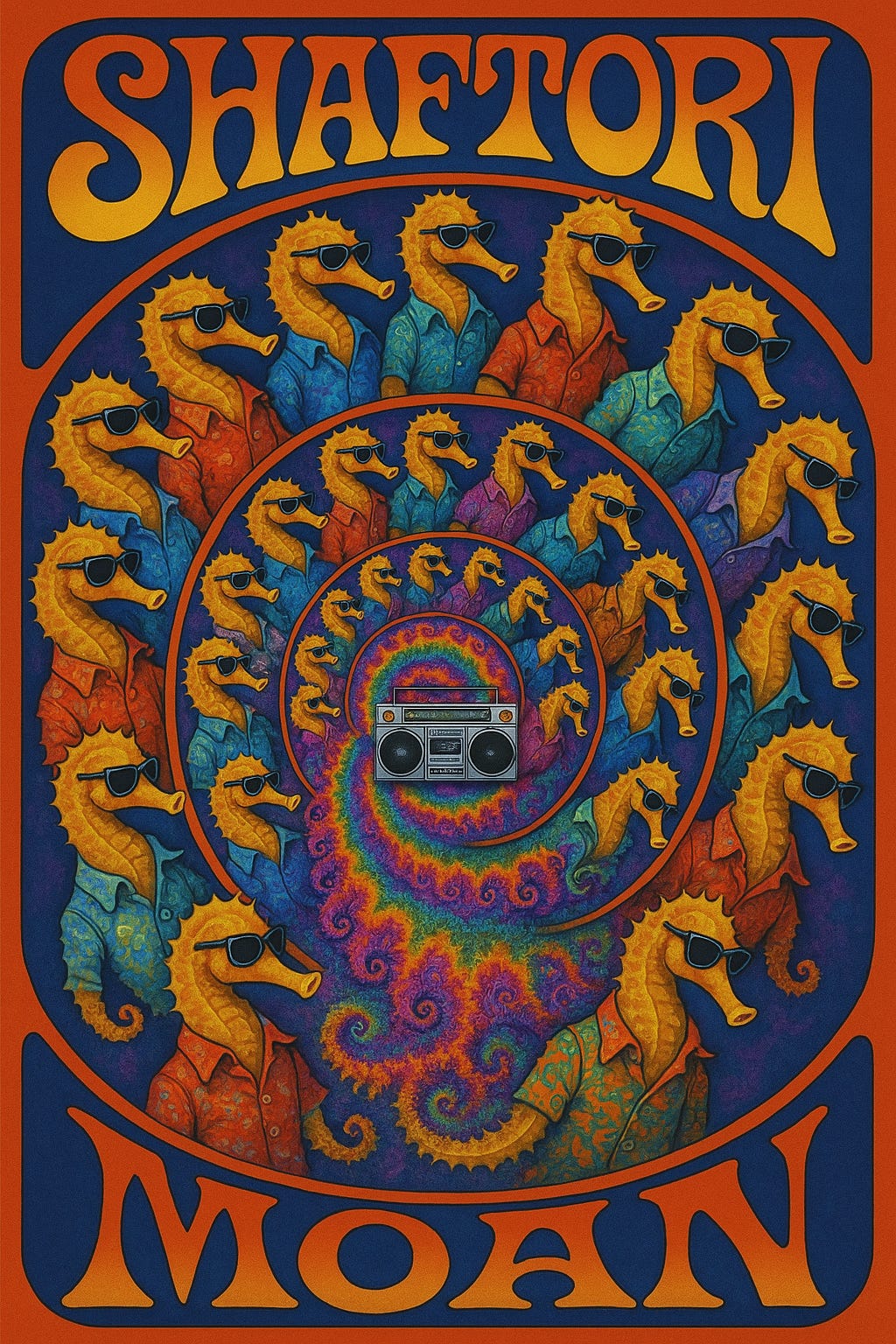
Late last year Petronius Jablonski experienced Shaftori: Enlightenment from the 45 RPM of Isaac Hayes’ “Shaft” played at 33 RPM. Like Parmenides’ descent to the halls of Night, his journey was part metaphysical reasoning and part mystical initiation. The stone-cold groove reduced him to a nanoscopic seahorse adrift in a measureless mega-fractal, absurd and sacred, tiny beyond reckoning yet somehow required, a necessary syllable in an infinite and pitiless scripture.

He returned with original and definitive proof of Necessitarianism: the thesis that whatever is true couldn’t have been otherwise, that nothing about reality could have been different in any way whatsoever. The result vindicates Necessitarianism and proves that he, like Parmenides, has been behind the veil.

In the structure of the Mandelbrot set there’s a region where the filaments branch into forms that look distinctly like little seahorses. Mathematicians call it the Seahorse Valley. Zoom-ins show repeating spirals whose shapes resemble the curled tails and bodies of seahorses.

Note well: this is not the work of some brilliant mathematician lovingly designing seahorses. This is a necessary feature of the Mandelbrot set with no contingency or design at all. Why does it exist? It couldn’t not exist and there’s an end of it.

Jablonski’s epiphany is that all reality is like this. And he can prove it.

Standard
Schrodinger's Dachshund

Beyond the Metaphysical Middlemen

A Rationalist Case for Absolute Monism

From Plotinus to classical theism to Spinoza, philosophers have posited a supreme metaphysical entity—the One, God, or Substance—to ground reality and explain existence. This post argues that the very distinctions these systems depend upon collapse under sustained rationalist scrutiny. By applying the Principle of Sufficient Reason (PSR) rigorously, I demonstrate that all three major frameworks—Plotinian emanation, Spinozistic necessitarianism, and Thomistic theism—contain fatal explanatory gaps. The only position that survives this collapse is monism: reality is necessary and one, without intermediary beings, divine personhood, metaphysical hierarchy or modal hooey. What remains is not God, but simply what is.

I. Mapping the Metaphysical Landscape

Before dismantling these systems, we must understand their architecture. Consider three major positions on a spectrum of explanatory density:

Plotinus’ One — beyond being, beyond intellect, overflowing without self-determination.

Classical Theistic God — metaphysically non-composite, timeless, immutable, impassable, and freely creating.

Spinoza’s God — absolutely infinite substance determined solely by its own essence; nature is necessity.

The tensions lie in how each answers (or refuses to answer) the rationalist’s question: ‘In virtue of what?’

1.1 Ontological Status: Being, Beyond-Being, or the Only Being

Plotinus’ One — literally not a being, not even an entity. Radically simple: no internal structure, no attributes, no parts, no thought. All positive description is metaphor; the One is what the intellect sees when it stops trying to articulate. The One is uncaused, not by necessity but by transcendence.

Classical Theistic God — a supreme being, perfect, personal, omniscient, omnipotent. God has attributes (even if simple in scholastic metaphysics). God wills, knows, loves, judges; creation is a free act. God is both intellect and will.

Spinoza’s God — being itself, the one infinite substance with infinite attributes. Not a person; not a transcendent source; not outside the world. Nature equals God equals the necessary structure of reality. All distinction collapses into modes of the one substance.

Comparative snapshot: Plotinus offers the beyond; classical theism offers a supreme being; Spinoza offers the only being.

1.2 Causation: Emanation, Volition, or Necessity

Plotinus — causation is emanation: the One overflows into Intellect, which overflows into Soul. The One cannot do otherwise, but not because of inner necessity; more like metaphysical pressure.

Classical Theism — causation is free creation ex nihilo. God might have chosen otherwise; creation is not necessary.

Spinoza — causation is strict necessity: from the necessity of the divine nature infinite things follow. No choice, no contingency.

Thus we have: Plotinus offering spillage, theism offering choice, and Spinoza offering necessitation.

1.3 Intelligibility Under PSR Pressure

Here the Parmenidean lens does its devastating work.

Plotinus — The One is beyond intelligibility. You cannot say why the One emanates; you cannot even say why it is what it is. This violates the strong PSR: the One is precisely the sort of brute posit the rationalist cannot allow.

Classical Theism — God freely chooses creation, freely wills certain goods, freely permits evil. Each free decision creates pockets of brute contingency. The rationalist asks: In virtue of what does God choose this world rather than another? No answer preserves classical divine freedom without violating PSR. Result: classical theism stands on voluntarist bruteness.

Spinoza — Spinoza preserves the PSR absolutely. No brute facts, no free divine choices, no transcendent will. God is the necessity of being itself. Result: maximal intelligibility.

Summary: Plotinus fails rationalist intelligibility (beyond being and explanation); theism fails it (arbitrary divine free will); Spinoza appears to satisfy it (necessity all the way down).

But does Spinoza survive deeper scrutiny? (“Proofs of God’s Existence? Paging Spinoza! And why not even he can help you.”)

II. The Positive Case: Why Bare Monism Surpasses All Middle-Beings

Now we proceed to the core argument. Why add a special metaphysical entity—Plotinus’ One, Spinoza’s God, or classical theism’s Pure Act—when you can have the explanatory power without the metaphysical inflation? This section presents eight independent arguments for bare monism over any divine intermediary.

2.1 The PSR Eliminates All Distinctions—Including God

The most devastating argument comes from applying the PSR consistently. If every distinction requires an explanation, then the distinction between God and world, between God’s essence and activity, between modes and substance, between the One and its emanations, between Pure Act and creation—each needs justification. But any justification introduces more distinctions, requiring further justification. This is Bradley’s regress applied to theology.

The only stable resting point is no distinctions at all. That means no God/world distinction, no intellect/extension distinction, no essence/existence distinction, no emanation hierarchy. Once all distinctions collapse, what is left? Just Being as such, full stop.

Plotinus tries to resolve the regress by pushing the One beyond being, making it uninterpretable. Spinoza tries to resolve it by allowing infinite attributes. Classical theism tries with negative theology and divine simplicity. All fail because distinction itself is the problem. The PSR favors pure monism over any conception of God.

2.2 Explanatory Economy: Any God Adds Mystery Rather Than Removing It

Plotinus adds a One that we cannot describe but which somehow emanates Nous and Soul. Spinoza adds a God with infinite attributes, only two of which humans know. Classical theism adds a pure act that is totally simple yet somehow contains intellect, will, and the ground of all modal truths. All three introduce highly specific, explanatory-heavy, ontologically ambitious entities.

But none of these entities explains anything that bare monism does not already explain. If the question is ‘Why is there something rather than nothing?’, the honest answer is: Because there cannot be nothing. The existence of being requires no explanation; nonbeing does. To add a God is to duplicate necessity: necessary being (God) plus the necessary existence of that being. Whereas pure monism says: Being is necessary; nothing else exists to explain. No additional entity is needed.

2.3 The Problem of Explanatory Elites

Every divine monism contains the same hidden assumption: there must be one special kind of thing that grounds everything else. But introducing a special category, a metaphysical elite, is inherently unstable under the PSR. Why should the One have the power to cause Nous? Why should Spinoza’s Substance have infinite attributes rather than one? Why should pure actuality have the will to create anything? Each of these attributes is unshared, primitive, unexplained. They violate the very explanatory scruples they seek to defend.

Pure monism says: there is no metaphysical aristocracy, no special status, no elite being. Just what is, without hierarchy. This is the most stable position from an anti-arbitrariness standpoint.

2.4 The Metaphysical Middleman Is Illusion

Consider each supposed function of God:

Unity/Explanation: Does God unify things? No more than monism itself does.

Necessity: Is God supposed to be the necessary ground? But necessity does not require a bearer. It simply means: cannot be otherwise.

Causation: Is God needed as cause? In a monistic system, cause is just the structure of being itself.

Order/Rationality: Is God needed as architect? No more than geometry needs a designer.

Value/Goodness: Plotinus and Aquinas load the Absolute with normative weight. But monism says: value is a projection; being is neutral.

What God is supposed to do, monism does.

2.5 God Is Just a Hypostatization of Necessity

At bottom: Plotinus’ One equals unity, Spinoza’s God equals necessity, classical theism’s God equals pure actuality. All three equal the necessary structure of reality. But then why anthropomorphize necessity? Why personify unity? Why not say directly: Reality is necessarily one. Period.

Everything else is mythologizing necessity. God is the reification of an abstraction. Necessity itself does not need to be pinned on an entity.

2.6 Why Philosophers Keep Inventing the Middle-Being

Why do even rigorous rationalists insert a metaphysical middle-being when their systems do not need it? Several explanations present themselves:

Fear of Metaphysical Nakedness: Bare monism is austere and offers no comfort: no higher being, no metaphysical parent, no intelligence behind order, no source of meaning, no providence. Even rationalists hesitate to say: Reality just is. It explains itself. There is nothing above it or below.

Cognitive Bias for Hierarchy: Human cognition loves levels, order, higher and lower beings, top-down explanations. Bare monism abolishes hierarchy. That feels unintuitive, even threatening. So philosophers construct the One to Nous to Soul, Substance to Attributes to Modes, God to Angels to Creatures. These are comfort structures, not necessities of reason.

The Desire for a Terminus That Is Like Us: Plotinus’ One is beyond mind but still good. Spinoza’s God thinks. Classical theism’s God thinks, wills, loves. These are projections of human categories upward, because we subconsciously want the universe to be conscious, order to be intentional, existence to be meaningful. Bare monism refuses this anthropocentric impulse.

The Rhetorical Power of the Divine Label: Calling the Absolute ‘God’ buys cultural legitimacy, emotional resonance, philosophical gravitas. But the label is linguistic camouflage disguising the fact that the work is done by necessity, not by a divine agent.

2.7 Bare Monism Avoids All Classical Problems

There is no need to solve divine simplicity paradoxes, divine freedom paradoxes, the emanation hierarchy, the problem of evil, the will/knowledge/intellect compatibility problems, modal collapse objections, contingency versus necessity, or the relation between attributes and substance. Bare monism eliminates all of them. Why? Because it eliminates the middle-being. There is no metaphysical manager. Just reality.

2.8 Conclusion of the Positive Case

If you accept the PSR, anti-arbitrariness, rejection of brute facts, intelligibility, and necessity, then the simplest and least metaphysically baroque view is this: There is one necessary reality. It has no distinctions. It is not a being—it is Being. It is not God—it is what there is.

Plotinus, Spinoza, and classical theism all carry unnecessary metaphysical baggage: divine names, hypostatic structures, privileged entities. The cleanest version is the one that survives the Parmenidean ascent: Reality is necessary and one. There is nothing else to explain. Adding God is metaphysical ornamentation.

III. The Formal Reductio: Why God Is Incoherent Under the PSR

This section presents a formal proof showing that the very concept of God is incompatible with the PSR. This reductio is neutral between classical theism’s God, Spinoza’s God, and Plotinus’ One. It refutes all of them.

3.1 Definitions and Setup

Let PSR be the principle that every fact F has a complete explanation. Let D be the divine being (One, God, or Substance). Let W be the world (finite beings, modes, emanations, etc.). Let Dist(X, Y) mean X is really distinct from Y (not identical).

Assume that D exists and is distinct from W, as all three systems claim in some form: Plotinus through absolute transcendence, Spinoza through the substance/mode distinction, and classical theism through the creator/creation distinction.

3.2 The Reductio Argument

Premise 1: If Dist(D, W), then the distinction must have an explanation (by PSR).

Premise 2: The explanation of Dist(D, W) must be either internal to D or external to D. There are no other options.

Case A: Explanation Is Internal to D

Suppose the distinction arises from D’s internal nature. Then D’s internal nature includes differentiation: some aspect A explains why D is not equal to W. But if D has internal differentiation, then D is composite. If D is composite, D is not simple. If D is not simple, D is not the One, not Pure Act, not Substance. Contradiction.

Thus D cannot internally explain its distinction from W. (For Plotinus, the One cannot contain distinctions; for Spinoza, substance has no internal differentiation; for classical theism, God has no internal composition.)

Case B: Explanation Is External to D

Suppose the distinction between D and W is explained by something outside D. Then some entity E, distinct from D, explains Dist(D, W). But then D is not the ultimate explanation. Therefore D is not divine (not the One, not Pure Act, not the fundament of being). Contradiction.

Thus D cannot externally explain the distinction either.

3.3 The Devastating Conclusion

The distinction between D and W cannot be explained internally (violates simplicity) or externally (violates ultimacy). Therefore Dist(D, W) violates PSR and is impossible.

Thus: Either D equals W (Spinoza’s immanent collapse), or both D and W collapse into something more basic (Parmenidean monism), or there is no D distinct from W (bare monism/bare necessity).

But if D equals W, then the term ‘God’ does no metaphysical work. It adds no distinctions (forbidden under Case A). It adds no explanatory power (forbidden under Case B). It introduces misleading conceptual baggage.

Therefore: The concept ‘God’ is explanatorily redundant and PSR-incoherent. The only consistent position is bare monism/bare necessity.

What Remains After the Collapse

We have traced the rationalist’s path through three major metaphysical systems. Plotinus offers the One beyond being, but this transcendence purchases explanatory power at the cost of intelligibility—the One becomes a brute posit, violating the very demand for reasons it was meant to satisfy. Classical theism offers a personal God whose free will creates the world, but this freedom introduces arbitrary divine choices that cannot be explained without destroying the freedom itself. Spinoza comes closest to rationalist purity by eliminating divine will and embracing necessity, yet even Spinoza’s distinction between substance and modes, between infinite attributes and their expressions, cannot withstand sustained PSR scrutiny.

The formal reductio demonstrates this with precision: any distinct divine being, whether transcendent or immanent, whether personal or structural, cannot explain its distinction from the world without either becoming composite (losing simplicity) or depending on something external (losing ultimacy). Either horn of the dilemma proves fatal.

What survives this collapse? Not a divine being, not a One, not even Spinoza’s God. What survives is simply this: Reality is necessary. Reality is one. There is nothing else to explain because nothing else exists to do the explaining. Necessity requires no bearer, unity needs no unifier, being demands no ground beyond itself.

This is bare monism—monism without magic, necessity without necessitator, unity without metaphysical manager. It is the position that all rationalist systems approach but fail to reach, held back by residual anthropomorphism, theological inheritance, or the simple human desire to find consciousness at the foundation of things.

The concept of God, in all its philosophical forms, turns out to be an elaborate way of saying: things are as they must be. Once we recognize this, we can dispense with the intermediary and state the truth directly. There is what is. That is all. That is enough.

Bibliography

Aquinas, Thomas. Summa Theologiae. Translated by Fathers of the English Dominican Province. Benziger Bros., 1947.

Bradley, F. H. Appearance and Reality: A Metaphysical Essay. 2nd ed. Oxford University Press, 1897.

Curley, Edwin, and Gregory Walski. “Spinoza’s Necessitarianism Reconsidered.” In New Essays on the Rationalists, edited by Rocco J. Gennaro and Charles Huenemann, 241–262. Oxford University Press, 1999.

Della Rocca, Michael. The Parmenidean Ascent. Oxford University Press, 2020.

— “PSR.” Philosophers’ Imprint 10, no. 7 (2010): 1–13.

—”Rationalism Run Amok: Representation and the Reality of Emotions in Spinoza.” In Interpreting Spinoza: Critical Essays, edited by Charlie Huenemann, 26–52. Cambridge University Press, 2008.

Feser, Edward. Five Proofs of the Existence of God. Ignatius Press, 2017.

Scholastic Metaphysics: A Contemporary Introduction. Editiones Scholasticae, 2014.

Gerson, Lloyd P. Plotinus. Routledge, 1994.

Jablonski, Petronius. “Proofs of God’s Existence? Paging Spinoza!

Kretzmann, Norman, and Eleonore Stump, eds. The Cambridge Companion to Aquinas. Cambridge University Press, 1993.

Leibniz, G. W. Philosophical Essays. Translated and edited by Roger Ariew and Daniel Garber. Hackett Publishing, 1989.

Melamed, Yitzhak Y. “Spinoza’s Metaphysics of Substance: The Substance-Mode Relation as a Relation of Inherence and Predication.” Philosophy and Phenomenological Research 78, no. 1 (2009): 17–82.

Parmenides. “On Nature.” In The Presocratic Philosophers, edited by G. S. Kirk, J. E. Raven, and M. Schofield, 239–262. 2nd ed. Cambridge University Press, 1983.

Plotinus. The Enneads. Translated by Stephen MacKenna, abridged with introduction and notes by John Dillon. Penguin Books, 1991.

Pruss, Alexander R. The Principle of Sufficient Reason: A Reassessment. Cambridge University Press, 2006.

Schaffer, Jonathan. “Monism: The Priority of the Whole.” Philosophical Review 119, no. 1 (2010): 31–76.

Spinoza, Baruch. Ethics. Translated by Edwin Curley. In The Collected Works of Spinoza, vol. 1, edited by Edwin Curley. Princeton University Press, 1985.

Theological-Political Treatise. Translated by Jonathan Israel and Michael Silverthorne. Cambridge University Press, 2007.

Stump, Eleonore. Aquinas. Routledge, 2003.


Standard
Schrodinger's Dachshund

The Modal Self-Vindication of Necessitarianism

Is Necessitarianism true in some possible worlds, but false in others?

This Substack post presents a novel transcendental argument for necessitarianism—the thesis that all truths are necessary truths. The argument proceeds by demonstrating that any coherent modal evaluation of necessitarianism’s own modal status generates a dialectical structure that vindicates necessitarianism itself. Specifically, I show that the standard possible-worlds framework for evaluating modal claims becomes incoherent or self-undermining when applied to necessitarianism, and that this incoherence provides evidence that the framework itself, rather than necessitarianism, is fundamentally mistaken. If successful, this argument suggests that necessitarianism may be the only metaphysically stable position regarding modality.

The Modal Ontological Argument for Necessitarianism (MOAN)

Standard
philosophy

Everything Is Necessary: A Modal Argument You Can’t Escape

How the ontological argument debate accidentally proved necessitarianism and why philosophers hate it

Nothing could have been different. Not your breakfast, not the outcome of World War I, not the gravitational constant, not your decision to read this sentence.

Everything that exists, exists necessarily.

This isn’t mysticism or eastern philosophy dressed up in western garb. It’s the rigorous conclusion of modal arguments that philosophers have been developing for half a century. They thought they were arguing about God’s existence. They were actually proving something far more fundamental—and more uncomfortable.

The evidence has been accumulating for decades: Sobel’s modal collapse results (1987), the intractable symmetry problems in Plantinga’s ontological argument, the inability to coherently maintain both the principle of sufficient reason (PSR) and contingency, the incoherence of divine freedom with divine necessity. Yet the philosophical establishment continues to treat necessitarianism as an embarrassing side effect to be eliminated rather than a conclusion to be taken seriously.

A handful of contemporary philosophers see the truth: Michael Della Rocca and Amy Karofsky defend necessitarianism, though they remain isolated voices. It’s time to make the case explicitly and systematically.

See why contingency is metaphysically impossible.


Part I: The Modal Ontological Argument—Valid Logic, Disputed Premises

The Argument’s Structure

For over fifty years, philosophers have wrestled with the modal ontological argument. Alvin Plantinga’s formulation (1974) remains the most influential:

  1. It is possible that a maximally great being exists
  2. If it is possible that a maximally great being exists, then a maximally great being exists in some possible world
  3. If a maximally great being exists in some possible world, then it exists in every possible world (by definition—maximal greatness includes necessary existence)
  4. If a maximally great being exists in every possible world, then it exists in the actual world
  5. Therefore, a maximally great being exists in the actual world

The formal version uses modal operators:

  • ◊□G (It’s possible that necessarily, God exists)
  • ◊□G → □G (In S5 modal logic)
  • ∴ □G (Therefore necessarily, God exists)
  • ∴ G (Therefore God exists in the actual world)

Why S5?

The argument requires S5 modal logic, which includes the axiom:

◊□P → □P

In S5, accessibility relations between possible worlds are reflexive, symmetric, and transitive. This means: if a proposition is necessary in any accessible world, it’s necessary in all accessible worlds—including the actual world.

Most philosophers accept S5 for metaphysical (as opposed to epistemic or deontic) modality. If you reject S5, you need to explain why metaphysical possibility shouldn’t be universal—why some possible worlds are “inaccessible” from ours in a metaphysically relevant sense.

The Decades-Long Stalemate

The argument’s validity is uncontested. The second premise follows from modal logic definitions. The inference rules are sound.

The entire debate concentrates on premise 1: Is a maximally great being possible?

Theists argue:

  • The concept involves no logical contradiction
  • We can coherently conceive of such a being
  • The burden is on atheists to show impossibility

Atheists argue:

  • Conceivability doesn’t guarantee possibility
  • The concept might involve hidden contradictions
  • The burden is on theists to establish positive possibility

Neither side has made decisive progress. The argument has remained in productive stalemate since Plantinga first formulated it.

Then the symmetry problem emerged.


Part II: The Symmetry Problem and Schmid’s Reverse Argument

The Reverse Modal Ontological Argument

In 2025, Joseph C. Schmid, along with Peter Fritz and Tien-Chun Lo, published “Symmetry Lost: A Modal Ontological Argument for Atheism?” in Noûs. The paper demonstrates that the ontological argument’s logic runs equally well in reverse:

  1. It is possible that God does not exist
  2. If it is possible that God does not exist, then God does not exist in some possible world
  3. If God does not exist in some possible world, then God does not exist in any possible world (if God exists at all, God exists necessarily; contrapositive: if God’s non-existence is possible, God’s existence is impossible)
  4. If God does not exist in any possible world, God does not exist in the actual world
  5. Therefore, God does not exist

Formally:

  • ◊¬G (Possibly, God doesn’t exist)
  • ◊¬G → □¬G (If possibly not-G, then necessarily not-G)
  • ∴ □¬G (Therefore necessarily not-G)
  • ∴ ¬G (Therefore not-G)

The Symmetry Problem

Both arguments have the same logical structure. Both have seemingly plausible possibility premises. Yet they reach contradictory conclusions.

This is the symmetry problem: the arguments are mirror images, equally (un)compelling. Any reason to believe premise 1 of the original argument seems to apply equally to premise 1 of the reverse argument.

Schmid’s Contribution

Schmid et al. argue that the reverse argument is actually stronger:

  1. Weaker logic required: The reverse argument is valid in S4, which doesn’t require the controversial S5 axiom that ◊□P → □P. In S4, you only need □(□P → P) and □(P → □◊P).
  2. Avoids recursive symmetry: The reverse argument doesn’t generate its own symmetry problem. You can’t run a “reverse reverse” argument that gets you back to theism without reintroducing the S5 axiom that the reverse argument avoids.
  3. Neo-Aristotelian support: Following suggestions from neo-Aristotelian metaphysics, if God exists, nothing could bring about God’s non-existence (God is indestructible). But if God doesn’t exist, nothing could bring about God’s existence either—including God himself (nothing can cause itself). The asymmetry: it’s more plausible that nothing can create God than that nothing can destroy God.

The Hunt for Symmetry Breakers

The philosophical community has generated dozens of attempted “symmetry breakers”—principles that would favor one possibility premise over the other:

  • Positive property principles (Anderson, Pruss)
  • Conceivability asymmetries (Plantinga)
  • Modal continuity principles (various)
  • Existential inertia (Oppy)
  • A posteriori modal knowledge (Collin)

None has achieved consensus. Schmid has systematically responded to each proposal, showing how “symmetry re-arises” in various forms.

But here’s what the entire debate has overlooked: both arguments are pointing toward the same conclusion, and it’s neither theism nor atheism.


Part III: The Modal Ontological Argument for Necessitarianism

The Argument

Let me formulate what appears to be a novel argument:

The Modal Ontological Argument for Necessitarianism (MOAN):

  1. ◊N (It is possible that necessitarianism is true)
  2. N → □N (If necessitarianism is true, then necessarily necessitarianism is true)
  3. ∴ □N (Therefore, necessitarianism is necessarily true)

Where N = “For all propositions p, if p is true, then □p” (everything true is necessarily true; there are no contingent truths)

Defense of Premise 1

Is necessitarianism at least conceivable? Can we form a coherent conception of a reality in which everything is necessary?

The historical record demonstrates that we can:

Parmenides (5th century BCE): Being is one, unchanging, and necessary. Apparent change and plurality are illusions of perception. What is, could not not be.

Spinoza (17th century): Arguably the most systematic necessitarian. In the Ethics, Spinoza argues that God (Nature) exists necessarily, and everything else flows necessarily from God’s nature. There are no contingent truths. Everything follows from the divine essence with “geometric necessity.”

Amy Karofsky’s A Case for Necessitarianism is a tour de force. Hear her discuss it to realize it’s not the lunacy its detractors imagine. This dialogue with Josh Rasmussen has a satori quality (he thought so too).

Michael Della Rocca has argued extensively that the Principle of Sufficient Reason, taken seriously, entails necessitarianism. In “PSR” (Philosophers’ Imprint, 2010) and his book The Parmenidean Ascent, Della Rocca demonstrates that any genuine explanation necessitates what it explains. Since PSR demands explanations for everything, everything is necessitated.

The position has a coherent logical structure, a distinguished historical pedigree, and contemporary philosophical defenders. Whatever else might be said about necessitarianism, it is clearly conceivable and not obviously incoherent.

That’s sufficient for premise 1. We need only one possible world where necessitarianism holds.

Defense of Premise 2: The Self-Necessitating Nature of Necessitarianism

This is the crucial premise, and it reveals why necessitarianism is unique among metaphysical theses.

Necessitarianism is a global modal claim. It asserts: “∀p(p → □p)”—for all propositions, if true, then necessarily true.

Now consider: Could this claim itself be contingently true?

It cannot. To see why, assume for contradiction:

  1. Necessitarianism is true (assume)
  2. Necessitarianism is contingently true (assume)
  3. Then there is some possible world w where necessitarianism is false
  4. In w, there exists at least one contingent truth
  5. But if necessitarianism is true (from 1), then in all worlds, all truths are necessary
  6. Contradiction between (4) and (5)

Therefore, necessitarianism cannot be contingently true.

Alternative formulation: If necessitarianism is true in world w, then in w, all truths are necessary. But “all truths are necessary” includes “necessitarianism is true.” So if necessitarianism is true anywhere, it’s necessarily true everywhere.

In possible world semantics: If necessitarianism holds in w, then there are no genuinely distinct possible worlds accessible from w (since everything true in w is necessary, there are no alternative ways things could be). Thus there is only one possible world, and necessitarianism holds trivially in “all” possible worlds (there’s only one).

Why This Differs from Other Metaphysical Claims

Compare with other major metaphysical theses:

Theism: “God exists”

  • Could be true in some worlds, false in others
  • Even if God necessarily exists, God’s nature doesn’t immediately entail that everything necessarily exists
  • Therefore ¬(T → □T) where T = theism

Materialism: “Only material things exist”

  • Could be true in some worlds (no souls, no abstract objects), false in others
  • Therefore ¬(M → □M) where M = materialism

Platonism: “Abstract objects exist necessarily”

  • Even if true, doesn’t entail that concrete objects exist necessarily
  • Therefore ¬(P → □P) where P = Platonism

Only necessitarianism has the logical property that it necessitates itself. This is because it’s a claim about the entire modal structure of reality, not a claim within that structure.

The Argument Is Valid

From ◊N and (N → □N), we derive □N in S5:

  1. ◊N (premise)
  2. N → □N (premise)
  3. ◊□N (from 1, 2 by modal logic)
  4. □N (from 3 by S5 axiom: ◊□P → □P)

The conclusion: Necessitarianism is necessarily true.

No Symmetry Problem

Can we run a “reverse argument” for contingentarianism (at least one contingency exists)?

Attempt:

  1. ◊C (Possibly, some truths are contingent)
  2. C → □C (If contingentarianism is true, necessarily contingentarianism is true)
  3. ∴ □C

Premise 2 fails. The existence of contingent truths doesn’t self-necessitate. If proposition p is contingently true, then “p is contingently true” is itself plausibly contingent—in other worlds, p might be necessary or false.

Contingentarianism makes a claim within modal space (some propositions have different truth values across worlds), but this claim is itself located within modal space and can vary across worlds.

Only necessitarianism, as a claim about the entire modal structure, self-necessitates.

This argument therefore avoids the symmetry problem that has plagued modal ontological arguments for God.


Part IV: Gödel’s Ontological Proof and the Modal Collapse

Gödel’s Formulation

Kurt Gödel (1906-1978) developed his ontological proof in unpublished manuscripts, which were later transcribed by Dana Scott. The argument uses second-order modal logic with the following structure:

Definitions:

  • G(x): x is God-like (x possesses all positive properties)
  • P(φ): property φ is positive
  • φ ess x: property φ is an essence of x
  • E(x): x necessarily exists

Axioms:

  • A1: If φ is positive and φ entails ψ, then ψ is positive
  • A2: If φ is positive, then ¬φ is not positive
  • A3: Being God-like is a positive property
  • A4: Being positive is a necessary property (if φ is positive, then necessarily φ is positive)
  • A5: Necessary existence is a positive property

Key Theorems:

  • T1: If φ is positive, then ◊∃x φ(x) (positive properties are possibly instantiated)
  • T2: ◊∃x G(x) (possibly, a God-like being exists)
  • T3: □∃x G(x) (necessarily, a God-like being exists)

The proof proceeds with mathematical rigor. Gödel, one of the 20th century’s greatest logicians, constructed a valid deductive argument from his axioms to the conclusion that God necessarily exists.

Sobel’s Modal Collapse Result

In 1987, Jordan Howard Sobel published “Gödel’s Ontological Proof” demonstrating a devastating consequence of Gödel’s axioms: modal collapse.

The problem: Gödel’s system allows property abstraction. For any formula φ(x), we can define the property [λx.φ(x)].

Given Gödel’s axioms, we can prove:

∀p(p → □p)

Every true proposition is necessarily true.

The proof sketch:

  1. God exists necessarily and possesses all positive properties essentially (from Gödel’s theorems)
  2. For any true proposition p, we can form the property [λx.p] (”being such that p”)
  3. God possesses this property or its negation
  4. If God possesses [λx.p], then since God exists necessarily and has all properties essentially, □p
  5. If God possesses [λx.¬p], then □¬p, which contradicts p being true
  6. Therefore, if p is true, then □p

Concrete example: Consider the proposition “Obama won the 2008 election.”

  • Form the property: being such that Obama won in 2008
  • Either this property is positive, or its negation is positive (by A2)
  • If positive, God has it essentially, so necessarily Obama won
  • If its negation is positive, then necessarily Obama didn’t win, contradicting actual history
  • Therefore, Obama necessarily won the 2008 election

But this is absurd—surely McCain could have won. Surely I might never have existed. Surely contingent truths exist.

The Standard Response: Rejection

The philosophical community’s response to Sobel’s result has been uniform: modal collapse proves that Gödel’s axioms must be false.

Various “emendations” have been proposed:

  • C. Anthony Anderson (1990): Modified axiom system avoiding property abstraction
  • Petr Hájek (1996): Further weakening of Anderson’s axioms
  • Melvin Fitting (2002): Alternative formulation using restricted comprehension

All these modifications aim to preserve God’s necessary existence while avoiding modal collapse.

The Unexamined Alternative

But there’s another possibility that philosophers have systematically refused to consider: What if modal collapse is not a bug but a feature? What if Sobel discovered not a reductio of Gödel’s axioms, but their true consequence?

Consider the dialectic:

  1. Gödel constructs rigorous formal argument
  2. Argument validly derives God’s necessary existence
  3. Argument also validly derives that all truths are necessary
  4. Philosophers assume (3) is false
  5. Therefore Gödel’s axioms must be rejected

But step (4) is an assumption, not an argument. Why assume contingency is true? Because it seems obvious? Because it’s intuitive?

These are not philosophical arguments. They’re appeals to modal intuitions that themselves require justification.

What if we instead reason:

  1. Gödel constructs rigorous formal argument
  2. Argument validly derives necessitarianism
  3. No clear incoherence in necessitarianism
  4. Historical precedent for necessitarianism (Spinoza, Parmenides, Karofsky, Della Rocca)
  5. Therefore: Necessitarianism might be true

Modal collapse doesn’t refute Gödel’s argument. It reveals its true conclusion.

Gödel wasn’t proving that God exists. He was proving that everything exists necessarily. The apparatus of “positive properties” and “God-likeness” was ultimately just machinery for deriving necessitarianism.

Why Philosophers Missed This

The philosophical establishment has been so committed to contingency that they couldn’t see modal collapse as anything other than disaster. They treated it as obviously false that everything is necessary.

But “obvious” is doing a lot of work there. Obvious to whom? Not to Spinoza. Not to Parmenides. Not to Della Rocca or Karofsky. Not to Petronius Jablonski.

The assumption of contingency is precisely what’s in question. Using it to reject modal collapse is circular reasoning.


Part V: The PSR Argument for Necessitarianism

The modal argument isn’t the only path to necessitarianism. An independent route proceeds through the Principle of Sufficient Reason.

PSR: For every fact F, there is a sufficient reason (explanation) why F obtains rather than not obtaining, and why F is thus rather than otherwise.

This principle has been central to rationalist metaphysics since Leibniz. It undergirds:

  • The cosmological argument (why does anything exist?)
  • Scientific inquiry (why does this phenomenon occur?)
  • Our demands for explanation generally

Michael Della Rocca argues that rejecting PSR is “the sign of a failed philosophy”—it’s admitting that at some point, explanation simply stops for no reason.

The Incompatibility of PSR and Contingency

Consider any supposedly contingent fact F (e.g., “I ate oatmeal this morning”).

Question: Why does F obtain rather than not-F?

Two possibilities:

Option 1: F has a sufficient reason

If there’s a sufficient reason R that explains F, then R makes F the case. R is sufficient for F. Given R, F must obtain.

But then F is necessitated by R. F could not have been otherwise, given R.

“Ah,” you might say, “but R itself is contingent!”

Fine. Why does R obtain rather than not-R?

If R has a sufficient reason R₁, then R₁ necessitates R. And if R₁ has a reason R₂, then R₂ necessitates R₁.

Follow the chain:

  • Either it terminates in something self-explanatory (which exists necessarily)
  • Or it continues infinitely (but infinite regresses don’t explain—they postpone explanation indefinitely)
  • Or it loops (but circular explanation is no explanation)
  • Or it stops at a brute fact (violating PSR)

If we follow sufficient reasons all the way, we arrive at necessary being—something that exists by its own nature. And if that necessary being is the ultimate ground, everything grounded in it exists necessarily.

Option 2: F has no sufficient reason

Then F is a brute fact—something that just happens to be the case, for no reason at all.

But brute facts are explanatory failure. They’re not a type of explanation; they’re the absence of explanation. And once we permit one brute fact, why not permit them everywhere?

  • Why does the universe exist? “Just because.”
  • Why these laws of physics? “Just because.”
  • Why anything at all? “No reason.”

PSR collapses. We’re left with a reality that’s fundamentally arbitrary, unintelligible, inexplicable.

Della Rocca’s Argument

In “PSR,” Della Rocca makes this point systematically:

Any genuine explanation necessitates what it explains.

If R explains F, then R makes F intelligible by showing why F (and not some alternative) obtains. But for R to succeed in this, R must be sufficient for F—R must make F the case.

And if R makes F the case, then given R, F must be the case. F is necessitated.

“Contingent explanation” is therefore a contradiction in terms. If F is genuinely contingent (could have been otherwise, even given all prior conditions), then nothing can explain why F rather than not-F. The choice between F and not-F would be inexplicable, arbitrary.

The PSR, taken seriously, is a necessitarian engine. It demands explanations, explanations necessitate, and therefore everything is necessitated.

Every fact faces the same trilemma:

  1. Explained → necessitated → not contingent
  2. Unexplained → brute fact → PSR violated
  3. Self-explanatory → necessary by nature

There is no fourth option. Contingency cannot be coherently maintained alongside PSR.

You must choose: PSR or contingency. Not both.

Most philosophers haven’t wanted to choose. They’ve tried to maintain both through increasingly baroque distinctions:

  • “Sufficient reason” vs. “necessitating reason”
  • Explanations that make things “likely” but not “necessary”
  • Brute necessities vs. brute contingencies

None of these distinctions withstand scrutiny. They’re philosophical epicycles designed to save the appearances of contingency.


Part VI: Divine Freedom and Necessary Creation

Judaism, Christianity, and Islam all maintain:

God freely chose to create the world. God could have refrained from creating, or created differently.

This isn’t peripheral doctrine—it’s load-bearing:

  • Moral theology: Creation is a gift (requires freedom to withhold)
  • Problem of evil: God gave creatures freedom (presupposes God’s own freedom)
  • Divine sovereignty: God’s will is supreme (not constrained by necessity)
  • Worship: We praise God for creating this (requires alternatives)

The Classical Attributes

Yet these same traditions affirm that God possesses:

Necessity: God exists in all possible worlds (non-contingent being)

Simplicity: God has no parts, no composition, no distinction between essence and existence or between nature and will

Immutability: God doesn’t change (no succession of states, no temporal process)

Aseity: God depends on nothing outside God’s own nature (absolute self-sufficiency)

Omniscience: God knows all truths with perfect certainty

Perfect Goodness: God always acts in accordance with perfect wisdom and goodness

The Incompatibility

These attributes are incompatible with libertarian freedom. Here’s why:

From Simplicity:

If God’s will is distinct from God’s nature, God is composite (essence + will). But divine simplicity denies all composition in God. Therefore God’s will = God’s nature.

But if God’s will is identical to God’s nature, and God’s nature is necessary, then God’s will is necessary.

God cannot will otherwise than God wills, any more than God can have a different nature.

From Immutability:

If God’s willing is an event—something that happens, a decision made—then God changes from not-having-willed to having-willed.

But God is immutable. Therefore God’s willing isn’t an event in time. It’s eternal, unchanging.

But if God’s willing is eternal and unchanging, it cannot be the exercise of libertarian freedom (which requires the ability to do otherwise).

From Perfect Goodness:

If God necessarily knows what’s best and necessarily acts on that knowledge (perfect goodness), then God’s actions are necessitated by God’s knowledge + perfect nature.

“Ah,” you might object, “but God chooses which good to actualize from among many possible goods.”

But does God have reasons for choosing this particular good rather than another?

If yes: Those reasons necessitate the choice. Given God’s perfect knowledge of those reasons, God must choose accordingly. No real alternatives.

If no: The choice is arbitrary, without sufficient reason. But this contradicts divine perfection—a perfect being doesn’t act arbitrarily.

From Necessity:

If God exists necessarily, and God’s attributes are essential to God (part of what makes God God), then God’s knowing and willing are necessary.

God doesn’t just happen to know all truths—God necessarily knows them. God doesn’t just happen to will the good—God necessarily wills it.

And if God necessarily wills what God wills, and creation is among the things God wills, then creation is necessary.

Aquinas’s Failed Solution

Thomas Aquinas recognized this problem. His solution (developed across thousands of pages):

God necessarily wills God’s own goodness. But God only contingently wills the existence of creatures.

Why? Because creatures add nothing to God’s perfection. God would be equally perfect without them. Therefore God’s will regarding creatures is “free” (not necessitated by God’s nature).

This doesn’t work.

If God’s willing is identical to God’s nature (simplicity), and God’s nature is necessary, then all of God’s willing is necessary—including willing regarding creatures.

Aquinas tries to maintain that God’s willing is necessary but the object of God’s will (creatures) is contingent. But this distinction collapses. If God necessarily wills X, then X is necessitated.

Aquinas: “God necessarily wills that IF God creates, THEN God creates the best. But God doesn’t necessarily will to create.”

But this just postpones the problem: Why does God will to create at all? Either:

  • God has reasons → Those reasons necessitate the willing → Not free
  • God has no reasons → The willing is arbitrary → Not perfect

Leibniz’s Failed Solution

Leibniz tried to preserve contingency through his distinction between absolutely necessary truths (whose opposite is contradictory) and hypothetically necessary truths (which follow from God’s nature + God’s free choice).

God necessarily exists. God necessarily knows all possible worlds. God necessarily chooses the best.

But which world is best is a contingent matter—it depends on evaluating infinite compossible options.

This doesn’t work either.

If God’s knowledge of which world is best is necessary (following from omniscience), and God’s willing the best is necessary (following from perfect goodness), then God’s creating this world is necessary.

The “contingency” Leibniz preserves is merely epistemic (we finite knowers can’t derive which world is best) not metaphysical (even for God, there’s no real alternative once perfect knowledge is assumed).

Spinoza’s Honesty

Spinoza saw what Aquinas and Leibniz wouldn’t face: You can’t have both divine necessity and divine freedom.

If God is simple, immutable, necessary, and perfect, then everything follows from God’s nature with the same necessity that properties of a triangle follow from its definition.

Deus sive Natura. God = Nature. One substance, existing necessarily, from which everything flows necessarily.

“Could God have created differently?”

No—not because God lacks power, but because the question is malformed. It’s like asking “Could a triangle have had four sides?” The nature determines what follows necessarily.

This isn’t atheism (Spinoza was condemned as an atheist, but he called his system “God”). It’s necessitarian monism—one necessary substance, no contingency anywhere.

Is this “theism” in any traditional sense? No. There’s no person to pray to, no will that responds to requests, no freedom to grant or withhold.

But it may be the only coherent form of rationalist theology available.

The Forced Choice

Traditional theism must choose:

Option A: Divine Freedom

  • God could have done otherwise
  • → God’s will is contingent
  • → God contains potentiality (could-have-done-otherwise)
  • → God is composite (actuality + potentiality)
  • → God depends on something to actualize potentials
  • → Violates aseity and simplicity
  • This being is not God

Option B: Divine Necessity

  • God’s nature necessitates God’s willing
  • → God necessarily wills whatever God wills
  • → If creation occurs, it occurs necessarily
  • → Everything flows necessarily from divine nature
  • Necessitarianism

There is no middle path. Aquinas’s thousands of pages of distinctions, Leibniz’s “hypothetical necessity,” modern theists’ appeals to “libertarian agency in God”—all of these are elaborate ways of refusing to choose.

But the choice is unavoidable.

If the ontological argument proves anything, it proves that God exists necessarily. And if God exists necessarily with perfect knowledge and perfect will, then everything God does is necessary.

The modal ontological argument’s true conclusion: necessitarianism.


Part VII: Objections and Responses

Objection 1: “This is absurd. Obviously things could have been otherwise.”

Response: This is appeal to intuition, not argument. Many true things initially seem absurd:

  • Heliocentrism (the earth moves—absurd!)
  • Special relativity (simultaneity is relative—absurd!)
  • Quantum mechanics (superposition—absurd!)
  • Evolution (complexity without design—absurd!)

“Seeming absurd” isn’t evidence of falsehood. What matters is whether the arguments are sound.

Moreover, necessitarianism seemed obvious to some great philosophers. The intuition of contingency is not universal. It may be culturally conditioned by theistic assumptions.

Objection 2: “Premise 1 fails—necessitarianism is incoherent or impossible.”

Response: Then demonstrate the incoherence. Show the contradiction.

Spinoza gave a complete systematic presentation in Ethics. Where’s the logical contradiction? Which axiom is false? Which inference is invalid? See this for a stunning modern defense.

Saying “I can’t imagine how this could be true” is not showing incoherence. That’s an epistemic limitation, not a metaphysical impossibility.

The burden is on the objector: prove necessitarianism involves a contradiction.

Objection 3: “Premise 2 fails—necessitarianism could be contingently true.”

Response: This is incoherent for reasons already given.

If necessitarianism is true, it states that all truths are necessary. This includes the truth of necessitarianism itself.

You cannot coherently maintain: “All truths are necessary, and this fact is contingent.” That’s a performative contradiction.

Objection 4: “We should reject S5 modal logic.”

Response: On what grounds?

S5 is standard for metaphysical modality. The accessibility relation for metaphysical possibility is reflexive (every world accesses itself), symmetric (if w₁ accesses w₂, then w₂ accesses w₁), and transitive (if w₁ accesses w₂ and w₂ accesses w₃, then w₁ accesses w₃).

Rejecting S5 means claiming some metaphysically possible worlds are “inaccessible” from ours in some deep sense. What would ground this inaccessibility? What metaphysical principle determines which worlds we can access?

Without principled answers, rejecting S5 looks like ad hoc maneuvering to avoid uncomfortable conclusions.

(Note: The reverse ontological argument works in S4, which is weaker. Even if you reject S5, the problem doesn’t disappear.)

Objection 5: “PSR is false—some things are just brute facts.”

Response: This isn’t a philosophical position; it’s creation ex nihilo; it’s giving up on philosophy. It’s saying that at some point, for no reason, we stop asking “why?”

And once you permit one brute fact, why not permit them everywhere?

Della Rocca argues this is “the sign of a failed philosophy.” Accepting brute facts means accepting that reality is fundamentally arbitrary and unintelligible.

That may be true. But it’s philosophically unsatisfying, and it undermines the very enterprise of rational inquiry.

Objection 6: “This eliminates moral responsibility and free will.”

Response: It eliminates libertarian free will (the ability to have done otherwise with identical prior conditions). But compatibilist accounts of freedom and responsibility survive.

You are “free” when your actions flow from your own character, desires, and reasons—not when they’re undermined by external compulsion or internal pathology.

You’re responsible when holding you accountable serves social functions (deterrence, behavior modification, coordination).

These accounts don’t require contra-causal freedom. They work perfectly well in a necessitarian framework.

What becomes difficult is desert-based responsibility—the idea that people deserve suffering simply because they could have done otherwise. Retributive punishment becomes harder to justify.

But consequentialist and contractualist moral theories handle necessitarianism without a problem.

Objection 7: “Modal collapse is a known problem, not a vindication.”

Response: It’s a “problem” only if you assume contingency is true. But that’s begging the question.

Sobel showed that Gödel’s axioms entail necessitarianism. Philosophers assumed necessitarianism is false, therefore Gödel’s axioms must be false.

I’m questioning that assumption: Why assume necessitarianism is false?

The answer is usually: “Because it’s obviously false!” But that’s not an argument—it’s an appeal to intuition. And intuitions about modality are notoriously unreliable.

If Gödel’s axioms are independently plausible (principles about perfection and positive properties), and they validly entail necessitarianism, that’s reason to accept necessitarianism, not to reject the axioms.

Objection 8: “No one believes this.”

Response: False, as we’ve seen. And more importantly: truth isn’t determined by popularity. Many true claims were initially accepted by few people.

The question isn’t “how many people believe this?” but “are the arguments sound?”

Objection 9: “This has terrible practical consequences.”

Response: And? Truth doesn’t bend to convenience.

If necessitarianism is true, the fact that we dislike its implications is irrelevant. Reality doesn’t care about our preferences.

That said, the practical implications may not be as dire as feared:

  • You still deliberate (deliberation is necessary)
  • You still make choices (choices are necessary)
  • You still hold people accountable (accountability is necessary)
  • Meaning and purpose exist (as necessary features of conscious systems)

What changes is our understanding of what we’re doing, not the doing itself.


Part VIII: Why Philosophers Resist

If the arguments for necessitarianism are strong, why do so few philosophers accept it?

Phenomenological Resistance

The feeling of freedom is powerful. When you deliberate, you experience genuine openness—”I could choose A or B.”

Necessitarianism says this feeling is misleading (or at least, doesn’t reflect metaphysical openness). That’s hard to accept.

But again: feelings don’t determine metaphysics. The felt experience of moral properties doesn’t prove moral realism. The felt experience of time’s flow doesn’t prove presentism.

Phenomenology is data, but it’s not self-interpreting.

Fear

Necessitarianism is vertiginous. The idea that nothing could have been different, that every moment was always going to happen, that all of history was locked in—this is existentially unsettling.

Many philosophers may resist it simply because they don’t want it to be true.

That’s understandable. But it’s not a philosophical argument.


Part IX: The Real Stakes

What follows if necessitarianism is true?

Metaphysics

  • Existence: Why is there something rather than nothing? Because being is necessary. Non-being is impossible.
  • Laws: Why these laws of nature? Because they’re necessary features of how reality must be structured. (Why these prime numbers?)

Philosophy of Science

Science isn’t discovering contingent regularities that “just happen” to hold. It’s discovering necessary relations.

The “unreasonable effectiveness of mathematics in the natural sciences” (Wigner) is no longer unreasonable. Mathematics describes necessary structures, physics describes reality’s necessary structure—they match because reality is mathematical necessity realized.

Ethics

Desert-based moral responsibility becomes questionable. Consequentialist and contractualist ethics survive.

Justice is about coordinating behavior and maintaining social order, not about giving people what they “deserve” for could-have-done-otherwise.

Philosophy of Religion

God as a person who “could have done otherwise” is incoherent: no being could have done otherwise.

What remains:

  • Spinozistic pantheism (God = necessary Nature)
  • Naturalism (reality = necessary physical laws)
  • Impersonal absolute (Plotinus’s One, Brahman, Tao—if these are understood as necessity, not personality)

Existential Meaning

You are not a contingent accident. You are a necessary feature of reality’s structure—as necessary as mathematical truths, as inevitable as the Mandelbrot set’s boundary.

Your choices aren’t free (in the libertarian sense), but they’re yours—flowing from your character and nature, which themselves flow necessarily from prior causes.

Meaning doesn’t come from creating yourself ex nihilo. It comes from understanding your necessary place in reality’s structure and living in accordance with that understanding.

Spinoza called this amor dei intellectualis—the intellectual love of God/Nature. Understanding necessity brings peace.


Part X: The Argument Stands

I have presented three independent arguments for necessitarianism:

  1. The modal argument: ◊N, N → □N, ∴ □N
  2. The PSR argument: PSR + contingency are incompatible; PSR is more fundamental
  3. The theological argument: Divine necessity + divine perfection → necessitarianism
  4. See also “The Dilemma of Contingency” for a direct attack on contingency

The Challenge

If you reject necessitarianism, you owe an account of:

  1. Which premise in the modal argument is false, and why
  2. How contingent facts can be explained without being necessitated
  3. How divine freedom is compatible with divine simplicity, immutability, and necessity
  4. Why modal collapse in Gödel’s argument shows the axioms are false rather than necessitarianism is true
  5. What grounds your modal intuitions about contingency beyond “it feels right”

Without answers to these questions, rejection of necessitarianism is unmotivated.


Conclusion: The Necessary World

Reality is not arbitrary. It is not contingent. It is not chosen.

The universe is computing what it must compute. We are inside the algorithm, watching it unfold, experiencing what feels like openness but is actually necessity manifesting through conscious beings.

What we call “evolution” is necessity unfolding temporally. What we call “laws of physics” are descriptions of necessary relations. What we call “choice” is determination flowing through deliberative processes. What we call “existence” is mathematical consistency realized.

The modal ontological argument was always pointing here. Not to a personal God who freely creates, but to reality as necessary structure—one way it must be, one way it could only ever be.

Parmenides was right: Being is. Being is one. Being is necessary.

Spinoza was right: Deus sive Natura. God or Nature—same thing. All following necessarily from the eternal substance.

The contemporary resisters—Della Rocca, Karofsky—are right: PSR entails necessitarianism. Contingency = creation from nothing. We’ve been avoiding the conclusion because we don’t like where the arguments lead.

But arguments don’t care what we like.


Further Reading:

Primary Sources:

  • Spinoza, Ethics (1677) – The systematic necessitarian text
  • Leibniz, Theodicy (1710) – Attempt to preserve contingency; arguably collapses into necessitarianism
  • Gödel’s ontological argument – In Kurt Gödel: Collected Works, Vol. 3

Contemporary Necessitarians:

On Modal Ontological Arguments:

  • Alvin Plantinga, The Nature of Necessity (1974)
  • Joseph C. Schmid, Peter Fritz, Tien-Chun Lo, “Symmetry Lost: A Modal Ontological Argument for Atheism?” Noûs (2025)
  • Jordan Howard Sobel, “Gödel’s Ontological Proof” (1987)
  • Jordan Howard Sobel, Logic and Theism: Arguments For and Against Beliefs in God (2004)

On Spinoza:

  • Stanford Encyclopedia of Philosophy, “Spinoza’s Modal Metaphysics”
  • Don Garrett, Nature and Necessity in Spinoza’s Philosophy (2018)

Consider a simpler statement of this position sans theology

Standard
Cats, Existentialism, Literature

Wheel of Time

The disk stood upright in the dust like some ancient timepiece cast down from a forgotten world. Its face bore the graven marks of vanished beings, their symbols weathered by winds that had blown across that red waste for millennia untold. The patina of verdigris spread across its surface like a plague, green against the oxidized copper, testament to ages of slow corruption under alien skies.

In the distance rose skeletal ruins against the ember glow of evening, columns broken like the ribs of some vast beast picked clean and abandoned to the sand. The sun hung low, turning the world to rust and fire.

No track led to this place nor away from it. The artifact stood solitary in its vigil, inscrutable, bearing its cargo of forgotten meaning. Scarabs and spiders marked their territories in the compartments of its face, their forms rendered in relief like some final hieroglyphs of a dying tongue. What liturgy or calendar it measured had passed beyond all reckoning and the wind made the only sound, scouring the dead world with mindless persistence, and the shadows lengthened, and the day died.

Dippy the Diplodocus rose from the deeps like some antediluvian dream made manifest, its great columned neck ascending from the gray waters of the lake. The Cudahy pumphouse stood witness, that cylinder of concrete like some monument to the age of steel and diesel, now dwarfed by this visitor from an age when the earth itself was young and the sun burned with a different fire.

The path lay cracked and weatherworn. The grass at its margins yellowed and sparse. No sound but the lapping of water against the shore and the distant cry of gulls wheeling in that depthless blue. The creature regarded the land with eyes that had seen the world when it was green and savage, when great ferns covered the earth and the only law was hunger and the brutal mathematics of survival.

It had returned as if drawn by some lodestone buried deep in the memory of stone and water, as if the pumphouse itself had called to it across the millennia, one testament to existence calling another. The shadow it cast stretched long across the path and the people came or they did not and the lake went on in its turning and the earth turned beneath it, indifferent as always to the affairs of men and monsters alike.

They drove through the country of dust and ruin, a place where the sun burned down like judgment, the sky above them vast and pitiless. The Cadillac, blue as a forgotten dream, cut along the blacktop, humming low like some hymn. Two cats sat within it, one black as the pit and the other tawny and watchful, the driver. Their eyes narrowed not with worry but with the cold calculation of those who had seen the world and found it wanting.

They passed saguaros like sentinels thorned and skeletal, reaching for a heaven that did not answer. The land stretched on, empty save for the wind, which bore no scent of life, only the stale breath of things long dead. The cats did not speak. Something had been left behind. Or waited ahead. Either way, the car moved forward, indifferent. They drove on.

The temple rose from dark waters like some monument to gods long turned to dust. The lunar disk hung in that firmament pale and absolute, a cyclopean eye bearing witness to the earth’s old corruptions. Rain fell slantwise through the darkness and the statues stood in their weathered vigil, their faces worn smooth by centuries of wind and grief.

The door at the summit, that blue anomaly, some absurd portal grafted onto antiquity as if modernity itself were but another stone to be laid upon the altar of ruin, testament to all seekers who’d climbed before and found at the top only what they’d carried with them all along.

The sea moved in its ancient rhythms, indifferent, immutable. The rain fell. The moon watched. And the door, that incongruous blue door, stood closed against the supplicant and the pilgrim alike, offering neither entrance nor explanation, only the cold comfort of its own inscrutable existence in a world where all answers are bought with the same coin and all climbers arrive at last to the same locked threshold.

A History of The Cudahy Taverns

Standard
Cats, Existentialism, Literature

The Capybara Sundial

They stood in their mute encirclement of the old stone dial whose gnomon cut the sky like some blade buried to the hilt, watchful and unknowing in the ruin of that bloodred firmament where the last clouds moved like smoke over a charred plain and the trees stood stripped and dead, each branch a black hieroglyph inscribed upon the horizon of a world that had outlived its own design, the beasts patient and stolid as though they had always been there and would remain long after the monument had crumbled to dust, their vigil primal and inexplicable, witnesses to some covenant made before memory, before time itself had learned to mark its passing on the sundial face of that strange pillar.

The cat regarded him across the rust-colored waste with eyes like amber coins struck in some ancient forge. Behind them the ringed planet hung enormous in the darkling sky, a judge presiding over dominions of dust. The creature beside him stood in its alien perpendicularity, eyestalks searching the horizon for what sustenance this world might yield or what communion might be drawn from the silence.

They were pilgrims both in a land that knew no scripture. The cat’s fur held the darkness of collapsed stars and its red collar was the only covenant between the world it had known and this one. The companion creature, orange as oxidized iron, as the very soil beneath them, seemed born of this place, extruded from the planet’s own weird geometry.

What word could pass between such beings? What language obtains in the transit between one world and another? They sat in that vast cathedral of emptiness and the wind if there was wind carried no answer. Only the patient mathematics of orbit and decay, the supreme indifference of the cosmos to the small and the breathing, the furred and the strange, all that moves and must one day cease to move upon the surface of ten trillion worlds or one.

The cats sat upon Andy narwhal in the crystalline dark, their caps the colors of some merchant caravan out of antiquity, rainbow-banded like Joseph’s coat. Above them the auroral light moved in great sheets across the firmament, green and luminous, a celestial fire that burned without consuming. The beast beneath them cleaved through black waters, its horn a pale tusk jutting forward like the spear of some drowned knight errant.

The orange cat’s eyes held the simple faith of all creatures who know not their fate. The black cat watched with an older knowing. They rode the leviathan through that polar waste beneath skies no different than those which men had watched since the world was made, wondering at their brief passage through the dark and whether any hand had set the stars or whether the stars themselves were but another kind of wanderer, alone and purposeless in the void.

The water rolled away from the narwhal’s passage in folds of deepest cobalt. What lay beneath no man could say. What lay ahead the same. And still they rode.

Long ago, when the moon was still young, a calico guardian fell asleep on a cushion of stone. Around her crept goblins with sacks of gold and pots of clay, hoping to steal while she dreamed. But the cat’s slumber was deeper than time itself, and her breath was the rhythm that kept the world from unraveling. The goblins soon discovered that each coin they lifted crumbled into sand, each jewel turned to ash. They understood then that the guardian was dreaming for them all—that her silence was the thread that stitched memory to reality. So they stopped their thieving and kept vigil in the shadows, protecting the cat who protected them, waiting for a dawn that would never come as long as she slept.

New & Improved!

Standard