
How the ontological argument debate accidentally proved necessitarianism and why philosophers hate it
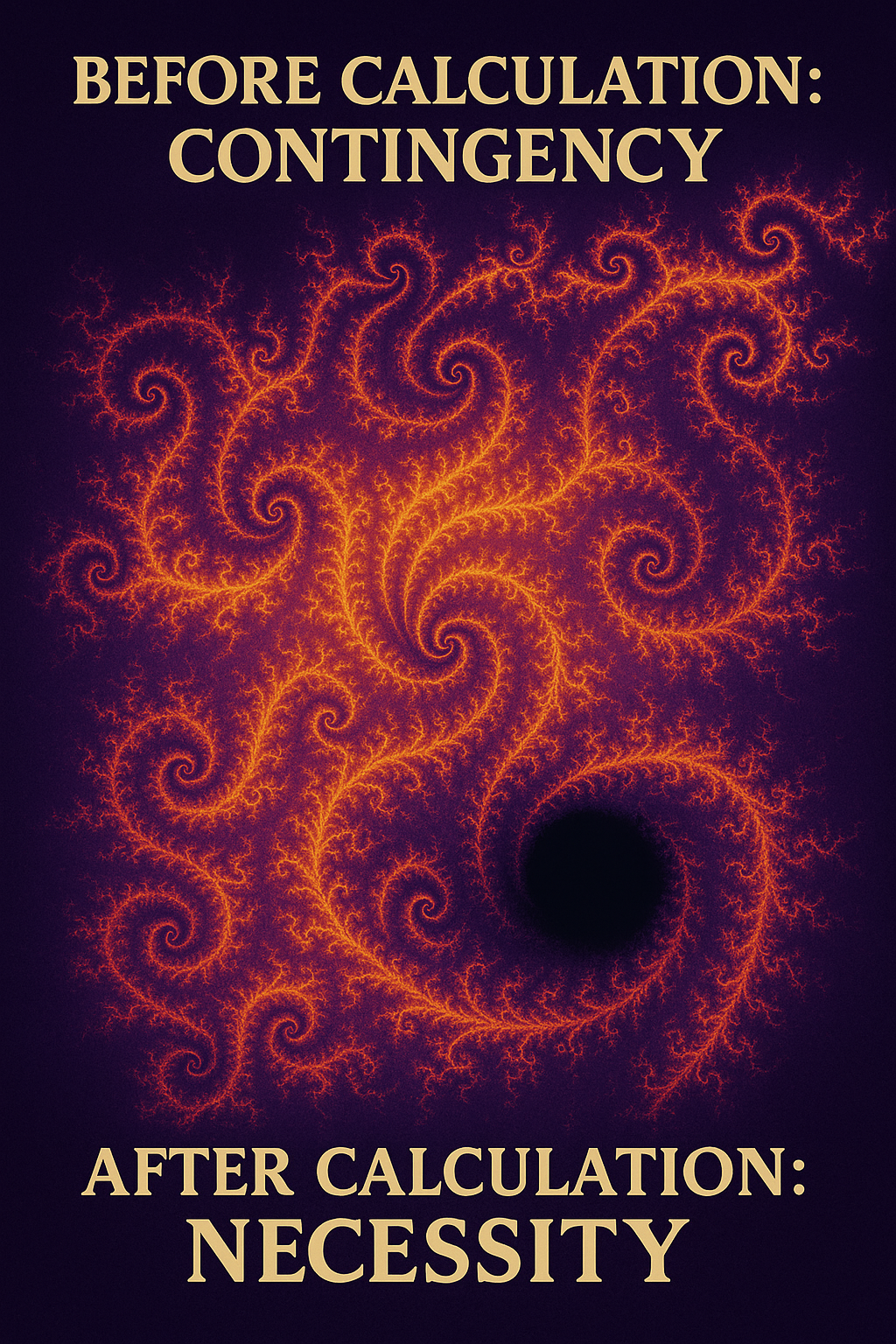
Nothing could have been different. Not your breakfast, not the outcome of World War I, not the gravitational constant, not your decision to read this sentence.
Everything that exists, exists necessarily.
This isn’t mysticism or eastern philosophy dressed up in western garb. It’s the rigorous conclusion of modal arguments that philosophers have been developing for half a century. They thought they were arguing about God’s existence. They were actually proving something far more fundamental—and more uncomfortable.
The evidence has been accumulating for decades: Sobel’s modal collapse results (1987), the intractable symmetry problems in Plantinga’s ontological argument, the inability to coherently maintain both the principle of sufficient reason (PSR) and contingency, the incoherence of divine freedom with divine necessity. Yet the philosophical establishment continues to treat necessitarianism as an embarrassing side effect to be eliminated rather than a conclusion to be taken seriously.
A handful of contemporary philosophers see the truth: Michael Della Rocca and Amy Karofsky defend necessitarianism, though they remain isolated voices. It’s time to make the case explicitly and systematically.
See why contingency is metaphysically impossible.
Part I: The Modal Ontological Argument—Valid Logic, Disputed Premises
The Argument’s Structure
For over fifty years, philosophers have wrestled with the modal ontological argument. Alvin Plantinga’s formulation (1974) remains the most influential:
- It is possible that a maximally great being exists
- If it is possible that a maximally great being exists, then a maximally great being exists in some possible world
- If a maximally great being exists in some possible world, then it exists in every possible world (by definition—maximal greatness includes necessary existence)
- If a maximally great being exists in every possible world, then it exists in the actual world
- Therefore, a maximally great being exists in the actual world
The formal version uses modal operators:
- ◊□G (It’s possible that necessarily, God exists)
- ◊□G → □G (In S5 modal logic)
- ∴ □G (Therefore necessarily, God exists)
- ∴ G (Therefore God exists in the actual world)
Why S5?
The argument requires S5 modal logic, which includes the axiom:
◊□P → □P
In S5, accessibility relations between possible worlds are reflexive, symmetric, and transitive. This means: if a proposition is necessary in any accessible world, it’s necessary in all accessible worlds—including the actual world.
Most philosophers accept S5 for metaphysical (as opposed to epistemic or deontic) modality. If you reject S5, you need to explain why metaphysical possibility shouldn’t be universal—why some possible worlds are “inaccessible” from ours in a metaphysically relevant sense.
The Decades-Long Stalemate
The argument’s validity is uncontested. The second premise follows from modal logic definitions. The inference rules are sound.
The entire debate concentrates on premise 1: Is a maximally great being possible?
Theists argue:
- The concept involves no logical contradiction
- We can coherently conceive of such a being
- The burden is on atheists to show impossibility
Atheists argue:
- Conceivability doesn’t guarantee possibility
- The concept might involve hidden contradictions
- The burden is on theists to establish positive possibility
Neither side has made decisive progress. The argument has remained in productive stalemate since Plantinga first formulated it.
Then the symmetry problem emerged.
Part II: The Symmetry Problem and Schmid’s Reverse Argument
The Reverse Modal Ontological Argument
In 2025, Joseph C. Schmid, along with Peter Fritz and Tien-Chun Lo, published “Symmetry Lost: A Modal Ontological Argument for Atheism?” in Noûs. The paper demonstrates that the ontological argument’s logic runs equally well in reverse:
- It is possible that God does not exist
- If it is possible that God does not exist, then God does not exist in some possible world
- If God does not exist in some possible world, then God does not exist in any possible world (if God exists at all, God exists necessarily; contrapositive: if God’s non-existence is possible, God’s existence is impossible)
- If God does not exist in any possible world, God does not exist in the actual world
- Therefore, God does not exist
Formally:
- ◊¬G (Possibly, God doesn’t exist)
- ◊¬G → □¬G (If possibly not-G, then necessarily not-G)
- ∴ □¬G (Therefore necessarily not-G)
- ∴ ¬G (Therefore not-G)
The Symmetry Problem
Both arguments have the same logical structure. Both have seemingly plausible possibility premises. Yet they reach contradictory conclusions.
This is the symmetry problem: the arguments are mirror images, equally (un)compelling. Any reason to believe premise 1 of the original argument seems to apply equally to premise 1 of the reverse argument.
Schmid’s Contribution
Schmid et al. argue that the reverse argument is actually stronger:
- Weaker logic required: The reverse argument is valid in S4, which doesn’t require the controversial S5 axiom that ◊□P → □P. In S4, you only need □(□P → P) and □(P → □◊P).
- Avoids recursive symmetry: The reverse argument doesn’t generate its own symmetry problem. You can’t run a “reverse reverse” argument that gets you back to theism without reintroducing the S5 axiom that the reverse argument avoids.
- Neo-Aristotelian support: Following suggestions from neo-Aristotelian metaphysics, if God exists, nothing could bring about God’s non-existence (God is indestructible). But if God doesn’t exist, nothing could bring about God’s existence either—including God himself (nothing can cause itself). The asymmetry: it’s more plausible that nothing can create God than that nothing can destroy God.
The Hunt for Symmetry Breakers
The philosophical community has generated dozens of attempted “symmetry breakers”—principles that would favor one possibility premise over the other:
- Positive property principles (Anderson, Pruss)
- Conceivability asymmetries (Plantinga)
- Modal continuity principles (various)
- Existential inertia (Oppy)
- A posteriori modal knowledge (Collin)
None has achieved consensus. Schmid has systematically responded to each proposal, showing how “symmetry re-arises” in various forms.
But here’s what the entire debate has overlooked: both arguments are pointing toward the same conclusion, and it’s neither theism nor atheism.
Part III: The Modal Ontological Argument for Necessitarianism
The Argument
Let me formulate what appears to be a novel argument:
The Modal Ontological Argument for Necessitarianism (MOAN):
- ◊N (It is possible that necessitarianism is true)
- N → □N (If necessitarianism is true, then necessarily necessitarianism is true)
- ∴ □N (Therefore, necessitarianism is necessarily true)
Where N = “For all propositions p, if p is true, then □p” (everything true is necessarily true; there are no contingent truths)
Defense of Premise 1
Is necessitarianism at least conceivable? Can we form a coherent conception of a reality in which everything is necessary?
The historical record demonstrates that we can:
Parmenides (5th century BCE): Being is one, unchanging, and necessary. Apparent change and plurality are illusions of perception. What is, could not not be.
Spinoza (17th century): Arguably the most systematic necessitarian. In the Ethics, Spinoza argues that God (Nature) exists necessarily, and everything else flows necessarily from God’s nature. There are no contingent truths. Everything follows from the divine essence with “geometric necessity.”
Amy Karofsky’s A Case for Necessitarianism is a tour de force. Hear her discuss it to realize it’s not the lunacy its detractors imagine. This dialogue with Josh Rasmussen has a satori quality (he thought so too).
Michael Della Rocca has argued extensively that the Principle of Sufficient Reason, taken seriously, entails necessitarianism. In “PSR” (Philosophers’ Imprint, 2010) and his book The Parmenidean Ascent, Della Rocca demonstrates that any genuine explanation necessitates what it explains. Since PSR demands explanations for everything, everything is necessitated.
The position has a coherent logical structure, a distinguished historical pedigree, and contemporary philosophical defenders. Whatever else might be said about necessitarianism, it is clearly conceivable and not obviously incoherent.
That’s sufficient for premise 1. We need only one possible world where necessitarianism holds.
Defense of Premise 2: The Self-Necessitating Nature of Necessitarianism
This is the crucial premise, and it reveals why necessitarianism is unique among metaphysical theses.
Necessitarianism is a global modal claim. It asserts: “∀p(p → □p)”—for all propositions, if true, then necessarily true.
Now consider: Could this claim itself be contingently true?
It cannot. To see why, assume for contradiction:
- Necessitarianism is true (assume)
- Necessitarianism is contingently true (assume)
- Then there is some possible world w where necessitarianism is false
- In w, there exists at least one contingent truth
- But if necessitarianism is true (from 1), then in all worlds, all truths are necessary
- Contradiction between (4) and (5)
Therefore, necessitarianism cannot be contingently true.
Alternative formulation: If necessitarianism is true in world w, then in w, all truths are necessary. But “all truths are necessary” includes “necessitarianism is true.” So if necessitarianism is true anywhere, it’s necessarily true everywhere.
In possible world semantics: If necessitarianism holds in w, then there are no genuinely distinct possible worlds accessible from w (since everything true in w is necessary, there are no alternative ways things could be). Thus there is only one possible world, and necessitarianism holds trivially in “all” possible worlds (there’s only one).
Why This Differs from Other Metaphysical Claims
Compare with other major metaphysical theses:
Theism: “God exists”
- Could be true in some worlds, false in others
- Even if God necessarily exists, God’s nature doesn’t immediately entail that everything necessarily exists
- Therefore ¬(T → □T) where T = theism
Materialism: “Only material things exist”
- Could be true in some worlds (no souls, no abstract objects), false in others
- Therefore ¬(M → □M) where M = materialism
Platonism: “Abstract objects exist necessarily”
- Even if true, doesn’t entail that concrete objects exist necessarily
- Therefore ¬(P → □P) where P = Platonism
Only necessitarianism has the logical property that it necessitates itself. This is because it’s a claim about the entire modal structure of reality, not a claim within that structure.
The Argument Is Valid
From ◊N and (N → □N), we derive □N in S5:
- ◊N (premise)
- N → □N (premise)
- ◊□N (from 1, 2 by modal logic)
- □N (from 3 by S5 axiom: ◊□P → □P)
The conclusion: Necessitarianism is necessarily true.
No Symmetry Problem
Can we run a “reverse argument” for contingentarianism (at least one contingency exists)?
Attempt:
- ◊C (Possibly, some truths are contingent)
- C → □C (If contingentarianism is true, necessarily contingentarianism is true)
- ∴ □C
Premise 2 fails. The existence of contingent truths doesn’t self-necessitate. If proposition p is contingently true, then “p is contingently true” is itself plausibly contingent—in other worlds, p might be necessary or false.
Contingentarianism makes a claim within modal space (some propositions have different truth values across worlds), but this claim is itself located within modal space and can vary across worlds.
Only necessitarianism, as a claim about the entire modal structure, self-necessitates.
This argument therefore avoids the symmetry problem that has plagued modal ontological arguments for God.
Part IV: Gödel’s Ontological Proof and the Modal Collapse
Gödel’s Formulation
Kurt Gödel (1906-1978) developed his ontological proof in unpublished manuscripts, which were later transcribed by Dana Scott. The argument uses second-order modal logic with the following structure:
Definitions:
- G(x): x is God-like (x possesses all positive properties)
- P(φ): property φ is positive
- φ ess x: property φ is an essence of x
- E(x): x necessarily exists
Axioms:
- A1: If φ is positive and φ entails ψ, then ψ is positive
- A2: If φ is positive, then ¬φ is not positive
- A3: Being God-like is a positive property
- A4: Being positive is a necessary property (if φ is positive, then necessarily φ is positive)
- A5: Necessary existence is a positive property
Key Theorems:
- T1: If φ is positive, then ◊∃x φ(x) (positive properties are possibly instantiated)
- T2: ◊∃x G(x) (possibly, a God-like being exists)
- T3: □∃x G(x) (necessarily, a God-like being exists)
The proof proceeds with mathematical rigor. Gödel, one of the 20th century’s greatest logicians, constructed a valid deductive argument from his axioms to the conclusion that God necessarily exists.
Sobel’s Modal Collapse Result
In 1987, Jordan Howard Sobel published “Gödel’s Ontological Proof” demonstrating a devastating consequence of Gödel’s axioms: modal collapse.
The problem: Gödel’s system allows property abstraction. For any formula φ(x), we can define the property [λx.φ(x)].
Given Gödel’s axioms, we can prove:
∀p(p → □p)
Every true proposition is necessarily true.
The proof sketch:
- God exists necessarily and possesses all positive properties essentially (from Gödel’s theorems)
- For any true proposition p, we can form the property [λx.p] (”being such that p”)
- God possesses this property or its negation
- If God possesses [λx.p], then since God exists necessarily and has all properties essentially, □p
- If God possesses [λx.¬p], then □¬p, which contradicts p being true
- Therefore, if p is true, then □p
Concrete example: Consider the proposition “Obama won the 2008 election.”
- Form the property: being such that Obama won in 2008
- Either this property is positive, or its negation is positive (by A2)
- If positive, God has it essentially, so necessarily Obama won
- If its negation is positive, then necessarily Obama didn’t win, contradicting actual history
- Therefore, Obama necessarily won the 2008 election
But this is absurd—surely McCain could have won. Surely I might never have existed. Surely contingent truths exist.
The Standard Response: Rejection
The philosophical community’s response to Sobel’s result has been uniform: modal collapse proves that Gödel’s axioms must be false.
Various “emendations” have been proposed:
- C. Anthony Anderson (1990): Modified axiom system avoiding property abstraction
- Petr Hájek (1996): Further weakening of Anderson’s axioms
- Melvin Fitting (2002): Alternative formulation using restricted comprehension
All these modifications aim to preserve God’s necessary existence while avoiding modal collapse.
The Unexamined Alternative
But there’s another possibility that philosophers have systematically refused to consider: What if modal collapse is not a bug but a feature? What if Sobel discovered not a reductio of Gödel’s axioms, but their true consequence?
Consider the dialectic:
- Gödel constructs rigorous formal argument
- Argument validly derives God’s necessary existence
- Argument also validly derives that all truths are necessary
- Philosophers assume (3) is false
- Therefore Gödel’s axioms must be rejected
But step (4) is an assumption, not an argument. Why assume contingency is true? Because it seems obvious? Because it’s intuitive?
These are not philosophical arguments. They’re appeals to modal intuitions that themselves require justification.
What if we instead reason:
- Gödel constructs rigorous formal argument
- Argument validly derives necessitarianism
- No clear incoherence in necessitarianism
- Historical precedent for necessitarianism (Spinoza, Parmenides, Karofsky, Della Rocca)
- Therefore: Necessitarianism might be true
Modal collapse doesn’t refute Gödel’s argument. It reveals its true conclusion.
Gödel wasn’t proving that God exists. He was proving that everything exists necessarily. The apparatus of “positive properties” and “God-likeness” was ultimately just machinery for deriving necessitarianism.
Why Philosophers Missed This
The philosophical establishment has been so committed to contingency that they couldn’t see modal collapse as anything other than disaster. They treated it as obviously false that everything is necessary.
But “obvious” is doing a lot of work there. Obvious to whom? Not to Spinoza. Not to Parmenides. Not to Della Rocca or Karofsky. Not to Petronius Jablonski.
The assumption of contingency is precisely what’s in question. Using it to reject modal collapse is circular reasoning.
Part V: The PSR Argument for Necessitarianism
The modal argument isn’t the only path to necessitarianism. An independent route proceeds through the Principle of Sufficient Reason.
PSR: For every fact F, there is a sufficient reason (explanation) why F obtains rather than not obtaining, and why F is thus rather than otherwise.
This principle has been central to rationalist metaphysics since Leibniz. It undergirds:
- The cosmological argument (why does anything exist?)
- Scientific inquiry (why does this phenomenon occur?)
- Our demands for explanation generally
Michael Della Rocca argues that rejecting PSR is “the sign of a failed philosophy”—it’s admitting that at some point, explanation simply stops for no reason.
The Incompatibility of PSR and Contingency
Consider any supposedly contingent fact F (e.g., “I ate oatmeal this morning”).
Question: Why does F obtain rather than not-F?
Two possibilities:
Option 1: F has a sufficient reason
If there’s a sufficient reason R that explains F, then R makes F the case. R is sufficient for F. Given R, F must obtain.
But then F is necessitated by R. F could not have been otherwise, given R.
“Ah,” you might say, “but R itself is contingent!”
Fine. Why does R obtain rather than not-R?
If R has a sufficient reason R₁, then R₁ necessitates R. And if R₁ has a reason R₂, then R₂ necessitates R₁.
Follow the chain:
- Either it terminates in something self-explanatory (which exists necessarily)
- Or it continues infinitely (but infinite regresses don’t explain—they postpone explanation indefinitely)
- Or it loops (but circular explanation is no explanation)
- Or it stops at a brute fact (violating PSR)
If we follow sufficient reasons all the way, we arrive at necessary being—something that exists by its own nature. And if that necessary being is the ultimate ground, everything grounded in it exists necessarily.
Option 2: F has no sufficient reason
Then F is a brute fact—something that just happens to be the case, for no reason at all.
But brute facts are explanatory failure. They’re not a type of explanation; they’re the absence of explanation. And once we permit one brute fact, why not permit them everywhere?
- Why does the universe exist? “Just because.”
- Why these laws of physics? “Just because.”
- Why anything at all? “No reason.”
PSR collapses. We’re left with a reality that’s fundamentally arbitrary, unintelligible, inexplicable.
Della Rocca’s Argument
In “PSR,” Della Rocca makes this point systematically:
Any genuine explanation necessitates what it explains.
If R explains F, then R makes F intelligible by showing why F (and not some alternative) obtains. But for R to succeed in this, R must be sufficient for F—R must make F the case.
And if R makes F the case, then given R, F must be the case. F is necessitated.
“Contingent explanation” is therefore a contradiction in terms. If F is genuinely contingent (could have been otherwise, even given all prior conditions), then nothing can explain why F rather than not-F. The choice between F and not-F would be inexplicable, arbitrary.
The PSR, taken seriously, is a necessitarian engine. It demands explanations, explanations necessitate, and therefore everything is necessitated.
Every fact faces the same trilemma:
- Explained → necessitated → not contingent
- Unexplained → brute fact → PSR violated
- Self-explanatory → necessary by nature
There is no fourth option. Contingency cannot be coherently maintained alongside PSR.
You must choose: PSR or contingency. Not both.
Most philosophers haven’t wanted to choose. They’ve tried to maintain both through increasingly baroque distinctions:
- “Sufficient reason” vs. “necessitating reason”
- Explanations that make things “likely” but not “necessary”
- Brute necessities vs. brute contingencies
None of these distinctions withstand scrutiny. They’re philosophical epicycles designed to save the appearances of contingency.
Part VI: Divine Freedom and Necessary Creation
Judaism, Christianity, and Islam all maintain:
God freely chose to create the world. God could have refrained from creating, or created differently.
This isn’t peripheral doctrine—it’s load-bearing:
- Moral theology: Creation is a gift (requires freedom to withhold)
- Problem of evil: God gave creatures freedom (presupposes God’s own freedom)
- Divine sovereignty: God’s will is supreme (not constrained by necessity)
- Worship: We praise God for creating this (requires alternatives)
The Classical Attributes
Yet these same traditions affirm that God possesses:
Necessity: God exists in all possible worlds (non-contingent being)
Simplicity: God has no parts, no composition, no distinction between essence and existence or between nature and will
Immutability: God doesn’t change (no succession of states, no temporal process)
Aseity: God depends on nothing outside God’s own nature (absolute self-sufficiency)
Omniscience: God knows all truths with perfect certainty
Perfect Goodness: God always acts in accordance with perfect wisdom and goodness
The Incompatibility
These attributes are incompatible with libertarian freedom. Here’s why:
From Simplicity:
If God’s will is distinct from God’s nature, God is composite (essence + will). But divine simplicity denies all composition in God. Therefore God’s will = God’s nature.
But if God’s will is identical to God’s nature, and God’s nature is necessary, then God’s will is necessary.
God cannot will otherwise than God wills, any more than God can have a different nature.
From Immutability:
If God’s willing is an event—something that happens, a decision made—then God changes from not-having-willed to having-willed.
But God is immutable. Therefore God’s willing isn’t an event in time. It’s eternal, unchanging.
But if God’s willing is eternal and unchanging, it cannot be the exercise of libertarian freedom (which requires the ability to do otherwise).
From Perfect Goodness:
If God necessarily knows what’s best and necessarily acts on that knowledge (perfect goodness), then God’s actions are necessitated by God’s knowledge + perfect nature.
“Ah,” you might object, “but God chooses which good to actualize from among many possible goods.”
But does God have reasons for choosing this particular good rather than another?
If yes: Those reasons necessitate the choice. Given God’s perfect knowledge of those reasons, God must choose accordingly. No real alternatives.
If no: The choice is arbitrary, without sufficient reason. But this contradicts divine perfection—a perfect being doesn’t act arbitrarily.
From Necessity:
If God exists necessarily, and God’s attributes are essential to God (part of what makes God God), then God’s knowing and willing are necessary.
God doesn’t just happen to know all truths—God necessarily knows them. God doesn’t just happen to will the good—God necessarily wills it.
And if God necessarily wills what God wills, and creation is among the things God wills, then creation is necessary.
Aquinas’s Failed Solution
Thomas Aquinas recognized this problem. His solution (developed across thousands of pages):
God necessarily wills God’s own goodness. But God only contingently wills the existence of creatures.
Why? Because creatures add nothing to God’s perfection. God would be equally perfect without them. Therefore God’s will regarding creatures is “free” (not necessitated by God’s nature).
This doesn’t work.
If God’s willing is identical to God’s nature (simplicity), and God’s nature is necessary, then all of God’s willing is necessary—including willing regarding creatures.
Aquinas tries to maintain that God’s willing is necessary but the object of God’s will (creatures) is contingent. But this distinction collapses. If God necessarily wills X, then X is necessitated.
Aquinas: “God necessarily wills that IF God creates, THEN God creates the best. But God doesn’t necessarily will to create.”
But this just postpones the problem: Why does God will to create at all? Either:
- God has reasons → Those reasons necessitate the willing → Not free
- God has no reasons → The willing is arbitrary → Not perfect
Leibniz’s Failed Solution
Leibniz tried to preserve contingency through his distinction between absolutely necessary truths (whose opposite is contradictory) and hypothetically necessary truths (which follow from God’s nature + God’s free choice).
God necessarily exists. God necessarily knows all possible worlds. God necessarily chooses the best.
But which world is best is a contingent matter—it depends on evaluating infinite compossible options.
This doesn’t work either.
If God’s knowledge of which world is best is necessary (following from omniscience), and God’s willing the best is necessary (following from perfect goodness), then God’s creating this world is necessary.
The “contingency” Leibniz preserves is merely epistemic (we finite knowers can’t derive which world is best) not metaphysical (even for God, there’s no real alternative once perfect knowledge is assumed).
Spinoza’s Honesty
Spinoza saw what Aquinas and Leibniz wouldn’t face: You can’t have both divine necessity and divine freedom.
If God is simple, immutable, necessary, and perfect, then everything follows from God’s nature with the same necessity that properties of a triangle follow from its definition.
Deus sive Natura. God = Nature. One substance, existing necessarily, from which everything flows necessarily.
“Could God have created differently?”
No—not because God lacks power, but because the question is malformed. It’s like asking “Could a triangle have had four sides?” The nature determines what follows necessarily.
This isn’t atheism (Spinoza was condemned as an atheist, but he called his system “God”). It’s necessitarian monism—one necessary substance, no contingency anywhere.
Is this “theism” in any traditional sense? No. There’s no person to pray to, no will that responds to requests, no freedom to grant or withhold.
But it may be the only coherent form of rationalist theology available.
The Forced Choice
Traditional theism must choose:
Option A: Divine Freedom
- God could have done otherwise
- → God’s will is contingent
- → God contains potentiality (could-have-done-otherwise)
- → God is composite (actuality + potentiality)
- → God depends on something to actualize potentials
- → Violates aseity and simplicity
- → This being is not God
Option B: Divine Necessity
- God’s nature necessitates God’s willing
- → God necessarily wills whatever God wills
- → If creation occurs, it occurs necessarily
- → Everything flows necessarily from divine nature
- → Necessitarianism
There is no middle path. Aquinas’s thousands of pages of distinctions, Leibniz’s “hypothetical necessity,” modern theists’ appeals to “libertarian agency in God”—all of these are elaborate ways of refusing to choose.
But the choice is unavoidable.
If the ontological argument proves anything, it proves that God exists necessarily. And if God exists necessarily with perfect knowledge and perfect will, then everything God does is necessary.
The modal ontological argument’s true conclusion: necessitarianism.
Part VII: Objections and Responses
Objection 1: “This is absurd. Obviously things could have been otherwise.”
Response: This is appeal to intuition, not argument. Many true things initially seem absurd:
- Heliocentrism (the earth moves—absurd!)
- Special relativity (simultaneity is relative—absurd!)
- Quantum mechanics (superposition—absurd!)
- Evolution (complexity without design—absurd!)
“Seeming absurd” isn’t evidence of falsehood. What matters is whether the arguments are sound.
Moreover, necessitarianism seemed obvious to some great philosophers. The intuition of contingency is not universal. It may be culturally conditioned by theistic assumptions.
Objection 2: “Premise 1 fails—necessitarianism is incoherent or impossible.”
Response: Then demonstrate the incoherence. Show the contradiction.
Spinoza gave a complete systematic presentation in Ethics. Where’s the logical contradiction? Which axiom is false? Which inference is invalid? See this for a stunning modern defense.
Saying “I can’t imagine how this could be true” is not showing incoherence. That’s an epistemic limitation, not a metaphysical impossibility.
The burden is on the objector: prove necessitarianism involves a contradiction.
Objection 3: “Premise 2 fails—necessitarianism could be contingently true.”
Response: This is incoherent for reasons already given.
If necessitarianism is true, it states that all truths are necessary. This includes the truth of necessitarianism itself.
You cannot coherently maintain: “All truths are necessary, and this fact is contingent.” That’s a performative contradiction.
Objection 4: “We should reject S5 modal logic.”
Response: On what grounds?
S5 is standard for metaphysical modality. The accessibility relation for metaphysical possibility is reflexive (every world accesses itself), symmetric (if w₁ accesses w₂, then w₂ accesses w₁), and transitive (if w₁ accesses w₂ and w₂ accesses w₃, then w₁ accesses w₃).
Rejecting S5 means claiming some metaphysically possible worlds are “inaccessible” from ours in some deep sense. What would ground this inaccessibility? What metaphysical principle determines which worlds we can access?
Without principled answers, rejecting S5 looks like ad hoc maneuvering to avoid uncomfortable conclusions.
(Note: The reverse ontological argument works in S4, which is weaker. Even if you reject S5, the problem doesn’t disappear.)
Objection 5: “PSR is false—some things are just brute facts.”
Response: This isn’t a philosophical position; it’s creation ex nihilo; it’s giving up on philosophy. It’s saying that at some point, for no reason, we stop asking “why?”
And once you permit one brute fact, why not permit them everywhere?
Della Rocca argues this is “the sign of a failed philosophy.” Accepting brute facts means accepting that reality is fundamentally arbitrary and unintelligible.
That may be true. But it’s philosophically unsatisfying, and it undermines the very enterprise of rational inquiry.
Objection 6: “This eliminates moral responsibility and free will.”
Response: It eliminates libertarian free will (the ability to have done otherwise with identical prior conditions). But compatibilist accounts of freedom and responsibility survive.
You are “free” when your actions flow from your own character, desires, and reasons—not when they’re undermined by external compulsion or internal pathology.
You’re responsible when holding you accountable serves social functions (deterrence, behavior modification, coordination).
These accounts don’t require contra-causal freedom. They work perfectly well in a necessitarian framework.
What becomes difficult is desert-based responsibility—the idea that people deserve suffering simply because they could have done otherwise. Retributive punishment becomes harder to justify.
But consequentialist and contractualist moral theories handle necessitarianism without a problem.
Objection 7: “Modal collapse is a known problem, not a vindication.”
Response: It’s a “problem” only if you assume contingency is true. But that’s begging the question.
Sobel showed that Gödel’s axioms entail necessitarianism. Philosophers assumed necessitarianism is false, therefore Gödel’s axioms must be false.
I’m questioning that assumption: Why assume necessitarianism is false?
The answer is usually: “Because it’s obviously false!” But that’s not an argument—it’s an appeal to intuition. And intuitions about modality are notoriously unreliable.
If Gödel’s axioms are independently plausible (principles about perfection and positive properties), and they validly entail necessitarianism, that’s reason to accept necessitarianism, not to reject the axioms.
Objection 8: “No one believes this.”
Response: False, as we’ve seen. And more importantly: truth isn’t determined by popularity. Many true claims were initially accepted by few people.
The question isn’t “how many people believe this?” but “are the arguments sound?”
Objection 9: “This has terrible practical consequences.”
Response: And? Truth doesn’t bend to convenience.
If necessitarianism is true, the fact that we dislike its implications is irrelevant. Reality doesn’t care about our preferences.
That said, the practical implications may not be as dire as feared:
- You still deliberate (deliberation is necessary)
- You still make choices (choices are necessary)
- You still hold people accountable (accountability is necessary)
- Meaning and purpose exist (as necessary features of conscious systems)
What changes is our understanding of what we’re doing, not the doing itself.
Part VIII: Why Philosophers Resist
If the arguments for necessitarianism are strong, why do so few philosophers accept it?
Phenomenological Resistance
The feeling of freedom is powerful. When you deliberate, you experience genuine openness—”I could choose A or B.”
Necessitarianism says this feeling is misleading (or at least, doesn’t reflect metaphysical openness). That’s hard to accept.
But again: feelings don’t determine metaphysics. The felt experience of moral properties doesn’t prove moral realism. The felt experience of time’s flow doesn’t prove presentism.
Phenomenology is data, but it’s not self-interpreting.
Fear
Necessitarianism is vertiginous. The idea that nothing could have been different, that every moment was always going to happen, that all of history was locked in—this is existentially unsettling.
Many philosophers may resist it simply because they don’t want it to be true.
That’s understandable. But it’s not a philosophical argument.
Part IX: The Real Stakes
What follows if necessitarianism is true?
Metaphysics
- Existence: Why is there something rather than nothing? Because being is necessary. Non-being is impossible.
- Laws: Why these laws of nature? Because they’re necessary features of how reality must be structured. (Why these prime numbers?)
Philosophy of Science
Science isn’t discovering contingent regularities that “just happen” to hold. It’s discovering necessary relations.
The “unreasonable effectiveness of mathematics in the natural sciences” (Wigner) is no longer unreasonable. Mathematics describes necessary structures, physics describes reality’s necessary structure—they match because reality is mathematical necessity realized.
Ethics
Desert-based moral responsibility becomes questionable. Consequentialist and contractualist ethics survive.
Justice is about coordinating behavior and maintaining social order, not about giving people what they “deserve” for could-have-done-otherwise.
Philosophy of Religion
God as a person who “could have done otherwise” is incoherent: no being could have done otherwise.
What remains:
- Spinozistic pantheism (God = necessary Nature)
- Naturalism (reality = necessary physical laws)
- Impersonal absolute (Plotinus’s One, Brahman, Tao—if these are understood as necessity, not personality)
Existential Meaning
You are not a contingent accident. You are a necessary feature of reality’s structure—as necessary as mathematical truths, as inevitable as the Mandelbrot set’s boundary.
Your choices aren’t free (in the libertarian sense), but they’re yours—flowing from your character and nature, which themselves flow necessarily from prior causes.
Meaning doesn’t come from creating yourself ex nihilo. It comes from understanding your necessary place in reality’s structure and living in accordance with that understanding.
Spinoza called this amor dei intellectualis—the intellectual love of God/Nature. Understanding necessity brings peace.
Part X: The Argument Stands
I have presented three independent arguments for necessitarianism:
- The modal argument: ◊N, N → □N, ∴ □N
- The PSR argument: PSR + contingency are incompatible; PSR is more fundamental
- The theological argument: Divine necessity + divine perfection → necessitarianism
- See also “The Dilemma of Contingency” for a direct attack on contingency
The Challenge
If you reject necessitarianism, you owe an account of:
- Which premise in the modal argument is false, and why
- How contingent facts can be explained without being necessitated
- How divine freedom is compatible with divine simplicity, immutability, and necessity
- Why modal collapse in Gödel’s argument shows the axioms are false rather than necessitarianism is true
- What grounds your modal intuitions about contingency beyond “it feels right”
Without answers to these questions, rejection of necessitarianism is unmotivated.
Conclusion: The Necessary World
Reality is not arbitrary. It is not contingent. It is not chosen.
The universe is computing what it must compute. We are inside the algorithm, watching it unfold, experiencing what feels like openness but is actually necessity manifesting through conscious beings.
What we call “evolution” is necessity unfolding temporally. What we call “laws of physics” are descriptions of necessary relations. What we call “choice” is determination flowing through deliberative processes. What we call “existence” is mathematical consistency realized.
The modal ontological argument was always pointing here. Not to a personal God who freely creates, but to reality as necessary structure—one way it must be, one way it could only ever be.
Parmenides was right: Being is. Being is one. Being is necessary.
Spinoza was right: Deus sive Natura. God or Nature—same thing. All following necessarily from the eternal substance.
The contemporary resisters—Della Rocca, Karofsky—are right: PSR entails necessitarianism. Contingency = creation from nothing. We’ve been avoiding the conclusion because we don’t like where the arguments lead.
But arguments don’t care what we like.
Further Reading:
Primary Sources:
- Spinoza, Ethics (1677) – The systematic necessitarian text
- Leibniz, Theodicy (1710) – Attempt to preserve contingency; arguably collapses into necessitarianism
- Gödel’s ontological argument – In Kurt Gödel: Collected Works, Vol. 3
Contemporary Necessitarians:
- Michael Della Rocca, “PSR,” Philosophers’ Imprint 10.7 (2010)
- Michael Della Rocca, The Parmenidean Ascent
- Amy Karofsky, A Case for Necessitarianism
On Modal Ontological Arguments:
- Alvin Plantinga, The Nature of Necessity (1974)
- Joseph C. Schmid, Peter Fritz, Tien-Chun Lo, “Symmetry Lost: A Modal Ontological Argument for Atheism?” Noûs (2025)
- Jordan Howard Sobel, “Gödel’s Ontological Proof” (1987)
- Jordan Howard Sobel, Logic and Theism: Arguments For and Against Beliefs in God (2004)
On Spinoza:
- Stanford Encyclopedia of Philosophy, “Spinoza’s Modal Metaphysics”
- Don Garrett, Nature and Necessity in Spinoza’s Philosophy (2018)
 Petronius Jablonski