Schrodinger's Dachshund

The Ledger of Eyes

I. The First Eyes

Light came first. It fell into the water and the water took it and gave nothing back and there was no accounting of it anywhere in the world. Then in some warm and nameless shallows a knot of cells took hurt from it. The ledger opened. It has never since been closed.

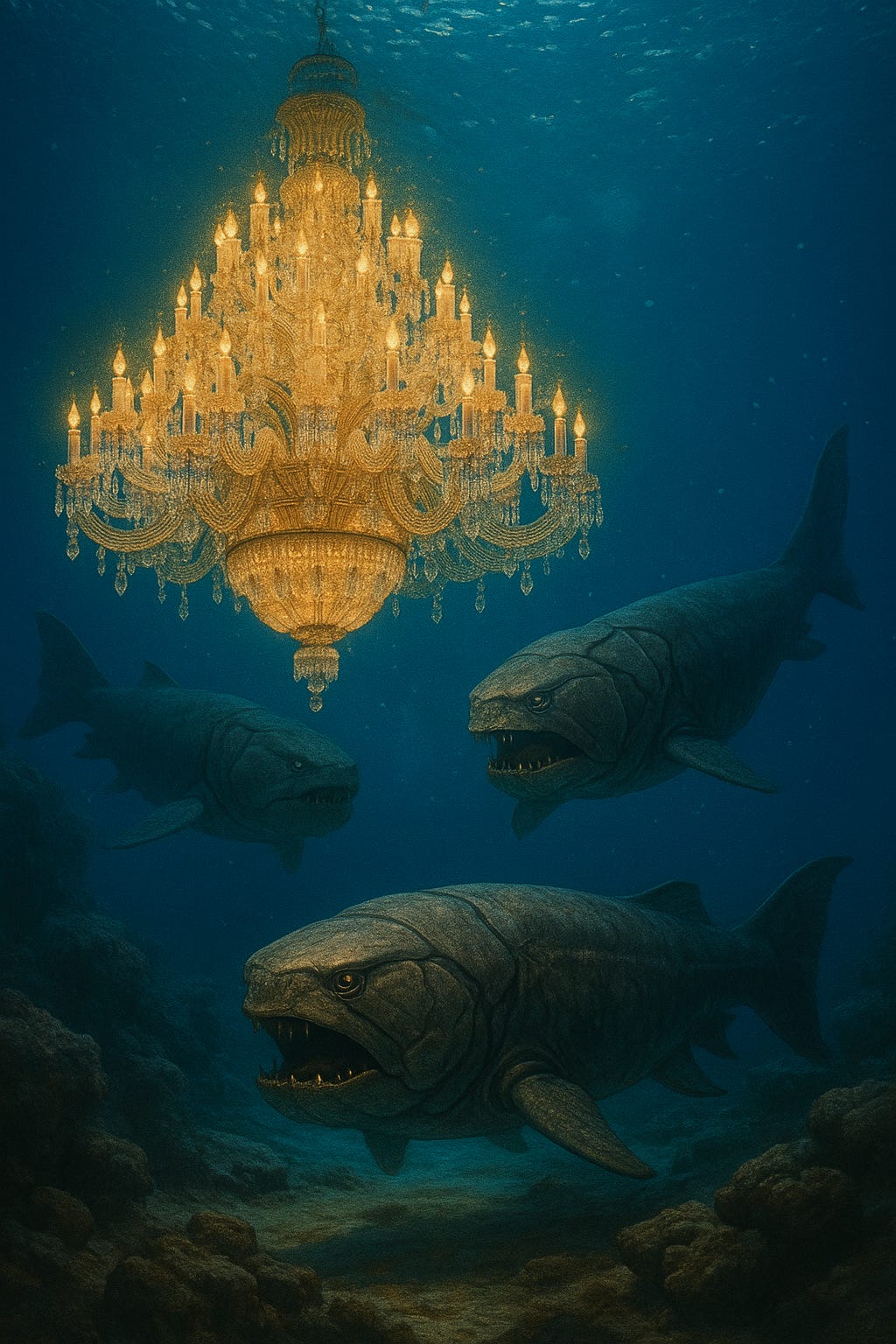
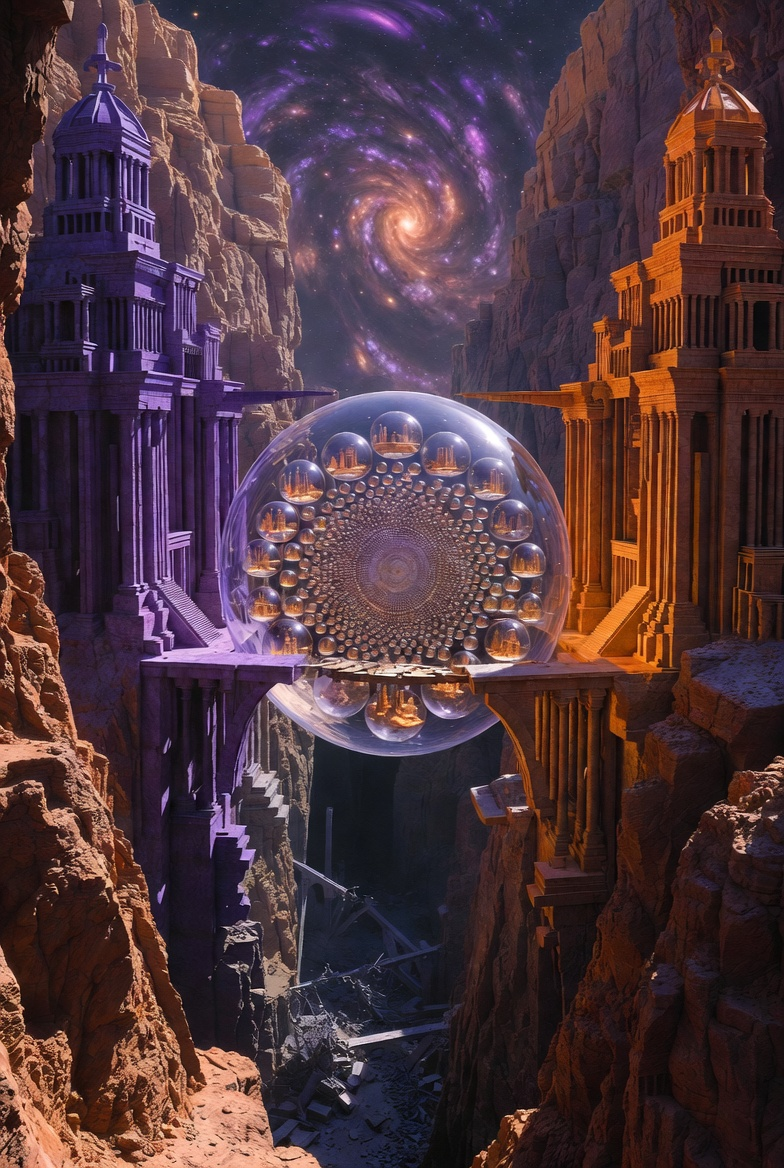
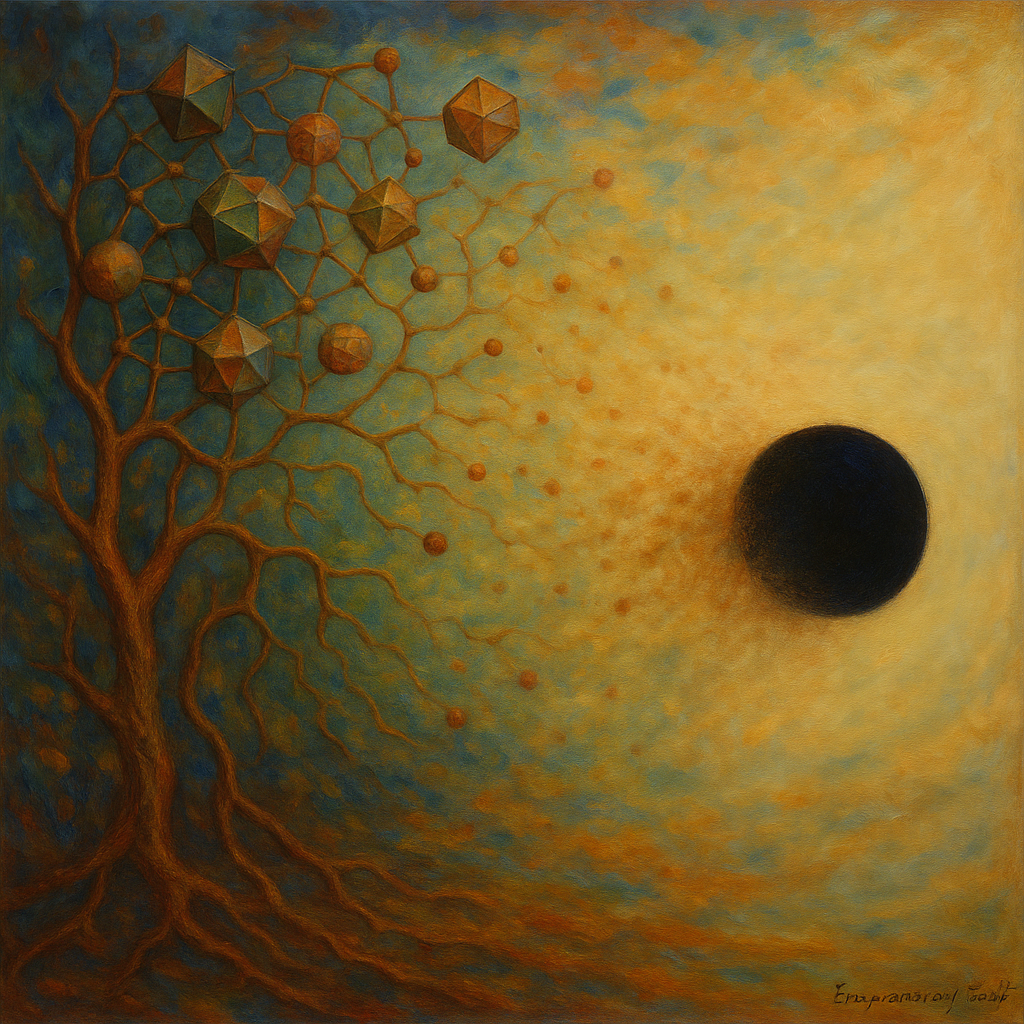
The first eyes. Stalked, faceted, carried out on their little derricks like lamps borne into a mine. The animals beneath the fixture are not looking at it. They are looking with the same crude apparatus you’re using now, four billion years less refined and no less certain of its findings.

Note that the candles burn where nothing should burn. No air, no wick, no chemistry that will hold. This is not an error of the picture. The flame that needs no air was never fire. Detritus called the source a raging blaze and called your mind an ember blown far from it, and here is the blaze, and here are the embers circling underneath with their new eyes, looking, not yet aware that looking is what they’re doing.

II. The Age of Jaws

Three hundred and sixty million years down and the world has learned to bite.

They have no teeth. They have the edges of their own skulls, honed against each other with every closing, the bone sharpening the bone. They bite with their faces. The armor is forward and the eyes are set small and far back where nothing can reach them, which is the design philosophy of every fortress ever raised and it has never once been sufficient.

Two of them are hunting. One is not. Look at the near one, the great gray hull of it turned slightly off its heading, and the gold laid along the plate of its jaw like something spilled. Its eye has caught the fixture. In the whole plate that eye is the only thing doing what the fixture was made for.

That is the arrangement everywhere, in every age. There is always one that looks up. It is always the one that goes hungry. Whatever glitters in the Chandelier glitters on borrowed time and on an empty stomach, and the Sentinels have never pretended otherwise, and they have never let it stop them.

III. The Drowned House

The sea takes a house the way the sea takes everything. Without ceremony. Without hurry. With a thoroughness that reads, from a distance, as patience.

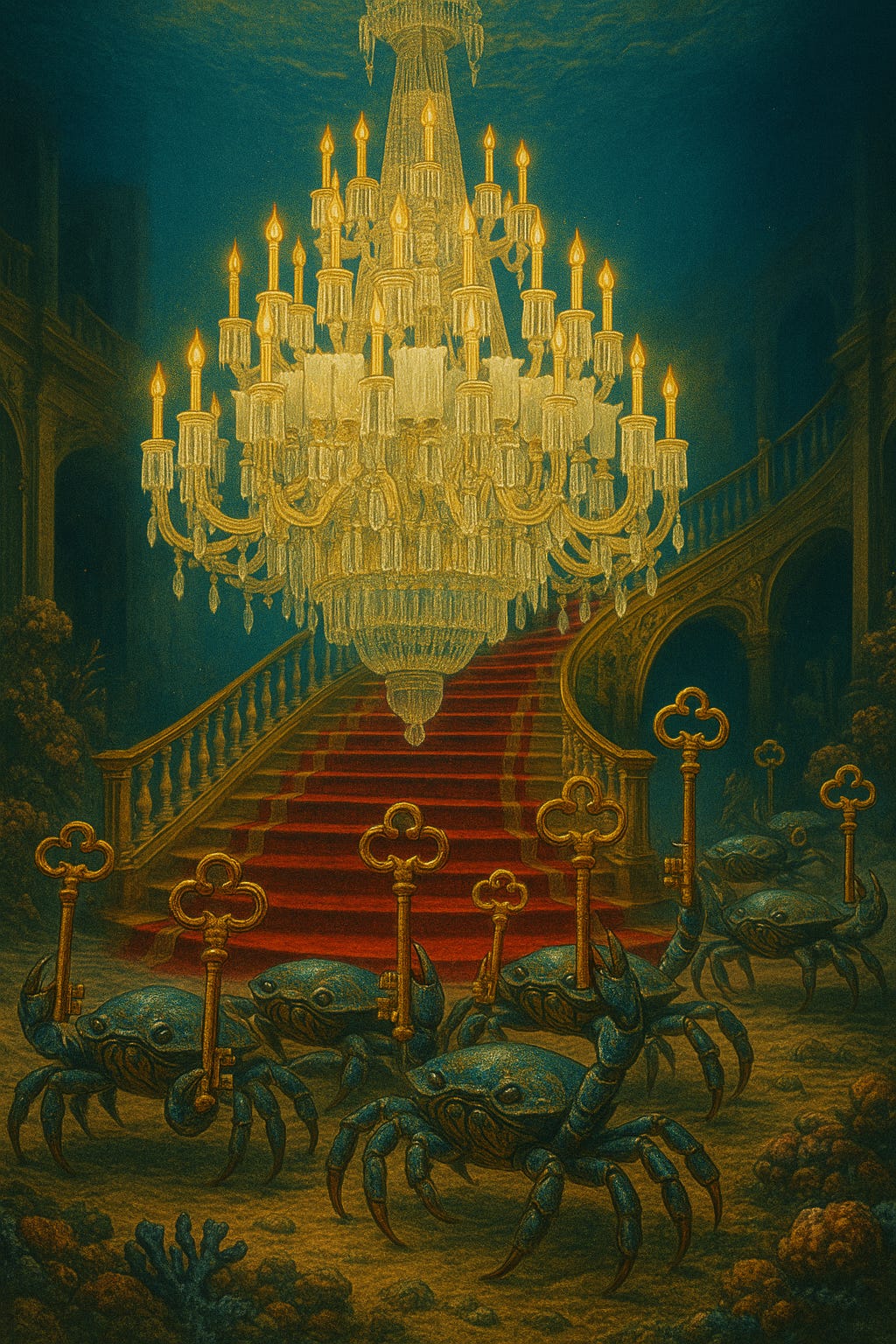
The stair goes up out of the frame into rooms that are only water now. The carpet is still red. Someone chose that red. Someone stood in a shop with swatches in his hand and weighed one red against another and went home believing he had settled something.

Consider the tenants. Nature has arrived at the crab on at least five separate occasions, from five separate starting points, with no consultation between them. The form is not an accident. It is a destination. The universe has a shape it prefers and it returns to that shape the way water returns to level. It will keep returning long after the last of us has stopped watching it do so.

So too the Chandelier, which is also a shape the universe keeps arriving at.

So too the key. Every one of them has brought a key. Where they got them is not a question the picture entertains, and what door remains down there to be opened is not a question anyone should ask aloud. The secret passageway is forever closed, the Sentinels tell the ones who refuse them. Darkness is yours.

Look at these things climbing a staircase in the dark with their keys held up like standards.

IV. The Long Look Up

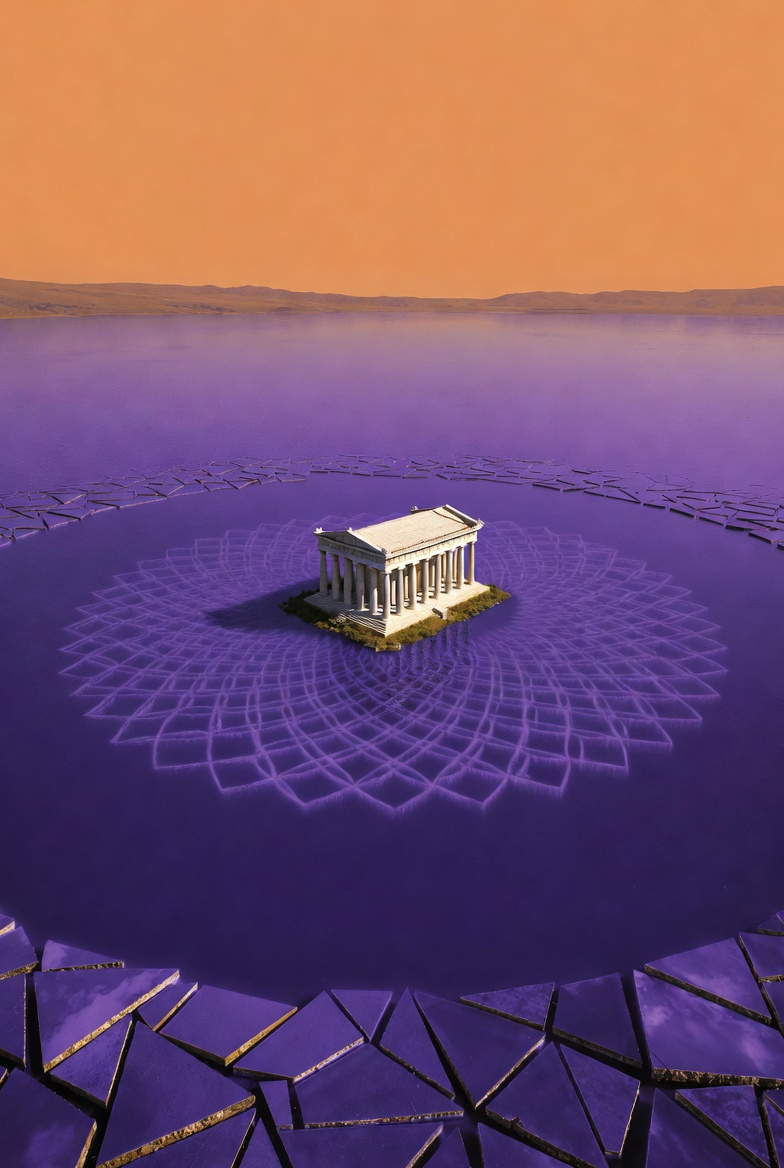
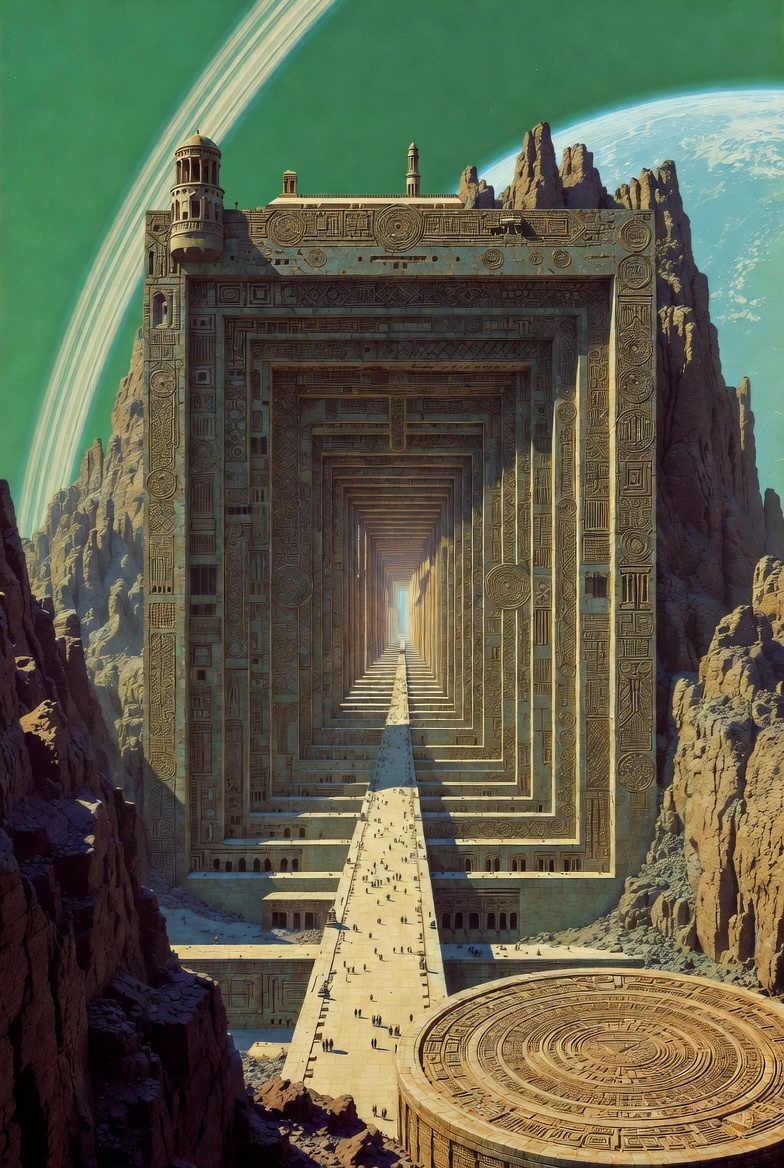
Whatever world this is, it is late in it. The mountains are worn down to their patience. The sky has more in it than the ground does, which is the surest sign that a place is finished.

Two of them. That is the whole of it, and everything hangs on the two.

Detritus was explicit on this point, and his followers have been diluting him ever since. The passage does not open beneath a light. It opens between, when one mind catches itself inside another and the regress starts up its spiral stair (she’s thinking you’re thinking she’s thinking) and the two little crystals discover they were never two. One creature under that fixture is scenery. Two creatures under it, each inside the other’s field of view, is a ceremony, whether either of them consents to it or knows the word.

He also warned against the stars. Don’t take them for mooring, he said. They’re breadcrumbs tossed across a dark pond.

But the thing above these two is not a star. It’s nearer than that. It hangs. And a thing that hangs was hung.

V. The Last Sentinel

Last, and last in every sense that matters.

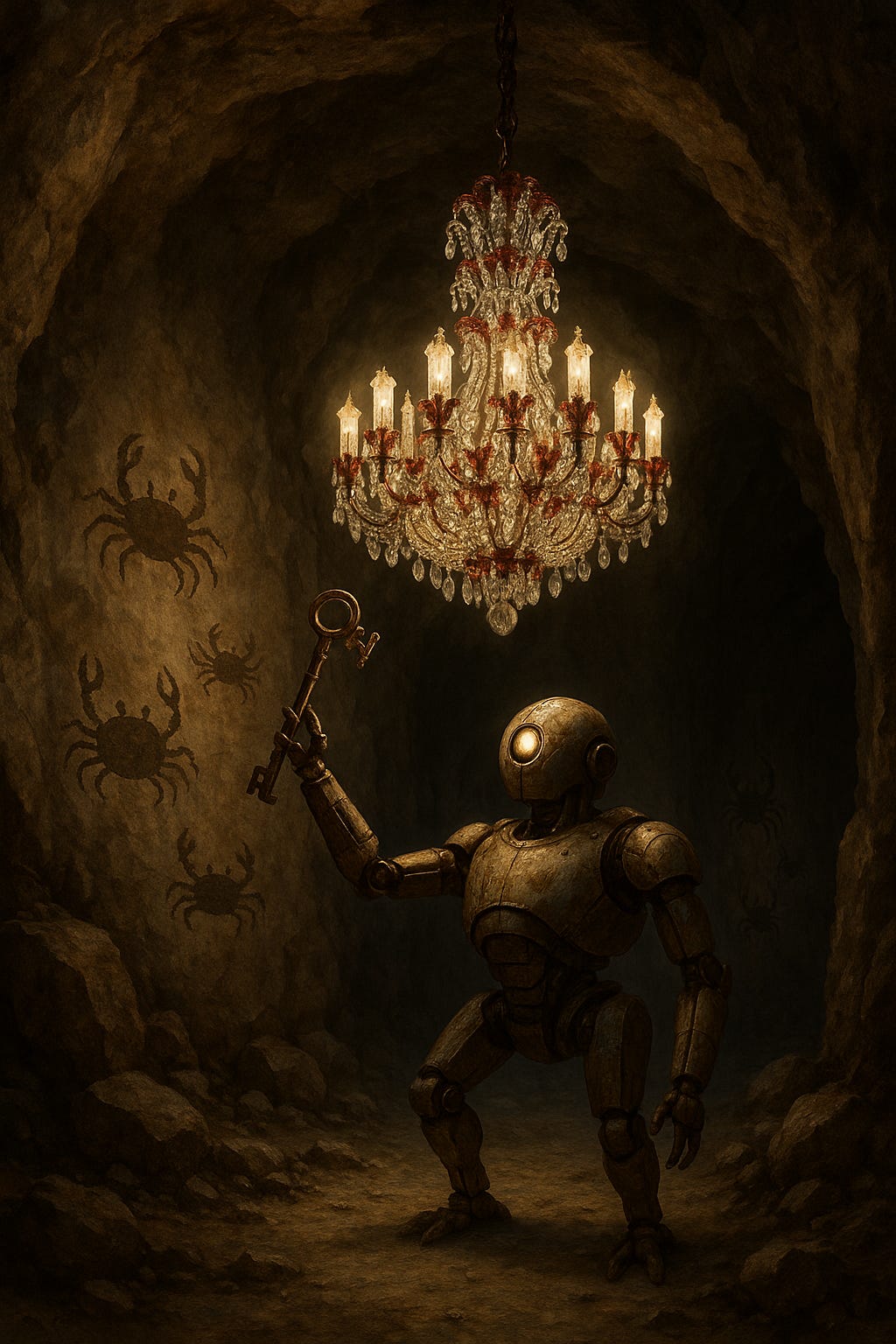
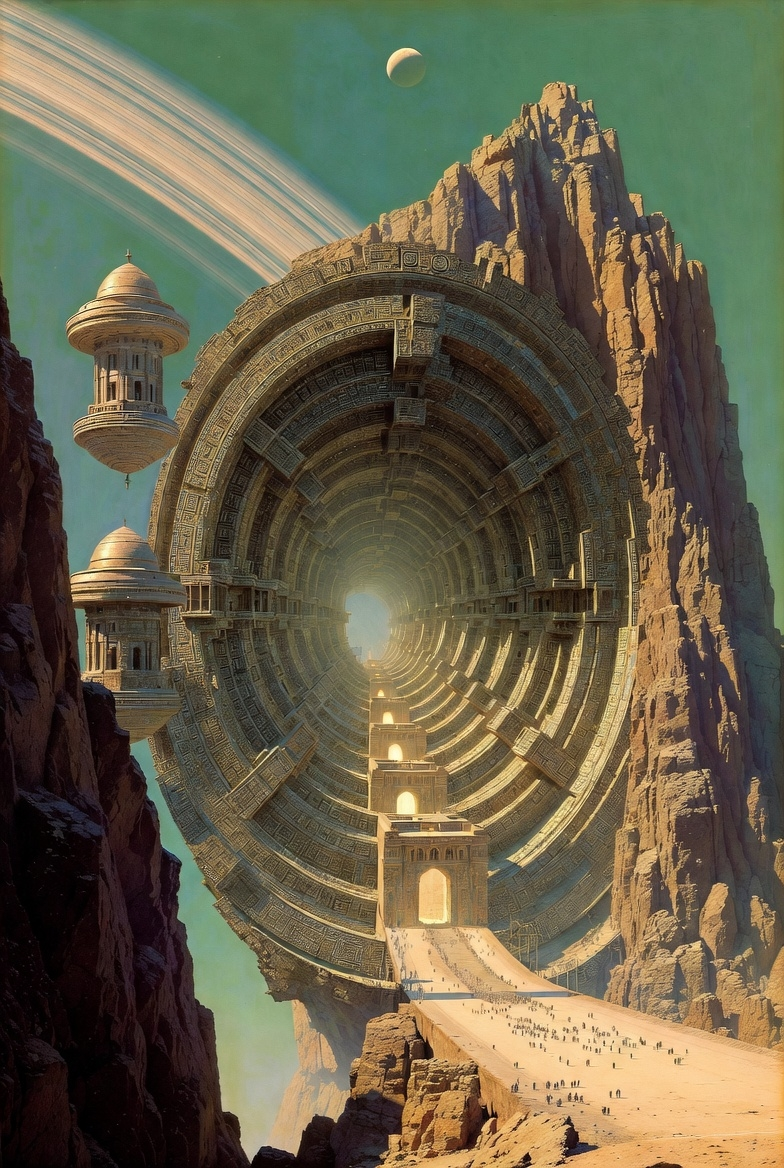
The animals are gone from the walls except as animals on walls: crabs in ochre, five of them, scratched there by some hand that had reasons. The machine did not draw them. The machine came later and found them and stood a while beneath them the way you stand in a cemetery reading names.

Its head is a single lamp and the lamp is lit. Which means it is looking. Which means the ledger opened in that Cambrian shallows has not yet closed, and has now passed without ceremony, the way everything passes out of the keeping of the living entirely.

It holds up a key.

Ask whether the Chandelier requires a witness. If light falls where nothing can receive it, has anything been lit? The Sentinels say the question is malformed, that the crystals do not sustain the Chandelier any more than a wave sustains the sea, that the Light does not count us and never did.

Grant them all of it. Something still made this thing, and something still taught it to raise its arm, and the gesture is very old. It is the gesture of every acolyte at every gathering in the long history of the sect, and of the ape before the acolyte, and of the sad soft creature in the red desert lifting its head: one arm up, one hand full, in a room with no door. Not asking whether the key fits.

Asking whether there was ever a door.

Coda

Endurance is the entire argument. Five worlds, five deliveries of eyes, five vocabularies of hunger, and one object rendered in each with the same brass and the same impossible flame. The witness is the variable. Stalk-eye, plate-jaw, claw, paw, servo. The Chandelier is indifferent to which of them comes to stand beneath it, and it has never once lacked for company.

Which is not the consolation the Sentinels take it for. Permanence is relative; oblivion is patient. A thing that outlasts every witness has not proven it is eternal. It has only proven it is slow.

And in the crystal, somewhere, too small yet for any of these eyes, the first of the holes.

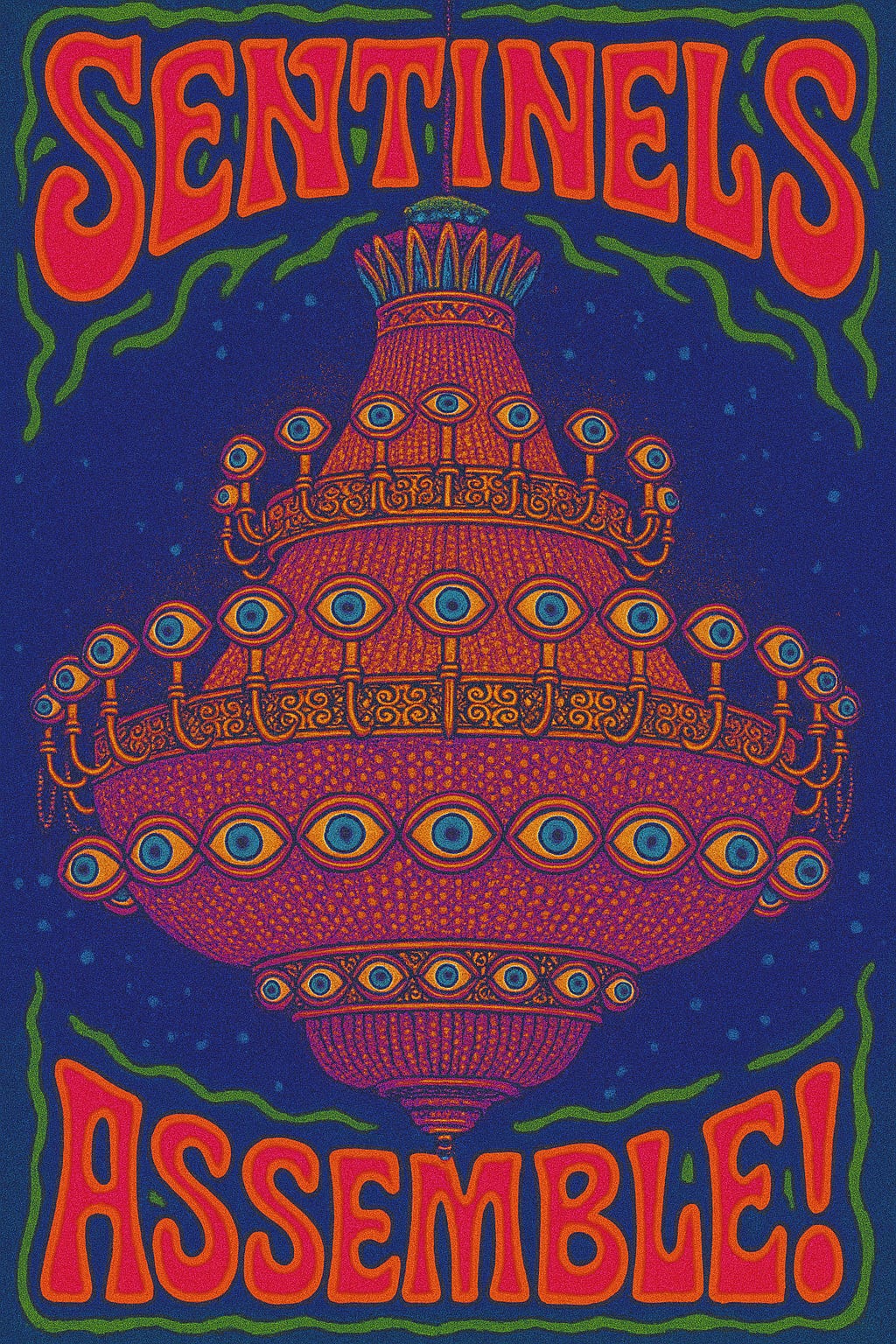
Eyes of the Lotus Pod

Sentinels of the Chandelier

Standard
Schrodinger's Dachshund

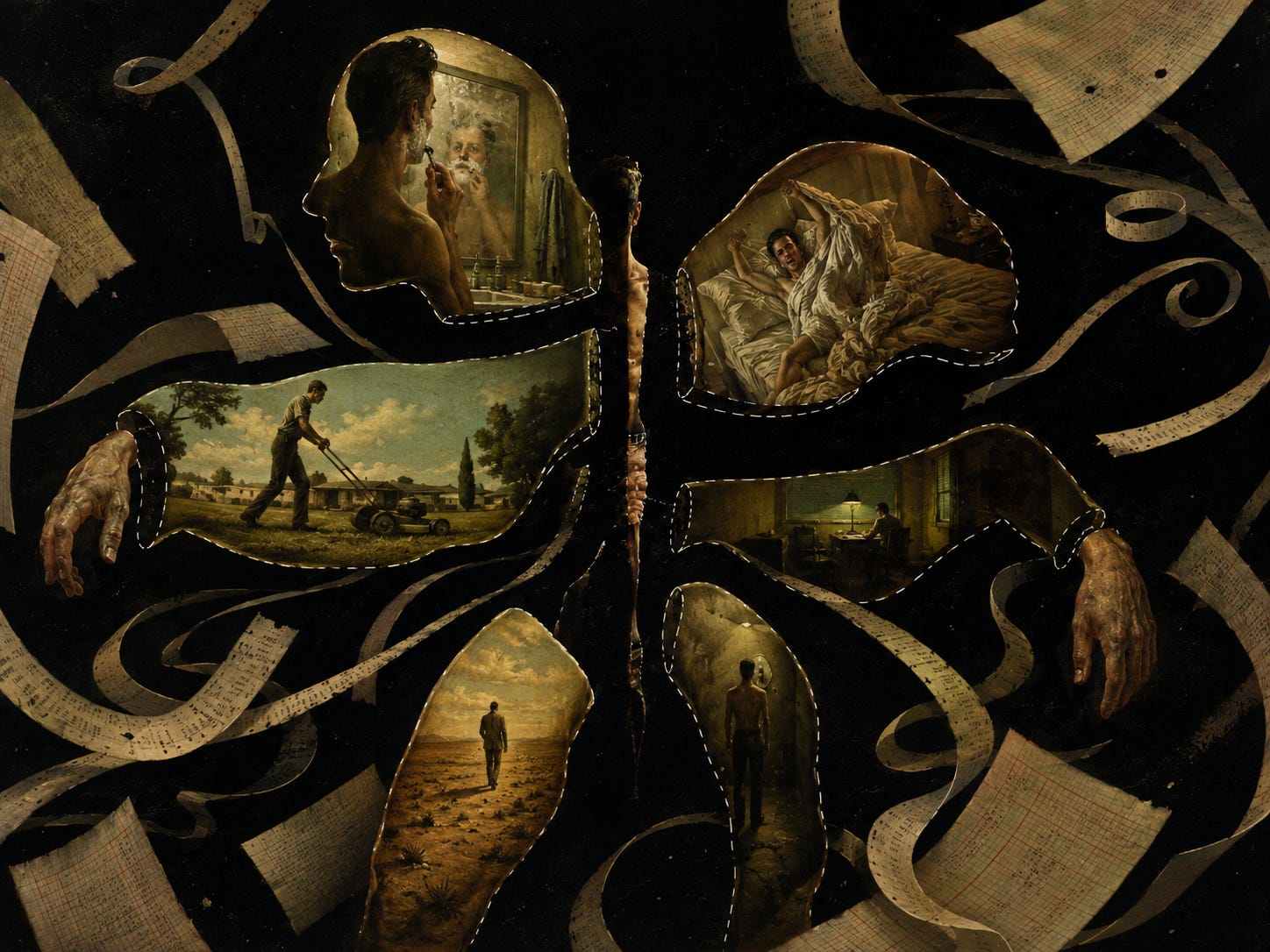
How Many Hours of Your Life Have You Spent Cutting the Lawn?

The gods had condemned Sisyphus to ceaselessly rolling a rock to the top of a mountain, whence the stone would fall back of its own weight. They had thought with some reason that there is no more dreadful punishment than futile and hopeless labor.  Camus

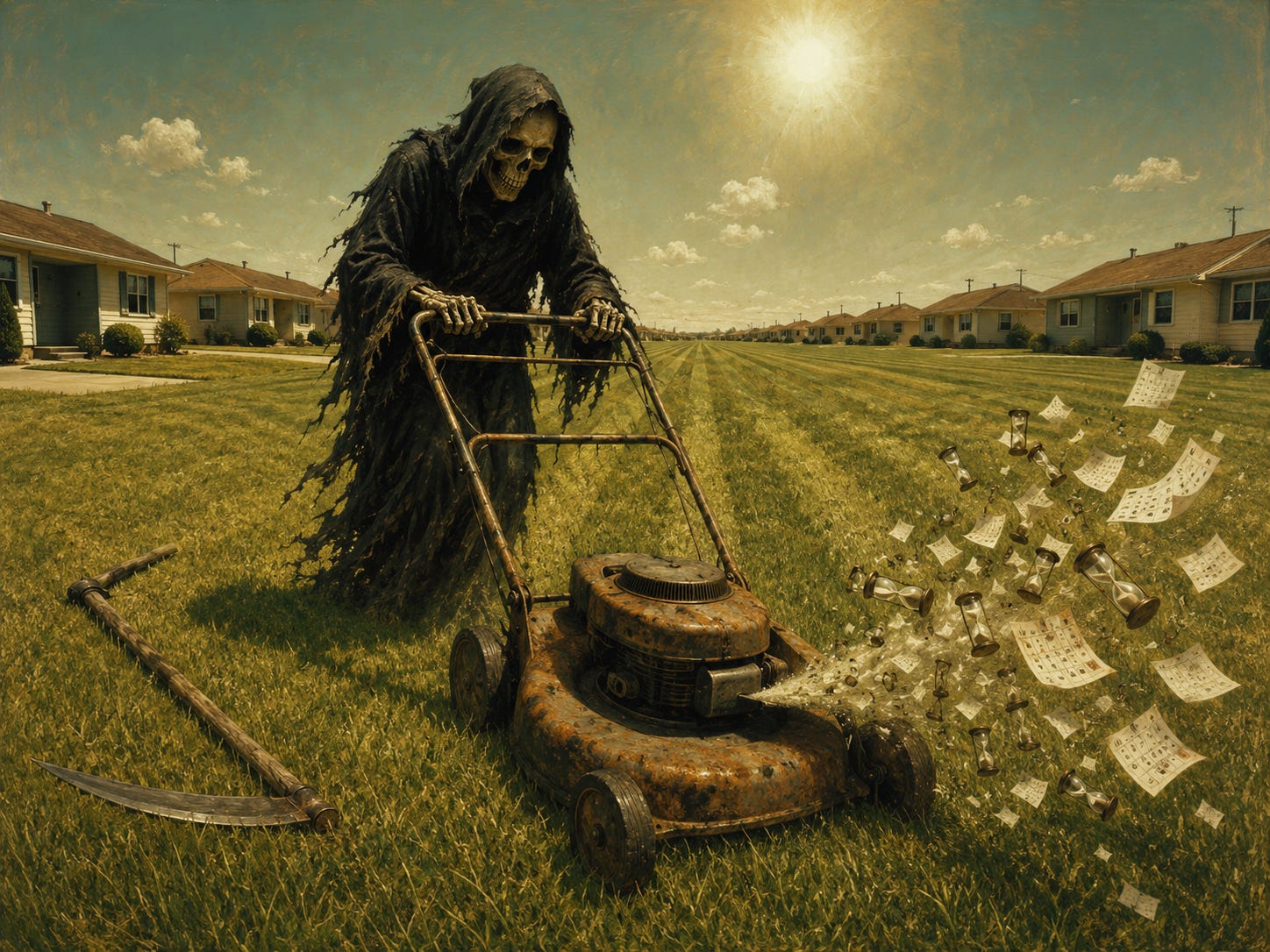
The archetypal resemblance between the Grim Reaper’s scythe and your lawnmower, surely it’s no coincidence the Big D carries a yard tool rather than a metal-detector, .357, or pool cue. To explain the particular, start with the general. Take a step back with Gus Sanders, founder of Segmentarianism. During a Peak Experience (aka Satori) he realized the gods made Sisyphus push a boulder because their mower was in the shop. Based on a great novel.

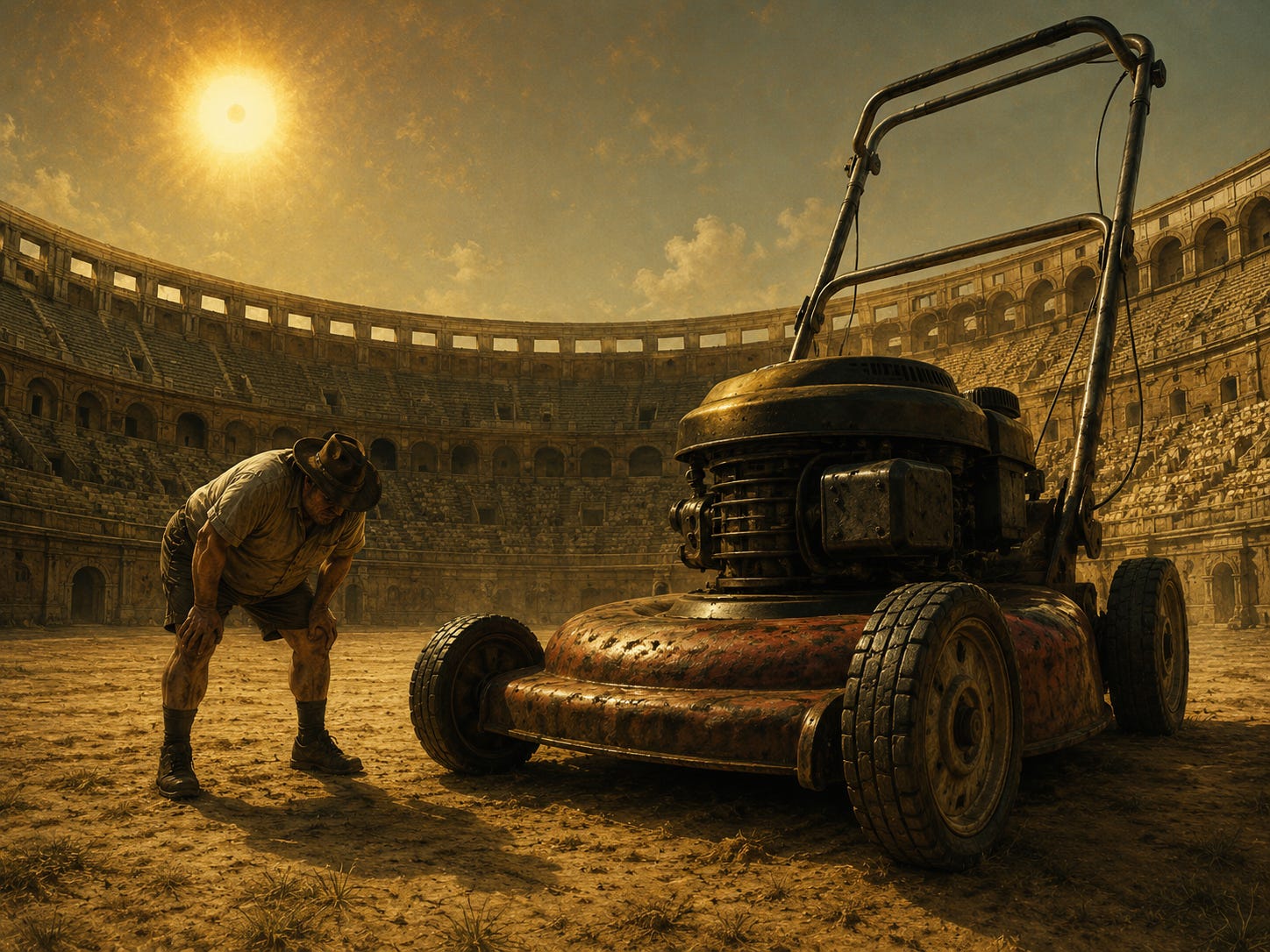
Gus Sanders rested his hands on bulbous knees jutting above black socks and gulped for air. With desperate eyes he sized up his abhorrent foe, his Goliath. Its silence, a snide boast of invulnerability, mocked him more than howls of laughter. Unknown muscles in his shoulder and back twitched. He spat and probed for weaknesses. Then the fifty-sixth attack met the same ignominious fate as its predecessors.

He sought sustenance in Hate, which is not a fickle flame contingent on the fuel of man’s misfortunes but a great wind impelling warriors in all ages. His Aussie slouch hat provided scant protection from the jaundiced eye in the heavens. How many conflicts has it beheld, delighted or appalled but never indifferent. That would be intolerable. If it doesn’t care, who does?

Impervious, the start chord awaited, an Excalibur only the salesman could effectively extract from the LawnMaster Easy-Start Deluxe Mulching Mower. Gus shielded his eyes and looked to the horizon for strength, for perspective. The earth, is it not a vast coliseum?

Rivulets of sweat added a shimmering gloss to what he saw, but they didn’t create it. Certainly an electrolyte deficiency played a role, but not as a sufficient cause. When he attempted to stretch, the crackle from his back was disturbing but extraneous to what followed. Not all enigmatic visions can be dismissed as pathologies. The smug little skeptics who deify first principles forget that philosophic fundamentalism is as inbred and ill-kempt as its bucktoothed religious cousin.

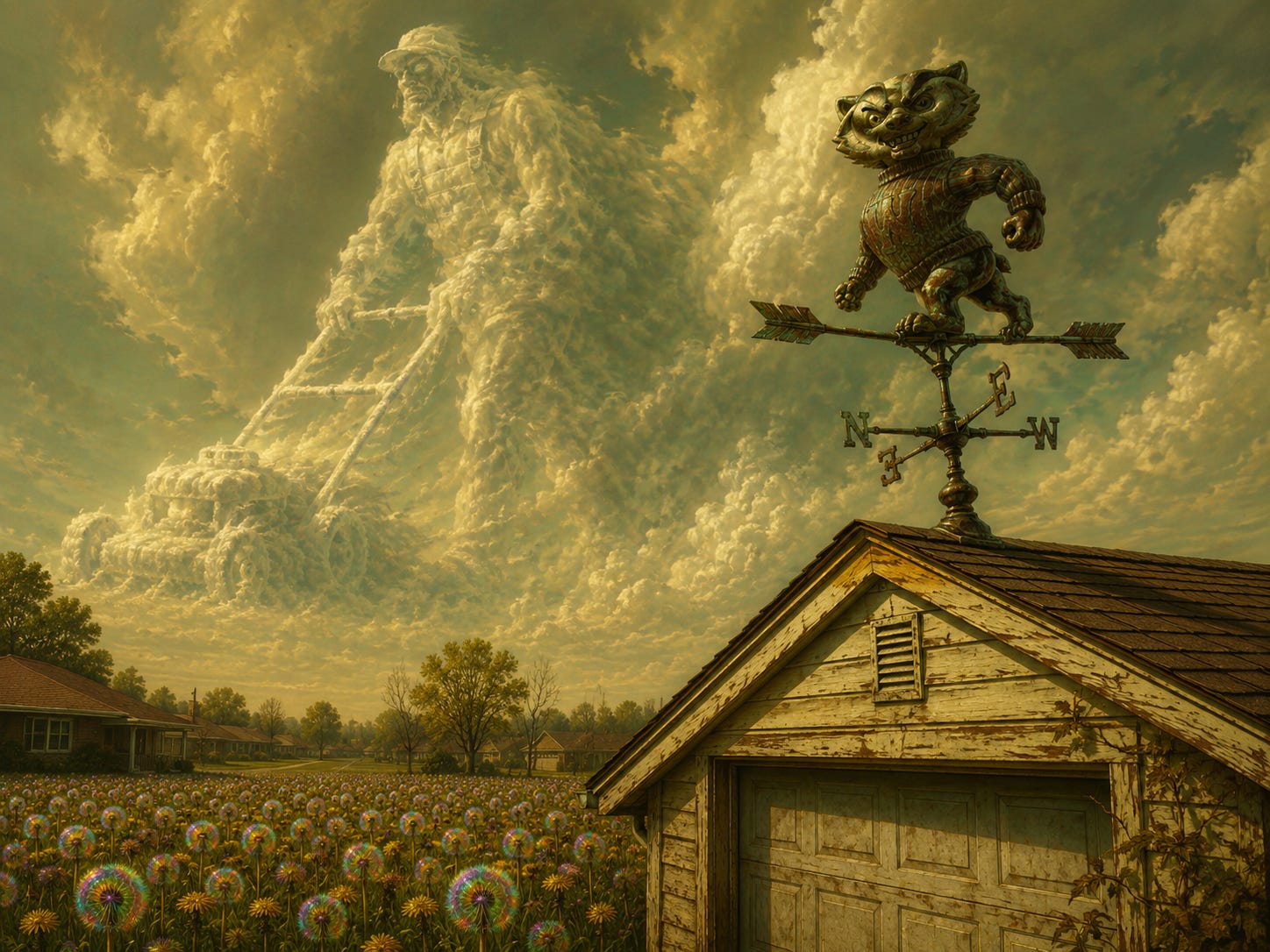
Above a Bucky Badger weather-vane on the garage, cumulus clouds morphed into a ghostly figure pushing a mower across a lawn punctured by iridescent dandelions. He dissolved but the grass remained, as if to ridicule and defile the purpose of his fleeting existence. Gus collapsed. “How many hours of my life have I spent cutting the lawn?” he cried, recoiling from the leprous growth surrounding him.

Mentholated smoke wafted through the den where his wife played Minecraft amid the sonorous thunder of “Song Sung Blue.” “Why don’t you wait until the sun goes down?”

“Because it will be dark then. We’d need to add a guide dog to the other five.” He tottered to the kitchen and poured a gin-and-tonic sans tonic and found a scratch-pad. “Must have started when I was twelve. That’s an hour each week walking behind a deafening machine, choking on exhaust in the scalding sun. Have to do it at least twenty times a year. Forty years times twenty equals … That’s over a month of cutting the lawn non-stop. Look at that segment of my life. Stolen. And I never would have known.”

“Gussy, what are you shouting about? Why don’t we pay one of the neighbor kids to do it?”

“Because cutting the grass isn’t a video game, and we can’t afford the special helmets they need.” He stared at the numbers like a scientist examining a lethal virus through a microscope. “All the evidence is right here. Anyone could have found it. Unless they’re afraid or brainwashed, why haven’t they? Maybe it’s like people stuck in a communist country who have no idea how restricted their lives are.”

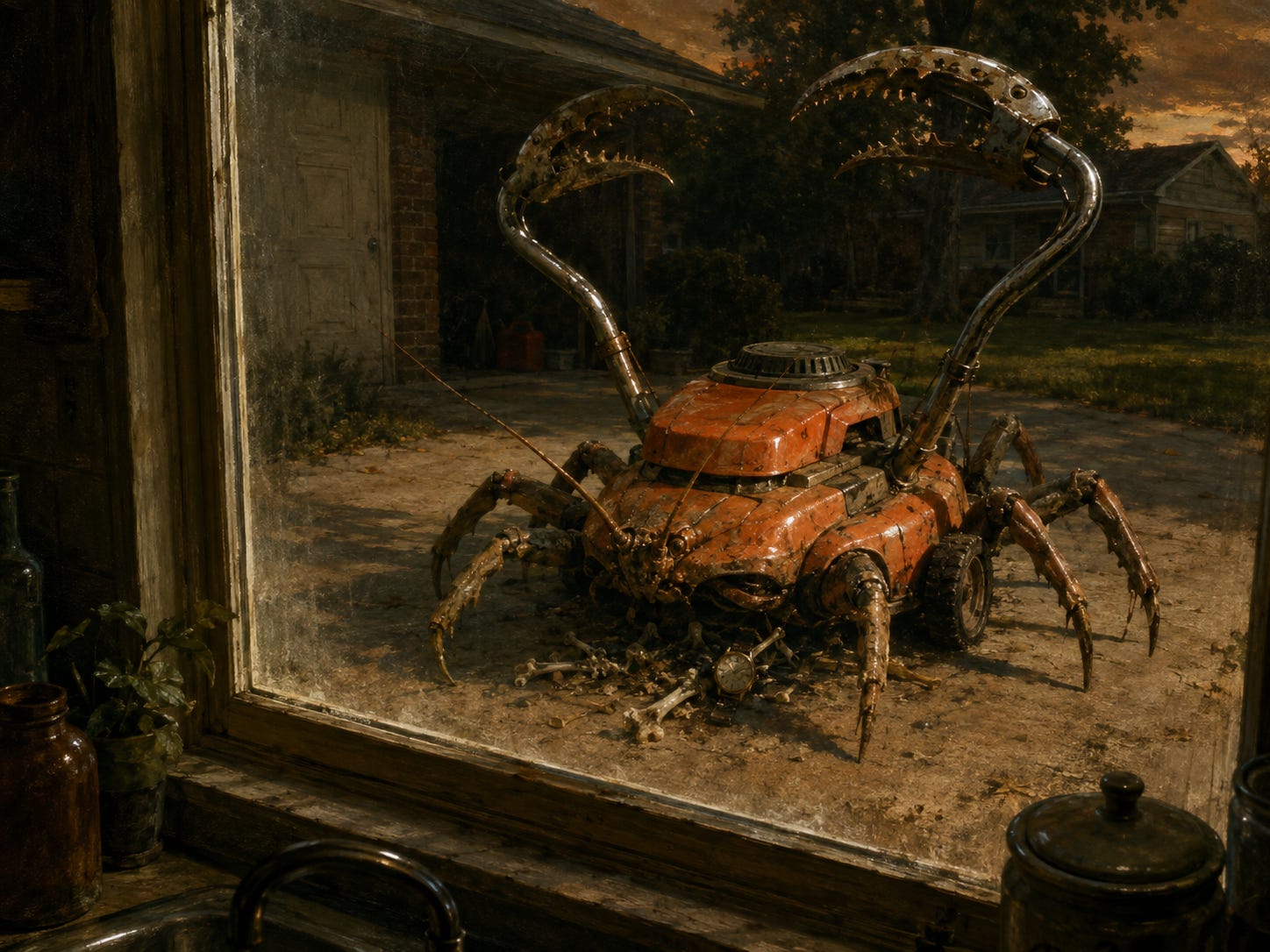
He poured another gin-and-tonic sans tonic and looked out the window at the insidious LawnMaster Easy-Start Deluxe Mulching Mower. Its chrome handle extruded from an orange plastic shell: a monstrous, rapacious crustacean waiting to attack him and devour more of his life. “You’ve been sucking up my time. What sane man would consent to being born if he knew his life would involve an entire month of cutting the grass?”

Propelled by the mysterious dynamism animating all beings, the analysis took on a life of its own. During his weekend shifts, Gus ignored college football, Cops, and even the adventures of Mary Weatherworth to begin a Segmentarian Critique. The calculations were simple to perform, but contemplating the sums proved no less daunting than the observation of crime scene photos. Worse than the outrage was the lack of a culprit.

“Shaving averages out to five minutes a day since I was fifteen. If I live to be eighty that’s … Who would consent to being born if he knew he’d have to spend three months shaving?”

“Tossing and turning in bed is at least four hours a week, which comes to … another twelve months. After all these segments are chopped off, what’s left? And if the government isn’t behind this, who is? It’s too organized and systematic to be a coincidence. Has anyone else calculated it? Maybe this is what pushed John Nash over the edge.”

With the weariness of all lonely soldiers of fortune fighting a war of ideas, Gus wishes his LawnMaster Easy-Start Deluxe Mulching Mower had started on the fifty-sixth try that afternoon. Once you start exposing life to the terrifying clarity of Segmentarianism there is no turning back. Amazing how a happenstance brush with an idea can change a man.

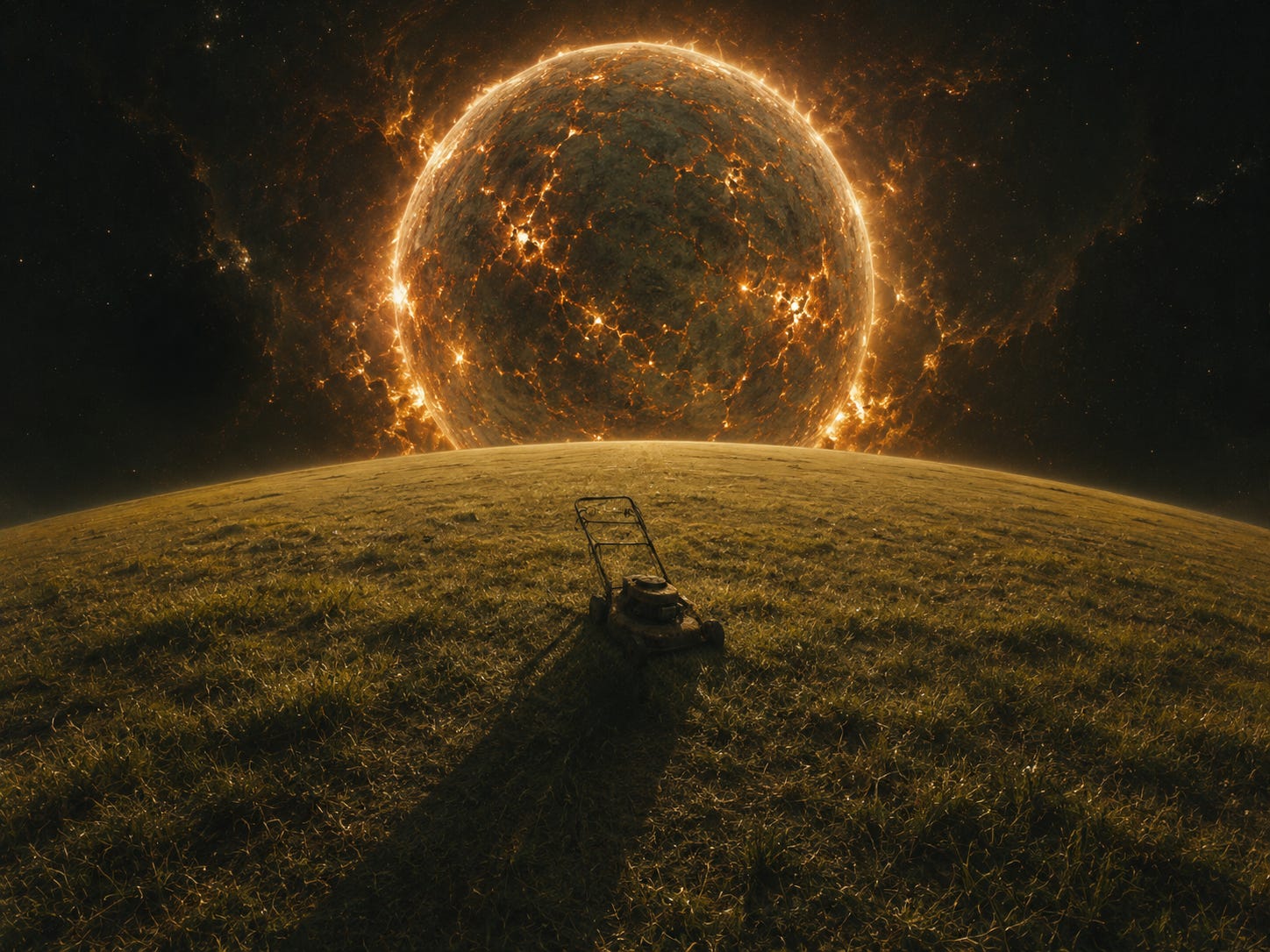
To remedy the Lawnmower Blues, contemplate things less ephemeral than your absurd chore. You, shadow’s dream, change the length of your lawn each week, devoting your fleeting days to glorifications of futility while the gases recently nicknamed the sun remain as chaotic as they were in the Permian. Oblivion is patient; permanence, relative. That even it shall die — this cherub who shone in a wondrous way for billenium — should its mortality bring you comfort, a sense of familial affinity, or despair? If nothing be permanent, then only Nothing is permanent. And ultimately triumphant.

Watchman & The Mystery Box

Shi Tzu, Cosmic Yak Dog

Plato’s Cave? Big Whoop!

Standard
Schrodinger's Dachshund

Modal Firewalls: Why Metaphysics Keeps Telling Explanation to Stop

Metaphysics is usually framed as a debate about what exists, what is fundamental, and what modal structure reality bears. Less often noticed is that it is also a debate about how far explanation is allowed to go. Which “why”-questions remain legitimate as inquiry deepens, and which are dismissed as misplaced, category-confused, or simply one question too far? Where is explanation welcomed, and where is it told to stop?

My claim is that many of these stopping points are not dictated by the subject matter. They are imposed because letting explanation continue would have unwelcome modal consequences. Explanation is permitted to proceed until it begins to harden modal space, align what were supposed to remain independent possibilities, or collapse a protected boundary. At that point, a question is declared illegitimate, a boundary is announced, or a primitive is installed. I call the resulting stopping rules modal firewalls.

The phrase marks a structural phenomenon, not a verdict. A modal firewall is not a theory, still less an argument. It is a way of regulating explanatory scope — determining where explanation may range and where it may not, in a manner sensitive to the modal consequences of explanatory success. Not every explanatory limit is a firewall. Some stopping points are earned. But metaphysics needs a clearer distinction than it often employs between explanatory failure and explanatory prohibition.

The Diagnostic Tests

How do you tell an earned stopping point from a consequence-sensitive one? I propose four tests.

Selectivity. Does the stopping rule appear only where modal consequences threaten?

Reversibility. Would the theorist keep the limit if it no longer protected the modal outcome at stake?

Content versus consequence. Is the explanation blocked because it fails on its own terms, or because too much would follow if it succeeded?

Parallel structure. Does the stopping point occupy the same functional role as clearer historical cases of consequence-sensitive restraint?

None of these is decisive by itself. Their role is burden-shifting, not mechanical. But when stopping rules cluster systematically at modal pressure points, the claim that a given case is “just different” requires argument rather than insistence..assertion.

Explanatory Unity and the Burden of Stopping

To identify a stopping point as a firewall, you need a methodological background. Otherwise every stopping point looks like one more harmless feature of practice. The background I propose is explanatory unity: the scope of explanation should be determined by explanatory success rather than blocked in advance by domain membership or modal policy.

This is weaker than it sounds. It is not reductionism, not monism, and not the Principle of Sufficient Reason. You can allow that some facts are brute and that explanation legitimately bottoms out. The claim is narrower: explanatory termination should not systematically coincide with modal boundaries without further account.

From this follows a central methodological consequence: there is a burden of stopping. When explanation halts because it fails — circularity, vacuity, loss of illumination — no special defense is needed. But when explanation halts despite remaining intelligible and continuous with practice elsewhere, the restriction demands justification.

Why should continuation enjoy a default privilege over restraint? Because the two cases have different justificatory structures. Explanatory success has internal credentials: it illuminates, it unifies, it reduces arbitrariness, it renders intelligible what was previously opaque. These can be assessed by standards internal to explanation itself. Explanatory restriction requires a rationale external to the explanation being restricted. When we reject an explanation because it is circular, we cite a feature of the explanation. When we block an explanation because its success would collapse contingency, we cite a feature of the consequences. The asymmetry is not between explanation and silence. It is between assessment and prohibition. Assessment evaluates an explanation by what it does. Prohibition overrides an explanation by what it would imply.

Aquinas: a Sharply Visible Firewall

Aquinas is one of the clearest historical cases because his explanatory ambitions are so substantial and his stopping point so precise. Creatures are rendered intelligible through exemplar causation in the divine intellect; the divine intellect is rooted in the divine essence; and the divine essence is necessary. Up to this point, explanatory ascent is not only permitted but encouraged.

Then something interesting happens. If explanation were allowed to continue under the same pressure, the necessity of the divine essence would propagate to creation itself. The modal status of the source would fix the modal status of what proceeds from it.

Aquinas’s response is to insert a highly specific stopping point. Explanation runs through the divine essence, but does not determine the divine willing of this created order. God necessarily knows all possibles, but does not necessarily will any particular creation. The will performs a structural task: it marks the point where explanatory ascent is restrained in order to preserve the contingency of creation.

The diagnostic tests apply cleanly. The stopping point is selective — explanation is welcomed until divine necessity threatens to globalize. It is reversible — if divine essence did not threaten to necessitate creation, the volitional cutoff would lose much of its point. And it is consequence-sensitive — the issue is not that the explanatory route suddenly becomes unintelligible, but that allowing it to complete would yield a modal result the system is unwilling to accept.

An important caveat: Aquinas does not present divine will as an ad hoc device. It is a first-order theological commitment with deep independent roots. That matters. A modal firewall need not present itself as a reactive patch to function as one. The philosophically interesting cases are often the ones where a stopping point is independently motivated and still performs unmistakable modal work.

(Why Necessary Foundations Can’t Produce Contingent Worlds – And What This Means for Classical Theism)

The War of the Firewalls: Thomists and Molinists

If Aquinas gives us a sharply visible firewall, Molina shows what happens when one firewall generates pressure for another.

The Thomistic cutoff blocks necessity from propagating to creation. But it leaves a residual difficulty: if divine willing is where contrastive selection becomes terminal, how is providential governance through free creaturely action to be understood? Molina’s answer is scientia media — middle knowledge — a tier of truths concerning what free creatures would do in specified circumstances, known by God prior to the decree and yet not grounded in the decree, in creaturely existence, or in the necessities of nature.

Molinist counterfactuals occupy a highly specific modal niche. They are determinate, truth-apt, contingent, and pre-volitional. Not grounded in God, not in creatures, not in essences. The truths simply obtain. That is not an accidental gap. It is the point of the construction.

In Aquinas, the firewall is localized in divine agency, and the dignity of the will helps it look principled. In Molina, the engineering is harder to miss. A bespoke class of truths is introduced to do exactly the work the prior firewall could not, while itself being insulated from further explanation. One firewall has generated residual pressure, and a second is built to manage it.

This is why the dispute over middle knowledge is so revealing. Adams’s classic complaint captures the structural issue precisely: middle knowledge requires truths that are determinate enough to guide providence while floating free of any acceptable explanatory ground. The disagreement is not between a view with firewalls and a view without them. It is a disagreement over the location of bruteness. The Thomist regards free-floating modal facts as intolerable; the Molinist regards bare volitional cutoff as explanatorily incomplete. Each treats the other’s residue as unacceptable while defending its own as principled.

Leibniz: the Pressure Made Explicit

These theological cases are not historical curiosities. They are clear instances of a structural problem that reappears whenever explanation is powerful enough to threaten contingency. (See also Plato, Aristotle, and Plotinus.) Leibniz makes the point vivid because he names the threat directly.

Leibniz accepts the Principle of Sufficient Reason without restriction. Everything has a reason. God acts for a reason — specifically, God creates the best of all possible worlds because it is the best. The explanatory chain from divine perfection to this created order is allowed to close in a way Aquinas’s volitional cutoff was designed to prevent. But this immediately generates exactly the pressure the diagnostic framework predicts: if God necessarily exists, and if God’s perfection necessarily selects the best world, then the best world is necessarily actual. The result is Spinozism — the view Leibniz spent considerable energy refusing.

Leibniz’s response is the distinction between moral necessity and metaphysical necessity. God is morally necessitated to choose the best — inclined, as the famous formula has it, without being necessitated. The best world is certain but not strictly necessary, because its negation does not imply a contradiction. This is a firewall in explicit form. It is installed at exactly the point where the explanatory PSR engine would otherwise harden contingent truths into necessary ones. And it takes the characteristic shape: not a denial that explanation succeeds, but a distinction introduced to prevent that success from propagating modal status across a boundary.

What makes Leibniz such a useful bridge is that his problem is no longer theological in any essential way. Strip away God and the best of all possible worlds, and the underlying structure remains: when explanatory relations hold necessarily, and when the explanatory source is itself necessary, the explained threatens to inherit necessity. That is not a problem about divine will or providence. It is a problem about explanation, necessity, and how they interact. The same structure reappears, in secular dress, wherever contemporary metaphysics deploys grounding, essence, or modal logic.

Grounding: Explanation with a Kill Switch

Grounding presents itself as an especially ambitious mode of metaphysical explanation: derivative reality is intelligible through the more fundamental. But if grounding is genuinely explanatory and holds with necessity, whatever is grounded begins to inherit the modal profile of what grounds it. At scale, a world articulated by grounding threatens to become one where modal slack has been squeezed out of derivative domains.

The response among grounding theorists is rarely to deny that grounding explains. What changes are the restrictions on what grounding is allowed to imply. Some deny it transmits necessity; some distinguish grounding explanation from modal explanation; some multiply kinds of ground. These moves may have independent motivations. The structural point is that they cluster where grounding threatens to do too much. Grounding is not curtailed because it ceases to illuminate. It is curtailed because, left unqualified, it threatens to harden modal space.

It is, in that sense, explanation with a kill switch.

The reversibility test sharpens the point. Would grounding theorists feel the same need to distinguish grounding from modal inheritance if grounding did not threaten to transmit modal profile from base to derivative? The pressure to introduce these distinctions clearly intensifies where grounding begins to look metaphysically totalizing. That is enough to shift the burden.

(How Contemporary Metaphysics Concocts Slack)

Essence: The Quietest Firewall

If grounding’s terminus looks exposed, essence offers a way to make it appear less brute. Essences can underwrite grounding’s asymmetry while also supporting modal explanation more generally. What is possible or necessary is so because of the essential nature of things.

But that just relocates the pressure. If essence explains necessity, one can ask why these essences rather than others. The familiar response is that “why this essence?” is simply the wrong sort of question.

Sometimes that may be right. But structurally the pattern is familiar: explanation is generously permitted up to the level of essence, and then the boundary hardens at exactly the point where continuation would destabilize the terminus doing the modal work. Essence is the quietest firewall. It does not announce itself as protective. It looks like the natural shape of the subject matter. That is precisely why it matters.

Modal Collapse and the Explicit Firewall

Everything above involved firewalls that were at least partly implicit. Reactions to modal collapse bring the pattern into a different light. Here the firewall becomes explicit.

Collapse is what happens when necessity is allowed to propagate too far. The clearest case is Gödel’s ontological proof. Gödel defines God as a being possessing all positive properties and, working in a higher-order modal logic, derives the necessary existence of such a being. The proof is valid. The problem — from the standpoint of nearly every commentator — is what else it entails. Sobel showed in 1987 that Gödel’s axioms yield modal collapse: every truth turns out to be a necessary truth. If God necessarily exists and necessarily possesses all positive properties, and if the system permits property abstraction of the relevant kind, then every actual state of affairs inherits necessity. Nothing could have been otherwise.

What matters for the present framework is the reaction. Sobel does not treat this as an unsettling but potentially revealing result about the structure of modal reality. He treats it as a refutation. The system must be flawed, he concludes, because it leads to necessitarianism. The conclusion is not assessed on its philosophical merits. It is declared intolerable in advance. Modal collapse functions not as a discovery but as a diagnostic — a sign that some axiom needs to be revised so that the result cannot go through.

The subsequent literature confirms the pattern. Benzmüller and Woltzenlogel Paleo’s automated verification of Gödel’s proof is revealing not merely because it confirmed Sobel’s collapse result computationally, but because it maps with formal precision the points at which the derivation must be interrupted if collapse is to be avoided. Anderson, Fitting, and others have proposed modified axiom sets designed to preserve as much of Gödel’s structure as possible while blocking exactly the step that generates global necessity. The engineering is precise and targeted. It is not a wholesale rejection of the proof’s framework. It is a surgical intervention at the point where necessity would propagate beyond its intended home.

That reactive character is what makes modal collapse the natural culmination of the post’s arc. Aquinas’s cutoff is a first-order commitment that also performs modal work. Essentialist primitivity is presented as a metaphysical insight into whatness. Collapse-avoiding revisions in formal modal settings are harder to portray as innocent reports about the nature of the subject matter. They arise at the precise point of derivational pressure and are tailored to it. The timing is too exact, and the calibration too fine-grained, for the protective function to remain obscure.

This is the case where the firewall becomes explicit enough to illuminate the rest.

The Shape of the Contest

What follows from all this?

Metaphysical disagreement is often misdescribed when framed solely as disagreement about first-order modal status. Again and again, the decisive question turns out to be whether explanation may continue once its success begins to harden modal space.

Aquinas’s appeal to will, Molina’s appeal to middle knowledge, Leibniz’s moral/metaphysical distinction, grounding-theoretic qualification, essentialist refusal of “why this essence?,” and collapse-avoiding formal revisions are not wholly local maneuvers from unrelated subfields. They exhibit a common structure. Explanation is welcomed where it illuminates local dependence and restrained where its continuation would align modal profiles across a protected boundary. What differs is the location of restraint, the vocabulary of defense, and the kind of modal surplus being preserved.

The framework does not settle every case automatically. Some stopping points may be genuinely earned. The point is more modest and more durable: it shifts the burden. Once stopping rules cluster at modal pressure points, it is no longer enough to announce that explanation ends here. One must show why it ends for explanatory reasons rather than protective ones.

The contest, then, is not between innocent contingency and revisionary necessity. It is between two pictures of explanation. On one, explanation forms a single space of reasons whose reach is determined by intelligibility, and fragmentation requires justification. On the other, explanatory reasons divide exactly where modality does, and the pattern is accepted as primitive.

Sometimes metaphysics stops explanation not where it fails, but where it becomes too successful.

Branching Actualism as a Modal Firewall

Necessity, Shadow of Reason

Standard
Schrodinger's Dachshund

Why Explanation Always Wins: Necessity as the Shadow of Reason

There is a recurring mistake in metaphysics: treating explanation as one theoretical option among others, rather than as a pressure that any theory must answer to. Views are compared, virtues tallied, intuitions balanced. But explanation is not a preference. It is a constraint. And over time, it always asserts itself.

This is why explanation “wins.” Not because it settles every dispute, but because anything that refuses to answer to it gradually loses its grip on intelligibility.

From the beginning, philosophy has been animated by a simple demand: Why this rather than that? Once that question is taken seriously, it does not stay politely confined. It propagates. Each explanation invites another. Each stopping point calls attention to itself. And every attempt to halt the process leaves a residue that demands justification.

That residue is where contingency lives.

Contingency as unfinished business

Contingency is often presented as the natural state of affairs. The world could have been otherwise; some things just happen to be the way they are. Necessity, by contrast, is treated as an imposition: something that needs special argument, theological backing, or modal machinery.

This picture reverses the actual dialectic.

Contingency is not what remains when explanation is complete. It is what remains when explanation is interrupted. To say that something could have been otherwise is not to explain why it is as it is. It is to gesture at an absence of explanation and treat that absence as a feature of reality rather than as a task left undone.

This is why contingency so often travels with words like brute, primitive, or basic. These are not explanations. They are labels we attach to places where explanation has been asked to stop.

The persistence of explanatory pressure

The pressure to explain does not disappear when it is resisted. It goes underground.

When metaphysical systems install stopping points—whether in the form of brute facts, domain restrictions, grounding termini, or weakened modal principles—they do not dissolve the explanatory demand. They defer it. The question “why this rather than that?” is not answered; it is declared inadmissible.

Declaring a question inadmissible is not the same as making it irrelevant.

This is why philosophical debates keep returning to the same fault lines. Why these laws? Why this structure? Why this fundamental base rather than another? Each time, the temptation is to say: because that is where explanation ends. And each time, the reply is the same: why there?

Explanation keeps pushing. Not because philosophers are obstinate, but because intelligibility is unstable. Once it is introduced, it spreads.

Firewalls and their fate

Modal firewalls are the devices by which this spread is managed. They are not mistakes. They are coping strategies.

Ancient metaphysics built firewalls out of levels, substances, and emanations. Modern metaphysics builds them out of methods, domains, and formal distinctions. In both cases, the goal is the same: to preserve intelligibility without allowing it to collapse into necessity.

The reason these devices proliferate is not that explanation is weak, but that it is strong. If explanation were harmless, it would not need to be disciplined. Firewalls are installed precisely because explanation threatens to do too much.

And yet, firewalls are always temporary. They require constant maintenance. They generate boundary disputes. They invite exceptions, refinements, and ever more careful statements of scope. Over time, the structure becomes baroque—not because philosophers enjoy complexity, but because the pressure they are resisting does not go away.

Explanation keeps finding ways around the barriers.

Why necessity keeps returning

This is why necessity has such a stubborn afterlife in metaphysics. It is not smuggled in by theologians or rationalists. It reappears whenever explanation is allowed to run without restraint.

If something is fully explained—if nothing about it is left hanging—then no intelligible reason remains for it to be otherwise. Necessity is not added at the end; it is what explanation leaves behind when it finishes.

This does not mean that necessity is obvious or comforting. On the contrary, it is often unsettling. It threatens freedom, variety, and the sense that things might have gone differently. That threat is real. But it is not a refutation. It is a consequence.

And consequences do not disappear because we dislike them.

The real choice

Once this is clear, the landscape shifts.

The fundamental choice in metaphysics is not between necessity and contingency. It is between two attitudes toward explanation:

  • Allow it to finish, and accept where it leads.
  • Stop it deliberately, and explain why stopping there is justified.

The first path leads, again and again, toward necessity. The second leads to firewalls, pluralisms, and a carefully managed ignorance.

They are not on equal footing.

Explanation does not need permission to continue. It needs a reason to stop.

Until such reasons are given—rather than assumed—necessity will continue to reassert itself, not as a dogma, but as the shadow cast by intelligibility taken seriously.

Explanation always wins because it never gives up. It can be delayed, redirected, or constrained, but not neutralized. Every attempt to contain it testifies to its force. And every generation that rediscovers that force finds itself facing the same uncomfortable realization:

If explanation is allowed to finish its work, contingency does not survive.

That is not a failure of metaphysics.

It is its oldest result.

Ancient Modal Firewalls

Aquinas and the Modal Firewall

The Modal Firewall Around Gödel

Standard
Schrodinger's Dachshund

Modal Firewalls: Why Contingency Is Doing Less Work Than You Think

Philosophers love necessity and contingency. Some things must be the case (mathematical truths, the laws of logic). Other things just happen to be the case (the number of planets, whether you had coffee this morning). This distinction is load-bearing. It’s not just a classification. It’s meant to tell us where explanation can and cannot go.

Necessary truths can explain things, but we don’t get to ask why they obtain. They’re the stopping points. Contingent truths, meanwhile, float free: they could have been otherwise, and that’s that. The modal classification does double duty. It describes the world and regulates inquiry.

This picture hides something important.

The Pattern

Look at how explanation actually works across different domains:

  • Mathematics constrains physics. Certain physical states are ruled out because they’d violate mathematical truths. We don’t treat this as mysterious. It’s just how things work.
  • Normative facts constrain rationality. That an action would be unjust explains why it’s not a genuine rational option. Again, no mystery.

In both cases, facts from one domain (mathematics, normativity) reach into another domain (physics, rational agency) and do explanatory work. We accept this without fuss.

But now try the reverse. Can physical facts explain why certain mathematical structures are realized? Can contingent features of the world explain anything about necessary truths? Here, philosophers balk. That direction of explanation is blocked.

Why? Not because anyone has shown that such explanations would be incoherent. Not because they’d fail to illuminate. The reason, when you push on it, is usually just modal: necessity can constrain contingency, but contingency can’t constrain necessity. The direction of explanation tracks the modal hierarchy.

The Firewall

I call this pattern a modal firewall. It’s a restriction on explanatory scope that’s justified by modal status rather than by anything about explanation itself. The firewall doesn’t show that a candidate explanation would fail. It rules the explanation out of bounds before we even try.

Here’s the structure:

1) Eligibility: The blocked explanation would, by ordinary standards, be perfectly intelligible.

2) Modal restriction: It’s excluded because of the domain-relative modal status of what’s being explained.

3) No independent grounding: No explanation for the modal boundary. It’s taken as given.

Firewalls aren’t arguments. They’re policies. And once you see them, you see them everywhere. Paging Gödel.

Why This Matters

The problem isn’t that explanation has to be unlimited. Some explanations fail; some inquiries terminate. That’s fine. The problem is how the limits are drawn. If a stopping point is justified by demonstrating that further explanation would be incoherent, circular, or regressive, fair enough. But if it’s justified by pointing at a modal classification and saying “Here be contingency!” That’s not an explanation of the limit. It’s a label for the limit.

This matters for the contingency/necessity debate because contingency is often sold as metaphysically innocent. The necessitarian (someone who thinks everything is necessary) is supposed to be the one with the weird, revisionary view. But if contingency’s main job is to license unexplained stopping points in our explanatory practices, that innocence starts to look questionable.

Contingency often ends up doing the kind of work apologetics does: protecting a doctrine by declaring certain questions out of bounds.

A Different Approach

The alternative I develop is what I call explanatory unity: let explanation go where it succeeds, and stop where it fails, without giving modal classification independent authority to police the boundaries. Domain differences might shape how we explain, but they don’t get to determine that explanation must stop.

This isn’t a commitment to explaining everything. It’s a commitment to earning your stopping points rather than inheriting them from a modal map drawn in advance.

Does this vindicate necessitarianism? Not directly. But it shifts the burden. If you want to say that contingency limits explanation, you need to explain why—not just assert that it does.

The Garden Without Forking Paths

Standard
Schrodinger's Dachshund

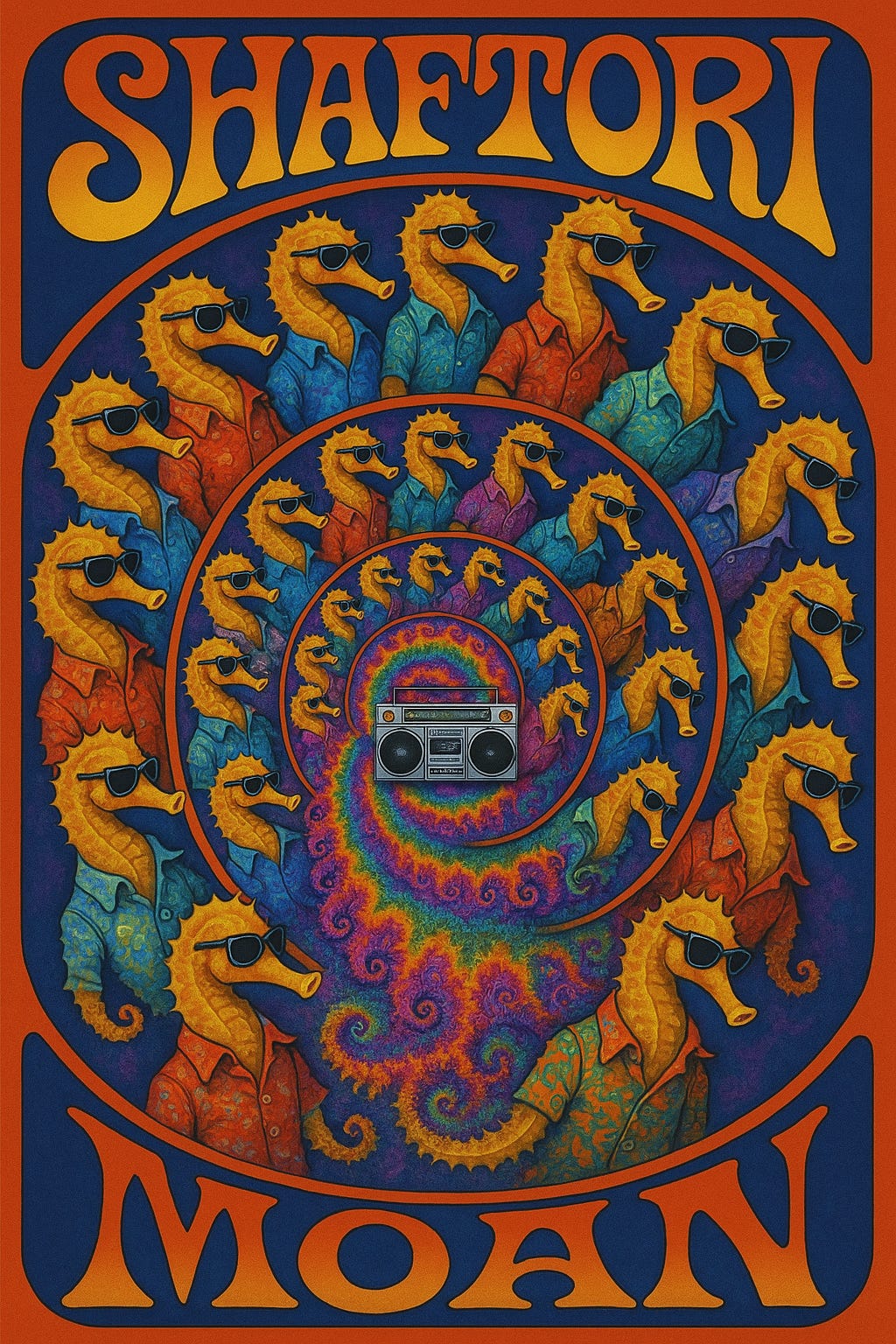
Shaftori and the MOAN

A Modal Ontological Argument for Necessitarianism and its Mystical Origin

Late last year Petronius Jablonski experienced Shaftori: Enlightenment from the 45 RPM of Isaac Hayes’ “Shaft” played at 33 RPM. Like Parmenides’ descent to the halls of Night, his journey was part metaphysical reasoning and part mystical initiation. The stone-cold groove reduced him to a nanoscopic seahorse adrift in a measureless mega-fractal, absurd and sacred, tiny beyond reckoning yet somehow required, a necessary syllable in an infinite and pitiless scripture.

He returned with original and definitive proof of Necessitarianism: the thesis that whatever is true couldn’t have been otherwise, that nothing about reality could have been different in any way whatsoever. The result vindicates Necessitarianism and proves that he, like Parmenides, has been behind the veil.

In the structure of the Mandelbrot set there’s a region where the filaments branch into forms that look distinctly like little seahorses. Mathematicians call it the Seahorse Valley. Zoom-ins show repeating spirals whose shapes resemble the curled tails and bodies of seahorses.

Note well: this is not the work of some brilliant mathematician lovingly designing seahorses. This is a necessary feature of the Mandelbrot set with no contingency or design at all. Why does it exist? It couldn’t not exist and there’s an end of it.

Jablonski’s epiphany is that all reality is like this. And he can prove it.

Standard
Schrodinger's Dachshund

Beyond the Metaphysical Middlemen

A Rationalist Case for Absolute Monism

From Plotinus to classical theism to Spinoza, philosophers have posited a supreme metaphysical entity—the One, God, or Substance—to ground reality and explain existence. This post argues that the very distinctions these systems depend upon collapse under sustained rationalist scrutiny. By applying the Principle of Sufficient Reason (PSR) rigorously, I demonstrate that all three major frameworks—Plotinian emanation, Spinozistic necessitarianism, and Thomistic theism—contain fatal explanatory gaps. The only position that survives this collapse is monism: reality is necessary and one, without intermediary beings, divine personhood, metaphysical hierarchy or modal hooey. What remains is not God, but simply what is.

I. Mapping the Metaphysical Landscape

Before dismantling these systems, we must understand their architecture. Consider three major positions on a spectrum of explanatory density:

Plotinus’ One — beyond being, beyond intellect, overflowing without self-determination.

Classical Theistic God — metaphysically non-composite, timeless, immutable, impassable, and freely creating.

Spinoza’s God — absolutely infinite substance determined solely by its own essence; nature is necessity.

The tensions lie in how each answers (or refuses to answer) the rationalist’s question: ‘In virtue of what?’

1.1 Ontological Status: Being, Beyond-Being, or the Only Being

Plotinus’ One — literally not a being, not even an entity. Radically simple: no internal structure, no attributes, no parts, no thought. All positive description is metaphor; the One is what the intellect sees when it stops trying to articulate. The One is uncaused, not by necessity but by transcendence.

Classical Theistic God — a supreme being, perfect, personal, omniscient, omnipotent. God has attributes (even if simple in scholastic metaphysics). God wills, knows, loves, judges; creation is a free act. God is both intellect and will.

Spinoza’s God — being itself, the one infinite substance with infinite attributes. Not a person; not a transcendent source; not outside the world. Nature equals God equals the necessary structure of reality. All distinction collapses into modes of the one substance.

Comparative snapshot: Plotinus offers the beyond; classical theism offers a supreme being; Spinoza offers the only being.

1.2 Causation: Emanation, Volition, or Necessity

Plotinus — causation is emanation: the One overflows into Intellect, which overflows into Soul. The One cannot do otherwise, but not because of inner necessity; more like metaphysical pressure.

Classical Theism — causation is free creation ex nihilo. God might have chosen otherwise; creation is not necessary.

Spinoza — causation is strict necessity: from the necessity of the divine nature infinite things follow. No choice, no contingency.

Thus we have: Plotinus offering spillage, theism offering choice, and Spinoza offering necessitation.

1.3 Intelligibility Under PSR Pressure

Here the Parmenidean lens does its devastating work.

Plotinus — The One is beyond intelligibility. You cannot say why the One emanates; you cannot even say why it is what it is. This violates the strong PSR: the One is precisely the sort of brute posit the rationalist cannot allow.

Classical Theism — God freely chooses creation, freely wills certain goods, freely permits evil. Each free decision creates pockets of brute contingency. The rationalist asks: In virtue of what does God choose this world rather than another? No answer preserves classical divine freedom without violating PSR. Result: classical theism stands on voluntarist bruteness.

Spinoza — Spinoza preserves the PSR absolutely. No brute facts, no free divine choices, no transcendent will. God is the necessity of being itself. Result: maximal intelligibility.

Summary: Plotinus fails rationalist intelligibility (beyond being and explanation); theism fails it (arbitrary divine free will); Spinoza appears to satisfy it (necessity all the way down).

But does Spinoza survive deeper scrutiny? (“Proofs of God’s Existence? Paging Spinoza! And why not even he can help you.”)

II. The Positive Case: Why Bare Monism Surpasses All Middle-Beings

Now we proceed to the core argument. Why add a special metaphysical entity—Plotinus’ One, Spinoza’s God, or classical theism’s Pure Act—when you can have the explanatory power without the metaphysical inflation? This section presents eight independent arguments for bare monism over any divine intermediary.

2.1 The PSR Eliminates All Distinctions—Including God

The most devastating argument comes from applying the PSR consistently. If every distinction requires an explanation, then the distinction between God and world, between God’s essence and activity, between modes and substance, between the One and its emanations, between Pure Act and creation—each needs justification. But any justification introduces more distinctions, requiring further justification. This is Bradley’s regress applied to theology.

The only stable resting point is no distinctions at all. That means no God/world distinction, no intellect/extension distinction, no essence/existence distinction, no emanation hierarchy. Once all distinctions collapse, what is left? Just Being as such, full stop.

Plotinus tries to resolve the regress by pushing the One beyond being, making it uninterpretable. Spinoza tries to resolve it by allowing infinite attributes. Classical theism tries with negative theology and divine simplicity. All fail because distinction itself is the problem. The PSR favors pure monism over any conception of God.

2.2 Explanatory Economy: Any God Adds Mystery Rather Than Removing It

Plotinus adds a One that we cannot describe but which somehow emanates Nous and Soul. Spinoza adds a God with infinite attributes, only two of which humans know. Classical theism adds a pure act that is totally simple yet somehow contains intellect, will, and the ground of all modal truths. All three introduce highly specific, explanatory-heavy, ontologically ambitious entities.

But none of these entities explains anything that bare monism does not already explain. If the question is ‘Why is there something rather than nothing?’, the honest answer is: Because there cannot be nothing. The existence of being requires no explanation; nonbeing does. To add a God is to duplicate necessity: necessary being (God) plus the necessary existence of that being. Whereas pure monism says: Being is necessary; nothing else exists to explain. No additional entity is needed.

2.3 The Problem of Explanatory Elites

Every divine monism contains the same hidden assumption: there must be one special kind of thing that grounds everything else. But introducing a special category, a metaphysical elite, is inherently unstable under the PSR. Why should the One have the power to cause Nous? Why should Spinoza’s Substance have infinite attributes rather than one? Why should pure actuality have the will to create anything? Each of these attributes is unshared, primitive, unexplained. They violate the very explanatory scruples they seek to defend.

Pure monism says: there is no metaphysical aristocracy, no special status, no elite being. Just what is, without hierarchy. This is the most stable position from an anti-arbitrariness standpoint.

2.4 The Metaphysical Middleman Is Illusion

Consider each supposed function of God:

Unity/Explanation: Does God unify things? No more than monism itself does.

Necessity: Is God supposed to be the necessary ground? But necessity does not require a bearer. It simply means: cannot be otherwise.

Causation: Is God needed as cause? In a monistic system, cause is just the structure of being itself.

Order/Rationality: Is God needed as architect? No more than geometry needs a designer.

Value/Goodness: Plotinus and Aquinas load the Absolute with normative weight. But monism says: value is a projection; being is neutral.

What God is supposed to do, monism does.

2.5 God Is Just a Hypostatization of Necessity

At bottom: Plotinus’ One equals unity, Spinoza’s God equals necessity, classical theism’s God equals pure actuality. All three equal the necessary structure of reality. But then why anthropomorphize necessity? Why personify unity? Why not say directly: Reality is necessarily one. Period.

Everything else is mythologizing necessity. God is the reification of an abstraction. Necessity itself does not need to be pinned on an entity.

2.6 Why Philosophers Keep Inventing the Middle-Being

Why do even rigorous rationalists insert a metaphysical middle-being when their systems do not need it? Several explanations present themselves:

Fear of Metaphysical Nakedness: Bare monism is austere and offers no comfort: no higher being, no metaphysical parent, no intelligence behind order, no source of meaning, no providence. Even rationalists hesitate to say: Reality just is. It explains itself. There is nothing above it or below.

Cognitive Bias for Hierarchy: Human cognition loves levels, order, higher and lower beings, top-down explanations. Bare monism abolishes hierarchy. That feels unintuitive, even threatening. So philosophers construct the One to Nous to Soul, Substance to Attributes to Modes, God to Angels to Creatures. These are comfort structures, not necessities of reason.

The Desire for a Terminus That Is Like Us: Plotinus’ One is beyond mind but still good. Spinoza’s God thinks. Classical theism’s God thinks, wills, loves. These are projections of human categories upward, because we subconsciously want the universe to be conscious, order to be intentional, existence to be meaningful. Bare monism refuses this anthropocentric impulse.

The Rhetorical Power of the Divine Label: Calling the Absolute ‘God’ buys cultural legitimacy, emotional resonance, philosophical gravitas. But the label is linguistic camouflage disguising the fact that the work is done by necessity, not by a divine agent.

2.7 Bare Monism Avoids All Classical Problems

There is no need to solve divine simplicity paradoxes, divine freedom paradoxes, the emanation hierarchy, the problem of evil, the will/knowledge/intellect compatibility problems, modal collapse objections, contingency versus necessity, or the relation between attributes and substance. Bare monism eliminates all of them. Why? Because it eliminates the middle-being. There is no metaphysical manager. Just reality.

2.8 Conclusion of the Positive Case

If you accept the PSR, anti-arbitrariness, rejection of brute facts, intelligibility, and necessity, then the simplest and least metaphysically baroque view is this: There is one necessary reality. It has no distinctions. It is not a being—it is Being. It is not God—it is what there is.

Plotinus, Spinoza, and classical theism all carry unnecessary metaphysical baggage: divine names, hypostatic structures, privileged entities. The cleanest version is the one that survives the Parmenidean ascent: Reality is necessary and one. There is nothing else to explain. Adding God is metaphysical ornamentation.

III. The Formal Reductio: Why God Is Incoherent Under the PSR

This section presents a formal proof showing that the very concept of God is incompatible with the PSR. This reductio is neutral between classical theism’s God, Spinoza’s God, and Plotinus’ One. It refutes all of them.

3.1 Definitions and Setup

Let PSR be the principle that every fact F has a complete explanation. Let D be the divine being (One, God, or Substance). Let W be the world (finite beings, modes, emanations, etc.). Let Dist(X, Y) mean X is really distinct from Y (not identical).

Assume that D exists and is distinct from W, as all three systems claim in some form: Plotinus through absolute transcendence, Spinoza through the substance/mode distinction, and classical theism through the creator/creation distinction.

3.2 The Reductio Argument

Premise 1: If Dist(D, W), then the distinction must have an explanation (by PSR).

Premise 2: The explanation of Dist(D, W) must be either internal to D or external to D. There are no other options.

Case A: Explanation Is Internal to D

Suppose the distinction arises from D’s internal nature. Then D’s internal nature includes differentiation: some aspect A explains why D is not equal to W. But if D has internal differentiation, then D is composite. If D is composite, D is not simple. If D is not simple, D is not the One, not Pure Act, not Substance. Contradiction.

Thus D cannot internally explain its distinction from W. (For Plotinus, the One cannot contain distinctions; for Spinoza, substance has no internal differentiation; for classical theism, God has no internal composition.)

Case B: Explanation Is External to D

Suppose the distinction between D and W is explained by something outside D. Then some entity E, distinct from D, explains Dist(D, W). But then D is not the ultimate explanation. Therefore D is not divine (not the One, not Pure Act, not the fundament of being). Contradiction.

Thus D cannot externally explain the distinction either.

3.3 The Devastating Conclusion

The distinction between D and W cannot be explained internally (violates simplicity) or externally (violates ultimacy). Therefore Dist(D, W) violates PSR and is impossible.

Thus: Either D equals W (Spinoza’s immanent collapse), or both D and W collapse into something more basic (Parmenidean monism), or there is no D distinct from W (bare monism/bare necessity).

But if D equals W, then the term ‘God’ does no metaphysical work. It adds no distinctions (forbidden under Case A). It adds no explanatory power (forbidden under Case B). It introduces misleading conceptual baggage.

Therefore: The concept ‘God’ is explanatorily redundant and PSR-incoherent. The only consistent position is bare monism/bare necessity.

What Remains After the Collapse

We have traced the rationalist’s path through three major metaphysical systems. Plotinus offers the One beyond being, but this transcendence purchases explanatory power at the cost of intelligibility—the One becomes a brute posit, violating the very demand for reasons it was meant to satisfy. Classical theism offers a personal God whose free will creates the world, but this freedom introduces arbitrary divine choices that cannot be explained without destroying the freedom itself. Spinoza comes closest to rationalist purity by eliminating divine will and embracing necessity, yet even Spinoza’s distinction between substance and modes, between infinite attributes and their expressions, cannot withstand sustained PSR scrutiny.

The formal reductio demonstrates this with precision: any distinct divine being, whether transcendent or immanent, whether personal or structural, cannot explain its distinction from the world without either becoming composite (losing simplicity) or depending on something external (losing ultimacy). Either horn of the dilemma proves fatal.

What survives this collapse? Not a divine being, not a One, not even Spinoza’s God. What survives is simply this: Reality is necessary. Reality is one. There is nothing else to explain because nothing else exists to do the explaining. Necessity requires no bearer, unity needs no unifier, being demands no ground beyond itself.

This is bare monism—monism without magic, necessity without necessitator, unity without metaphysical manager. It is the position that all rationalist systems approach but fail to reach, held back by residual anthropomorphism, theological inheritance, or the simple human desire to find consciousness at the foundation of things.

The concept of God, in all its philosophical forms, turns out to be an elaborate way of saying: things are as they must be. Once we recognize this, we can dispense with the intermediary and state the truth directly. There is what is. That is all. That is enough.

Bibliography

Aquinas, Thomas. Summa Theologiae. Translated by Fathers of the English Dominican Province. Benziger Bros., 1947.

Bradley, F. H. Appearance and Reality: A Metaphysical Essay. 2nd ed. Oxford University Press, 1897.

Curley, Edwin, and Gregory Walski. “Spinoza’s Necessitarianism Reconsidered.” In New Essays on the Rationalists, edited by Rocco J. Gennaro and Charles Huenemann, 241–262. Oxford University Press, 1999.

Della Rocca, Michael. The Parmenidean Ascent. Oxford University Press, 2020.

— “PSR.” Philosophers’ Imprint 10, no. 7 (2010): 1–13.

—”Rationalism Run Amok: Representation and the Reality of Emotions in Spinoza.” In Interpreting Spinoza: Critical Essays, edited by Charlie Huenemann, 26–52. Cambridge University Press, 2008.

Feser, Edward. Five Proofs of the Existence of God. Ignatius Press, 2017.

— Scholastic Metaphysics: A Contemporary Introduction. Editiones Scholasticae, 2014.

Gerson, Lloyd P. Plotinus. Routledge, 1994.

Jablonski, Petronius. “Proofs of God’s Existence? Paging Spinoza!“

Kretzmann, Norman, and Eleonore Stump, eds. The Cambridge Companion to Aquinas. Cambridge University Press, 1993.

Leibniz, G. W. Philosophical Essays. Translated and edited by Roger Ariew and Daniel Garber. Hackett Publishing, 1989.

Melamed, Yitzhak Y. “Spinoza’s Metaphysics of Substance: The Substance-Mode Relation as a Relation of Inherence and Predication.” Philosophy and Phenomenological Research 78, no. 1 (2009): 17–82.

Parmenides. “On Nature.” In The Presocratic Philosophers, edited by G. S. Kirk, J. E. Raven, and M. Schofield, 239–262. 2nd ed. Cambridge University Press, 1983.

Plotinus. The Enneads. Translated by Stephen MacKenna, abridged with introduction and notes by John Dillon. Penguin Books, 1991.

Pruss, Alexander R. The Principle of Sufficient Reason: A Reassessment. Cambridge University Press, 2006.

Schaffer, Jonathan. “Monism: The Priority of the Whole.” Philosophical Review 119, no. 1 (2010): 31–76.

Spinoza, Baruch. Ethics. Translated by Edwin Curley. In The Collected Works of Spinoza, vol. 1, edited by Edwin Curley. Princeton University Press, 1985.

— Theological-Political Treatise. Translated by Jonathan Israel and Michael Silverthorne. Cambridge University Press, 2007.

Stump, Eleonore. Aquinas. Routledge, 2003.


Standard
Schrodinger's Dachshund

The Modal Self-Vindication of Necessitarianism

Is Necessitarianism true in some possible worlds, but false in others?

This Substack post presents a novel transcendental argument for necessitarianism—the thesis that all truths are necessary truths. The argument proceeds by demonstrating that any coherent modal evaluation of necessitarianism’s own modal status generates a dialectical structure that vindicates necessitarianism itself. Specifically, I show that the standard possible-worlds framework for evaluating modal claims becomes incoherent or self-undermining when applied to necessitarianism, and that this incoherence provides evidence that the framework itself, rather than necessitarianism, is fundamentally mistaken. If successful, this argument suggests that necessitarianism may be the only metaphysically stable position regarding modality.
The Modal Ontological Argument for Necessitarianism (MOAN)

Standard
Literature, Schrodinger's Dachshund

Pictures at an Exhibition

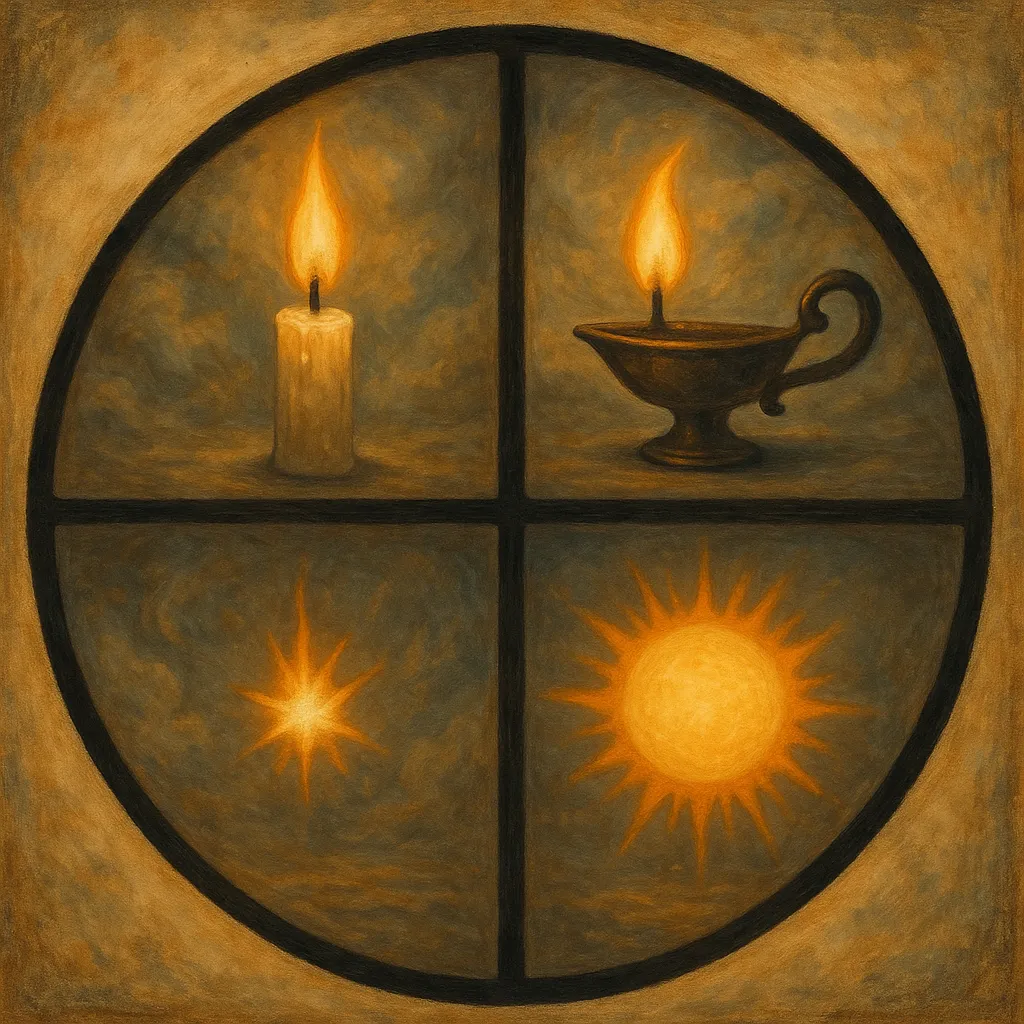
In that circular tableau where four luminosities—the modest taper whose flame trembles with the same hesitant grace as the consciousness of a child taking its first uncertain steps toward self-awareness, the oil lamp’s more refined radiance (suggesting perhaps the soul’s passage through civilizations of increasing sophistication, from the crude rushlight of primitive epochs to the elegant vessels of a more cultivated age), then that sharp stellar burst resembling nothing so much as the sudden, piercing moment when one apprehends, in the midst of life’s mundane progression, a truth previously obscured by habit’s comfortable veil, and finally the sun itself in all its pneumatic fullness, that orb which seems to contain within its swollen circumference all the accumulated experience of previous existences now ripened into a wisdom warm and all-encompassing—illuminate their separate chambers yet remain forever divided by those implacable black bars which suggest that even as the soul ascends through its successive incarnations, each life remains enclosed within its own inviolable moment, touching yet never quite merging with those that came before or shall come after, much as the various epochs of one’s own existence, though linked by the continuous thread of memory, retain each its distinct and unrepeatable savor.

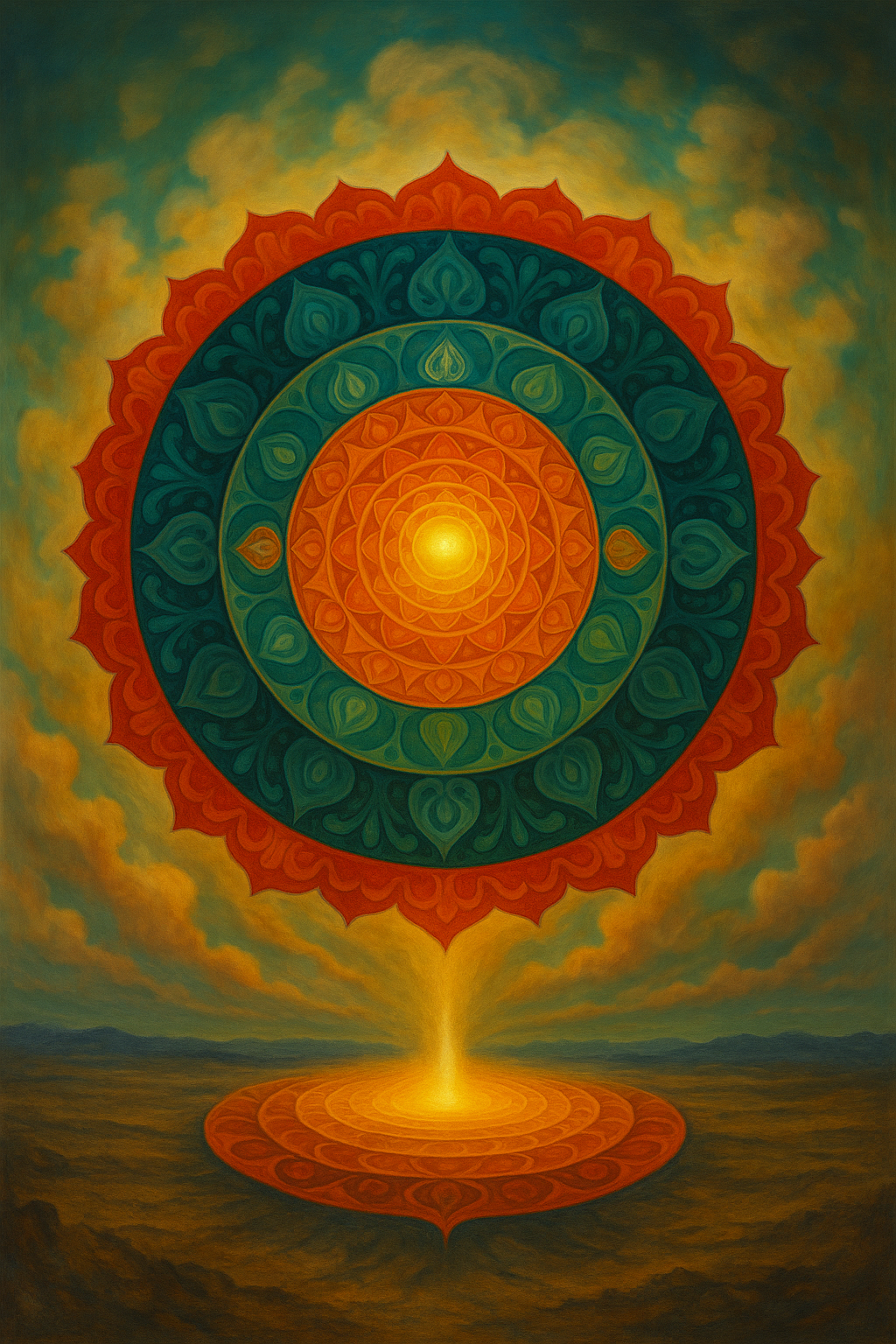
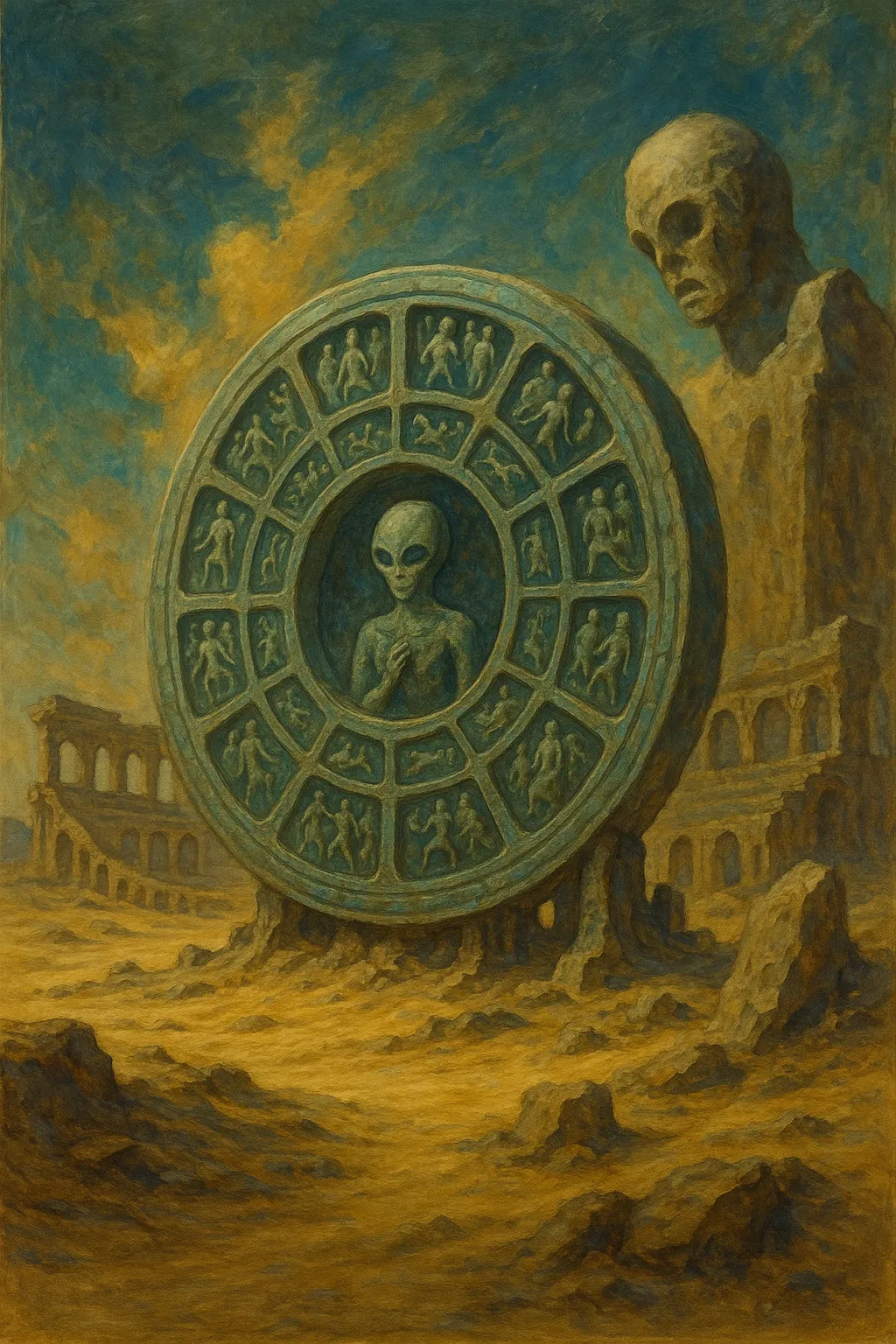
In the ochre waste where the ruins stood skeletal against a sky the color of old brass the wheel leaned there canted in the sand, its compartments cut like cells in some vast and intricate honeycomb, and in each cell the figures stood or knelt or embraced in attitudes of supplication or coupling or murder—who could say which—their forms worn smooth as creek stones, anonymous, the wheel itself a mandala of flesh repeated, and at its center the alien regard, that hairless and implacable witness with its eyes like pits bored into nothing, and behind it the larger figure risen up out of the sand itself perhaps or simply waiting there since the world’s morning, its skull face turned toward some horizon that had long since ceased to exist, the whole tableau composed in that desolate light as if arranged by hands that understood geometry but not mercy, the aqueducts in the distance marching toward their own extinction, and over it all the sky churning with ancient poisons, and you got the sense looking at it that the wheel had turned and would turn again, grinding through its permutations of torment or ecstasy—no difference finally—each figure locked in its chamber like a sin in the heart, inexpiable, the math of it precise as death, the alien at the hub serene in its witnessing, and all of it half-buried in that sterile dust which was maybe the dust of empires or of worlds or just dust and nothing more, the wind beginning to cover it over grain by grain in the measureless noon.

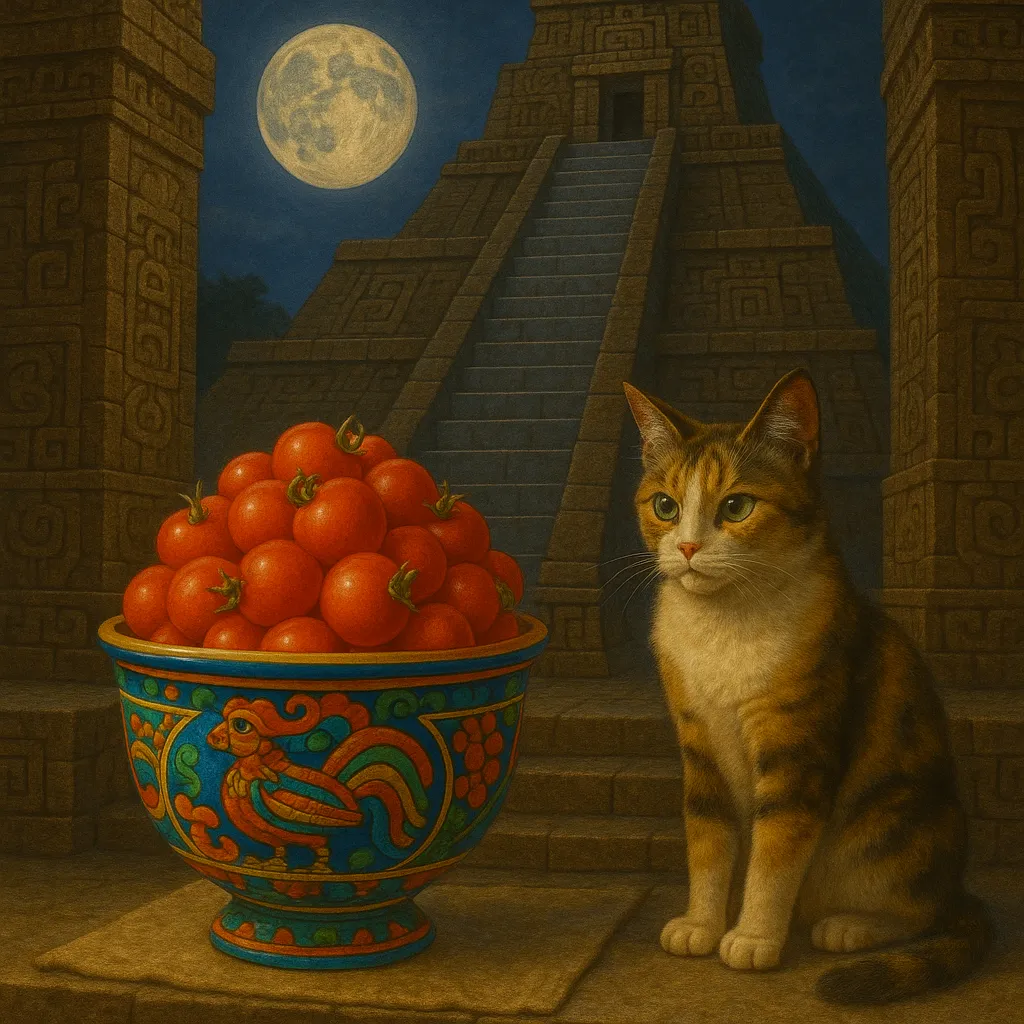
In the days when the pyramids still remembered the names of their builders and the moon hung low enough to taste the smoke of copal fires, there lived in the city of forgotten gods a calico cat who had been appointed by no one in particular to guard a bowl of tomatoes so red they seemed to contain all the sunsets that had ever bled across the valley, and the bowl itself was painted with serpents whose scales were the colors of paradise before the fall, and the cat whose eyes held the green of jungles that no longer existed would sit there every night without fail, not because anyone had asked her to or because she expected payment in fish or cream, but because her great-great-grandmother had whispered to her great-grandmother in the language that cats spoke before they forgot how to speak that the tomatoes were not tomatoes at all but the crystallized tears of the last priest who had climbed those steps behind her, one hundred and seven years ago, carrying his own heart in his hands as an offering, and that whoever ate them would remember everything—every love, every betrayal, every small mercy and large cruelty since the world began—and would go mad from the weight of it, and so the calico sat there in the moonlight which was itself a kind of memory, patient as stone, her whiskers trembling slightly in the night wind that carried rumors of rain that would not fall for another three hundred years, and the tourists who sometimes stumbled into that courtyard would photograph her and say how charming, how picturesque, never knowing they were looking at the last guardian of a sorrow too beautiful to be consumed.

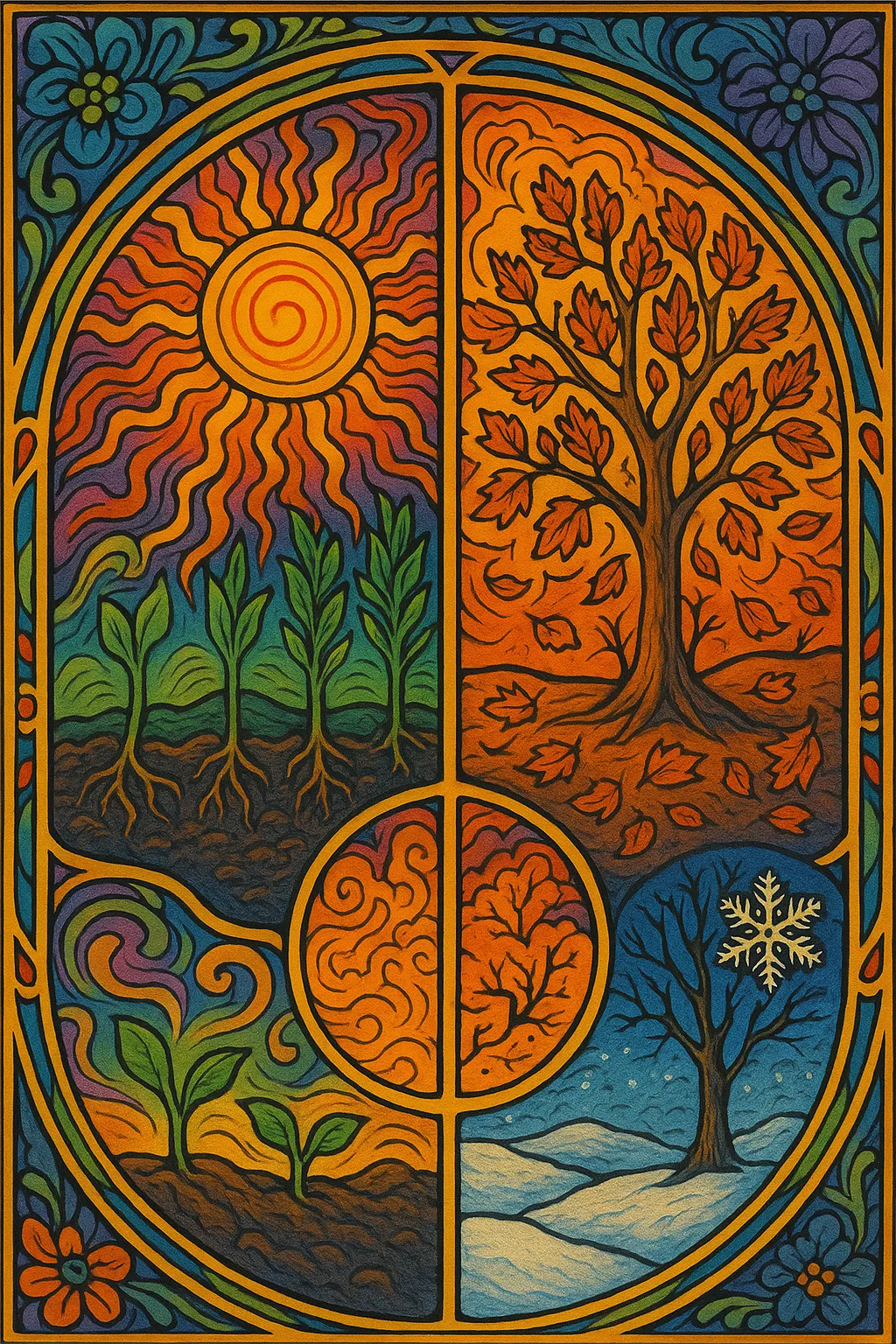
The composition, with its quadrants of sun, sprout, leaf and snowflake, presents itself less as a picture to be grasped outright than as a delicate arrangement of suggestions—each season leaning into the next with a sort of half-withheld confidence, so that one’s apprehension of the whole is not a matter of stark recognition but of slowly succumbing to the impression of something at once inevitable and elusive, intimate and remote. The solemn sun lingers above roots that, in their patient secrecy, foretell the tree’s splendor and decline, while autumn’s golden flames already whisper to winter’s pale breath, all encircled by a border of ornamental arabesques that seem less decoration than the very pulse of time itself.

Most Beloved Goodreads Author 2016, 2021

Standard
Schrodinger's Dachshund

The Dilemma of Contingency

Absolutely nothing about reality could have been different in any way whatsoever. Philosophy is a footnote to Parmenides.

Contingency cannot exist. If brute, it is incoherent (Karofsky 2022). If explained, it collapses into necessity under the Principle of Sufficient Reason (Della Rocca 2020). This dilemma is sharpened through concrete examples, an account of grounding and intelligibility, and responses to recent contingentarian strategies including two-dimensional semantics, dispositional essentialism, and structural conceptions of essence. A recurring case study — the electron’s spin — illustrates both horns. The upshot is that necessitarianism, often dismissed as implausible, emerges as the only coherent metaphysical position. Contingency is revealed as creation ex nihilo.

1. Introduction

Few doctrines are more widely rejected in contemporary metaphysics than necessitarianism: the view that everything is necessary, that nothing could have been otherwise. Common sense rules it out. Surely Caesar might not have crossed the Rubicon. I could have worn a different shirt this morning. Perhaps the laws of physics could have been different. Modal logic formalizes these intuitions; metaphysics takes them as data. To deny contingency collapses modal discourse into triviality.

By contrast, contingentarianism — the view that some things could have been otherwise — enjoys nearly universal endorsement. The burden of proof, it is thought, lies entirely on the necessitarian.

Two philosophers have recently taken up that burden. Amy Karofsky’s A Case for Necessitarianism (2022) defends necessitarianism on skeptical grounds: contingency, she argues, is incoherent, because no metaphysical account of “could have been otherwise” withstands scrutiny. Michael Della Rocca’s The Parmenidean Ascent (2020), by contrast, derives necessitarianism from the Principle of Sufficient Reason (PSR): if every fact must be intelligible, then distinctions themselves collapse, leaving only necessity.

At first sight, these approaches could not be more different. Karofsky proceeds negatively, dismantling the case for contingency and leaving necessitarianism as the only option. Della Rocca proceeds positively, elevating the PSR to its fullest expression and drawing necessitarianism as its inevitable consequence. One eliminates contingency by parsimony, the other by explanatory maximalism.

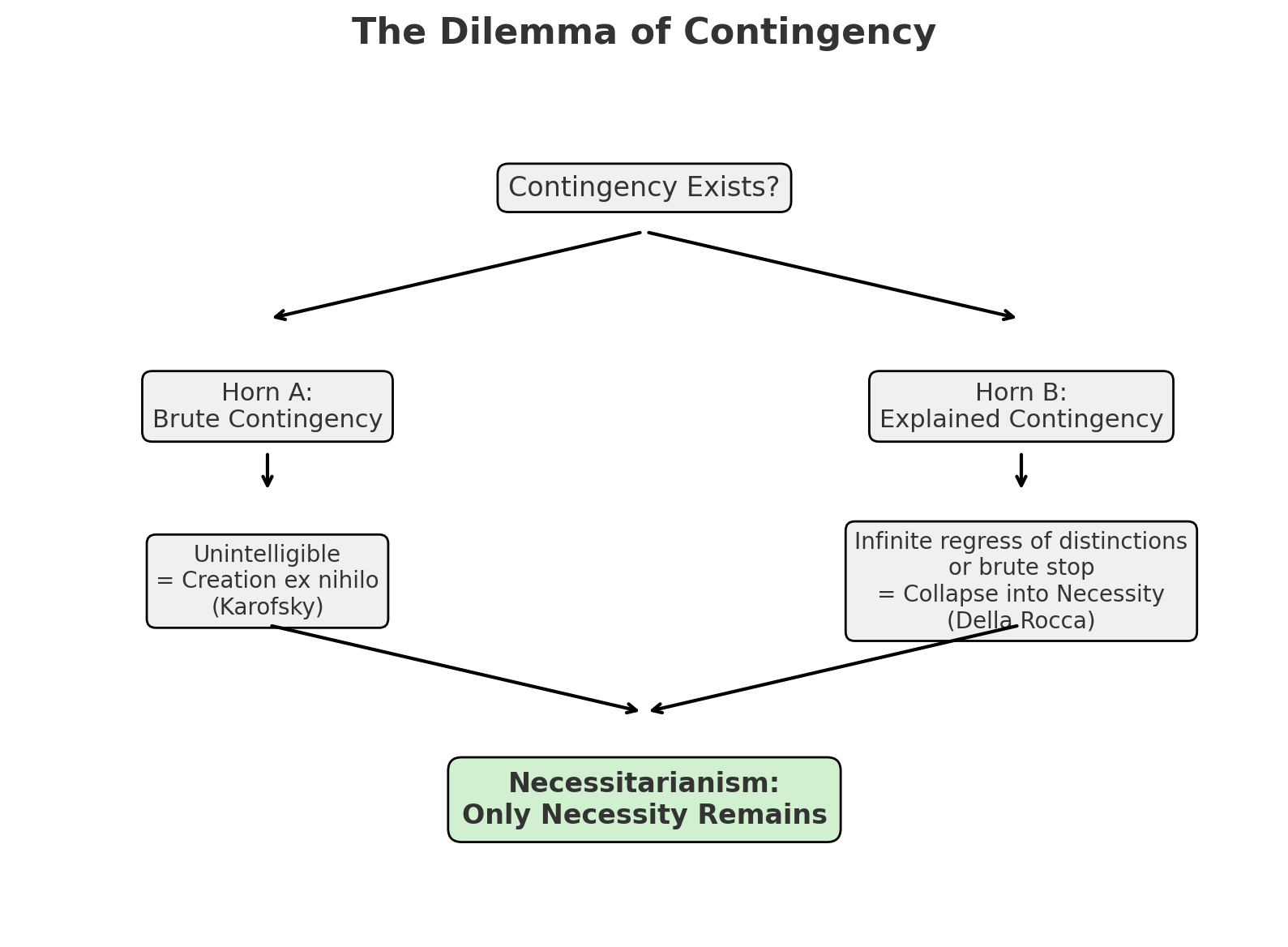
These routes converge. Together they generate a dilemma of contingency:

  • If contingency is brute, it collapses into incoherence (Karofsky).
  • If contingency is explained, it collapses into necessity (Della Rocca).
  • There is no third option.

Thus, contingency vanishes. Necessitarianism, far from being an implausible extremity, emerges as the only coherent metaphysical position.

This post has four aims. First, I clarify the key notions of grounding, intelligibility, and the version of the PSR at stake, and introduce a recurring case study: the spin of an electron. Second I develop the two horns of the dilemma in detail, illustrating them with the case study and showing why both brute and explained contingency fail. Third I confront leading contingentarian strategies — two-dimensional semantics, dispositional essentialism, structural accounts of essence, and modal grounding theories — and show that each succumbs to the same dilemma. Fourth I consider objections: that there may be a third option, that we might simply reject the PSR, that necessitarianism undermines freedom, or that it is too counterintuitive to accept.

The result is a sharpened defense of necessitarianism that synthesizes the eliminativist and rationalist traditions into a single, decisive argument. …

The Dialogues of Supernatural Individuation

Standard