
Absolutely nothing about reality could have been different in any way whatsoever. Philosophy is a footnote to Parmenides.
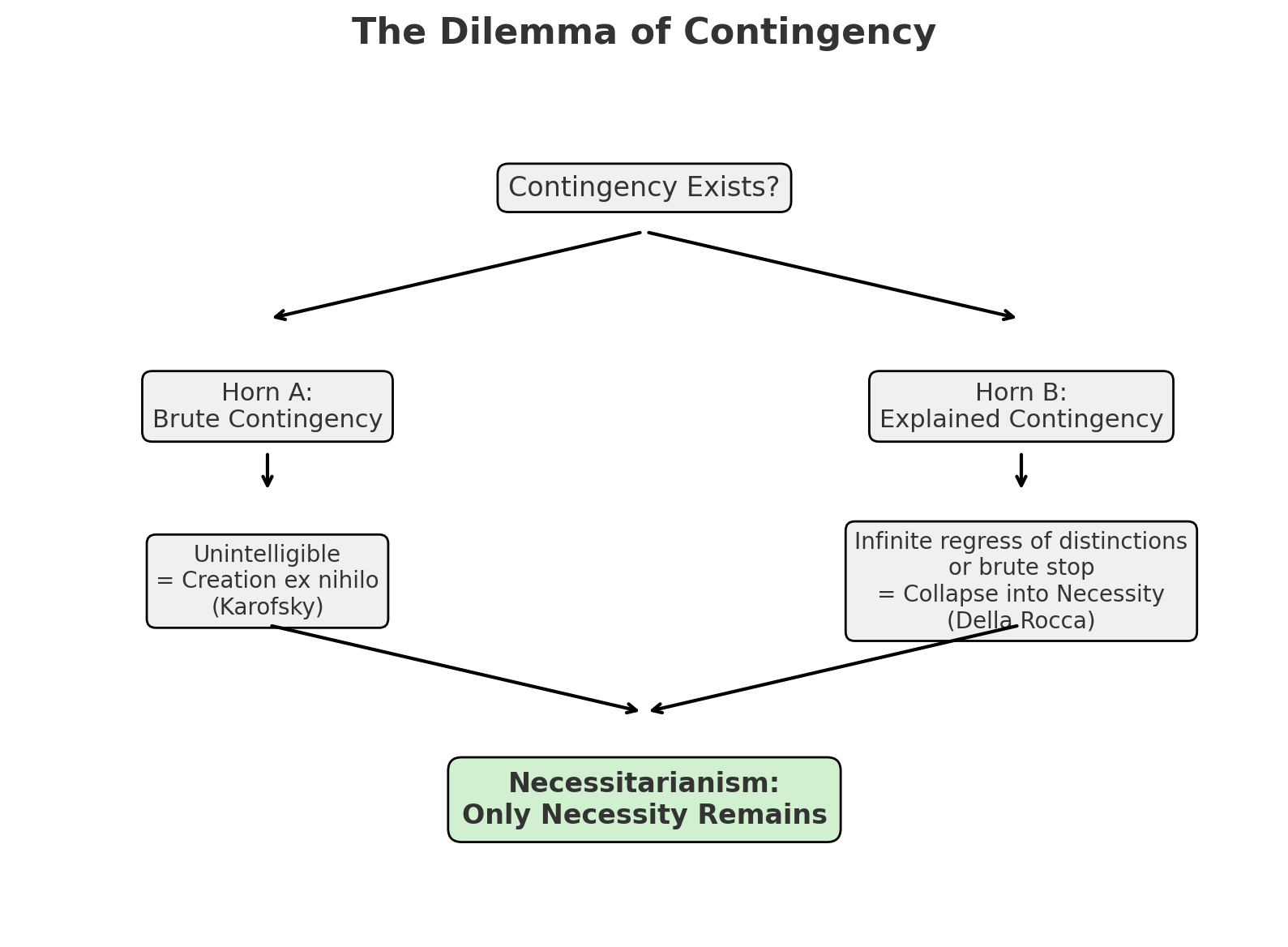
Contingency cannot exist. If brute, it is incoherent (Karofsky 2022). If explained, it collapses into necessity under the Principle of Sufficient Reason (Della Rocca 2020). This dilemma is sharpened through concrete examples, an account of grounding and intelligibility, and responses to recent contingentarian strategies including two-dimensional semantics, dispositional essentialism, and structural conceptions of essence. A recurring case study — the electron’s spin — illustrates both horns. The upshot is that necessitarianism, often dismissed as implausible, emerges as the only coherent metaphysical position. Contingency is revealed as creation ex nihilo.
1. Introduction
Few doctrines are more widely rejected in contemporary metaphysics than necessitarianism: the view that everything is necessary, that nothing could have been otherwise. Common sense rules it out. Surely Caesar might not have crossed the Rubicon. I could have worn a different shirt this morning. Perhaps the laws of physics could have been different. Modal logic formalizes these intuitions; metaphysics takes them as data. To deny contingency collapses modal discourse into triviality.
By contrast, contingentarianism — the view that some things could have been otherwise — enjoys nearly universal endorsement. The burden of proof, it is thought, lies entirely on the necessitarian.
Two philosophers have recently taken up that burden. Amy Karofsky’s A Case for Necessitarianism (2022) defends necessitarianism on skeptical grounds: contingency, she argues, is incoherent, because no metaphysical account of “could have been otherwise” withstands scrutiny. Michael Della Rocca’s The Parmenidean Ascent (2020), by contrast, derives necessitarianism from the Principle of Sufficient Reason (PSR): if every fact must be intelligible, then distinctions themselves collapse, leaving only necessity.
At first sight, these approaches could not be more different. Karofsky proceeds negatively, dismantling the case for contingency and leaving necessitarianism as the only option. Della Rocca proceeds positively, elevating the PSR to its fullest expression and drawing necessitarianism as its inevitable consequence. One eliminates contingency by parsimony, the other by explanatory maximalism.
These routes converge. Together they generate a dilemma of contingency:
- If contingency is brute, it collapses into incoherence (Karofsky).
- If contingency is explained, it collapses into necessity (Della Rocca).
- There is no third option.
Thus, contingency vanishes. Necessitarianism, far from being an implausible extremity, emerges as the only coherent metaphysical position.
This post has four aims. First, I clarify the key notions of grounding, intelligibility, and the version of the PSR at stake, and introduce a recurring case study: the spin of an electron. Second I develop the two horns of the dilemma in detail, illustrating them with the case study and showing why both brute and explained contingency fail. Third I confront leading contingentarian strategies — two-dimensional semantics, dispositional essentialism, structural accounts of essence, and modal grounding theories — and show that each succumbs to the same dilemma. Fourth I consider objections: that there may be a third option, that we might simply reject the PSR, that necessitarianism undermines freedom, or that it is too counterintuitive to accept.
The result is a sharpened defense of necessitarianism that synthesizes the eliminativist and rationalist traditions into a single, decisive argument. …

 Petronius Jablonski