Ontology, philosophy

Aquinas and the Modal Firewall

Arthur Lovejoy’s The Great Chain of Being is often read as a history of metaphysical exuberance: plenitude, overflow, and the slow erosion of contingency under explanatory pressure. What’s easier to miss is that Lovejoy also gives us a sharp diagnostic lens for understanding how philosophers attempt to contain that pressure.

What that lens reveals is a recurring structural move. I call it a modal firewall.

A modal firewall is a principled restriction on explanatory reach: a point at which intelligible reasons are permitted to explain structure, value, or possibility, but are forbidden from determining actuality. The firewall does not reject explanation. It commands it, then tells it where it must stop.

Seen through this lens, Thomas Aquinas becomes a revealing case—not because he invents the maneuver, but because Lovejoy’s framing makes its structure unusually clear.

The pressure Aquinas accepts

Lovejoy emphasizes that Aquinas fully accepts the rationalist pressures that make necessitarianism tempting. God is pure actuality. God is perfect goodness. God’s intellect contains the complete intelligible structure of all possible beings. Explanation is not optional; it is constitutive of intelligibility itself.

Given that package, a familiar question presses itself: if goodness is fully intelligible, why would a perfectly good being fail to actualize what is good? Why would possibility outrun actuality?

This is not yet Spinoza speaking. It is the pressure Aquinas must confront before Spinoza radicalizes it.

Crucially, Aquinas does not respond by weakening explanation. He does not appeal to mystery, opacity, or brute divine choice. God’s intellect remains exhaustive; reasons remain reasons. The pressure toward necessity is fully in place.

The firewall: divine will as modal cutoff

Aquinas’s response is not to deny the pressure but to block its extension.

Although God necessarily knows all possibles and their relative perfections, God does not necessarily will any of them. Creation is therefore not a logical consequence of divine nature but a contingent act of volition. God could have created a different world, or no world at all.

This is the firewall.

Explanatory reasons may explain what creatures are like, if they exist. They may explain why creation would be fitting or good. But they are not permitted to explain that creation occurs, or why this possible world is actual rather than another. At precisely that juncture, explanation is told where it must stop.

For a rationalist, this is the most uncomfortable possible outcome. Explanation is not refuted; it is obeyed everywhere except where obedience would eliminate contingency. The firewall does not emerge from explanation; it is imposed upon it.

Leibniz rationalizes plenitude; Spinoza completes it

This is where Lovejoy’s tripartite schema earns its keep.

To say that Leibniz rationalizes plenitude is to say that he removes Aquinas’s firewall while preserving contingency in name. God necessarily acts for sufficient reason, but contingency is relocated into the structure of reasons themselves. Different possible worlds are intelligible; God freely selects the best among them. Plenitude is no longer blocked. It is disciplined by optimization.

Spinoza, by contrast, refuses the remaining distinction. If God’s nature explains everything that exists, then nothing could have been otherwise. Possibility collapses into actuality. There is no selection among alternatives because there are no genuine alternatives to select among.

Where Leibniz preserves contingency by complicating reason, Spinoza abolishes it by allowing reason to run without remainder.

In Lovejoy’s narrative: Aquinas contains plenitude by prohibition; Leibniz rationalizes it through sufficient reason and optimality; Spinoza completes it by removing the prohibition altogether.

Lovejoy’s diagnostic contribution

It would be a mistake to claim that Aquinas invents this maneuver. Voluntarist strategies of this sort have deep roots, including in Islamic theology and medieval debates about divine freedom. What Lovejoy contributes is not a genealogy of voluntarism but a structural diagnosis: he shows how Aquinas’s appeal to divine will functions as a targeted containment strategy within an otherwise rationalist framework.

This matters, because not all appeals to will stand in the same relation to reason. An occasionalist denial of secondary causation, for example, may dismantle the explanatory machinery itself rather than merely restricting its scope. Aquinas’s strategy is different. He preserves explanation almost everywhere. That’s what makes the firewall both powerful and philosophically unstable.

Seen through Lovejoy’s lens, Aquinas is not someone who rejects necessitarian pressure, but someone who cordons it off. Contingency survives only because explanation is commanded to halt at a specific boundary.

And once that boundary is made visible, a further question becomes unavoidable: What justifies telling explanation where it must stop?

That question, Lovejoy suggests without fully pressing, will not remain contained.

Ancient Modal Firewalls

The Modal Firewall Around Gödel

Standard
Schrodinger's Dachshund

Modal Firewalls: Why Contingency Is Doing Less Work Than You Think

Philosophers love necessity and contingency. Some things must be the case (mathematical truths, the laws of logic). Other things just happen to be the case (the number of planets, whether you had coffee this morning). This distinction is load-bearing. It’s not just a classification. It’s meant to tell us where explanation can and cannot go.

Necessary truths can explain things, but we don’t get to ask why they obtain. They’re the stopping points. Contingent truths, meanwhile, float free: they could have been otherwise, and that’s that. The modal classification does double duty. It describes the world and regulates inquiry.

This picture hides something important.

The Pattern

Look at how explanation actually works across different domains:

  • Mathematics constrains physics. Certain physical states are ruled out because they’d violate mathematical truths. We don’t treat this as mysterious. It’s just how things work.
  • Normative facts constrain rationality. That an action would be unjust explains why it’s not a genuine rational option. Again, no mystery.

In both cases, facts from one domain (mathematics, normativity) reach into another domain (physics, rational agency) and do explanatory work. We accept this without fuss.

But now try the reverse. Can physical facts explain why certain mathematical structures are realized? Can contingent features of the world explain anything about necessary truths? Here, philosophers balk. That direction of explanation is blocked.

Why? Not because anyone has shown that such explanations would be incoherent. Not because they’d fail to illuminate. The reason, when you push on it, is usually just modal: necessity can constrain contingency, but contingency can’t constrain necessity. The direction of explanation tracks the modal hierarchy.

The Firewall

I call this pattern a modal firewall. It’s a restriction on explanatory scope that’s justified by modal status rather than by anything about explanation itself. The firewall doesn’t show that a candidate explanation would fail. It rules the explanation out of bounds before we even try.

Here’s the structure:

1) Eligibility: The blocked explanation would, by ordinary standards, be perfectly intelligible.

2) Modal restriction: It’s excluded because of the domain-relative modal status of what’s being explained.

3) No independent grounding: No explanation for the modal boundary. It’s taken as given.

Firewalls aren’t arguments. They’re policies. And once you see them, you see them everywhere. Paging Gödel.

Why This Matters

The problem isn’t that explanation has to be unlimited. Some explanations fail; some inquiries terminate. That’s fine. The problem is how the limits are drawn. If a stopping point is justified by demonstrating that further explanation would be incoherent, circular, or regressive, fair enough. But if it’s justified by pointing at a modal classification and saying “Here be contingency!” That’s not an explanation of the limit. It’s a label for the limit.

This matters for the contingency/necessity debate because contingency is often sold as metaphysically innocent. The necessitarian (someone who thinks everything is necessary) is supposed to be the one with the weird, revisionary view. But if contingency’s main job is to license unexplained stopping points in our explanatory practices, that innocence starts to look questionable.

Contingency often ends up doing the kind of work apologetics does: protecting a doctrine by declaring certain questions out of bounds.

A Different Approach

The alternative I develop is what I call explanatory unity: let explanation go where it succeeds, and stop where it fails, without giving modal classification independent authority to police the boundaries. Domain differences might shape how we explain, but they don’t get to determine that explanation must stop.

This isn’t a commitment to explaining everything. It’s a commitment to earning your stopping points rather than inheriting them from a modal map drawn in advance.

Does this vindicate necessitarianism? Not directly. But it shifts the burden. If you want to say that contingency limits explanation, you need to explain why—not just assert that it does.

The Garden Without Forking Paths

Standard
Schrodinger's Dachshund

Shaftori and the MOAN

A Modal Ontological Argument for Necessitarianism and its Mystical Origin

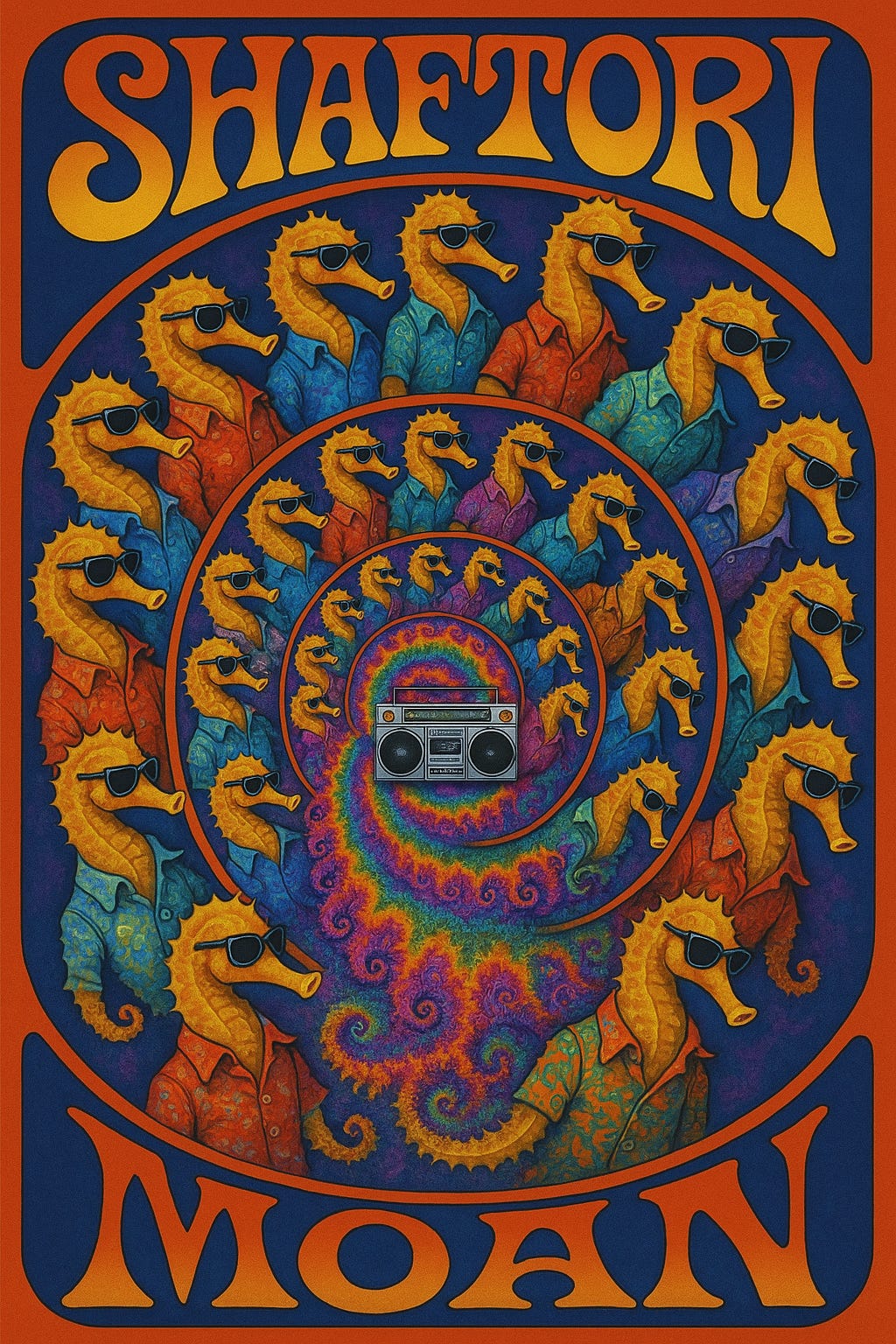
Late last year Petronius Jablonski experienced Shaftori: Enlightenment from the 45 RPM of Isaac Hayes’ “Shaft” played at 33 RPM. Like Parmenides’ descent to the halls of Night, his journey was part metaphysical reasoning and part mystical initiation. The stone-cold groove reduced him to a nanoscopic seahorse adrift in a measureless mega-fractal, absurd and sacred, tiny beyond reckoning yet somehow required, a necessary syllable in an infinite and pitiless scripture.

He returned with original and definitive proof of Necessitarianism: the thesis that whatever is true couldn’t have been otherwise, that nothing about reality could have been different in any way whatsoever. The result vindicates Necessitarianism and proves that he, like Parmenides, has been behind the veil.

In the structure of the Mandelbrot set there’s a region where the filaments branch into forms that look distinctly like little seahorses. Mathematicians call it the Seahorse Valley. Zoom-ins show repeating spirals whose shapes resemble the curled tails and bodies of seahorses.

Note well: this is not the work of some brilliant mathematician lovingly designing seahorses. This is a necessary feature of the Mandelbrot set with no contingency or design at all. Why does it exist? It couldn’t not exist and there’s an end of it.

Jablonski’s epiphany is that all reality is like this. And he can prove it.

Standard