
In which the classical theist and the necessitarian are discovered to be the same man in different pants
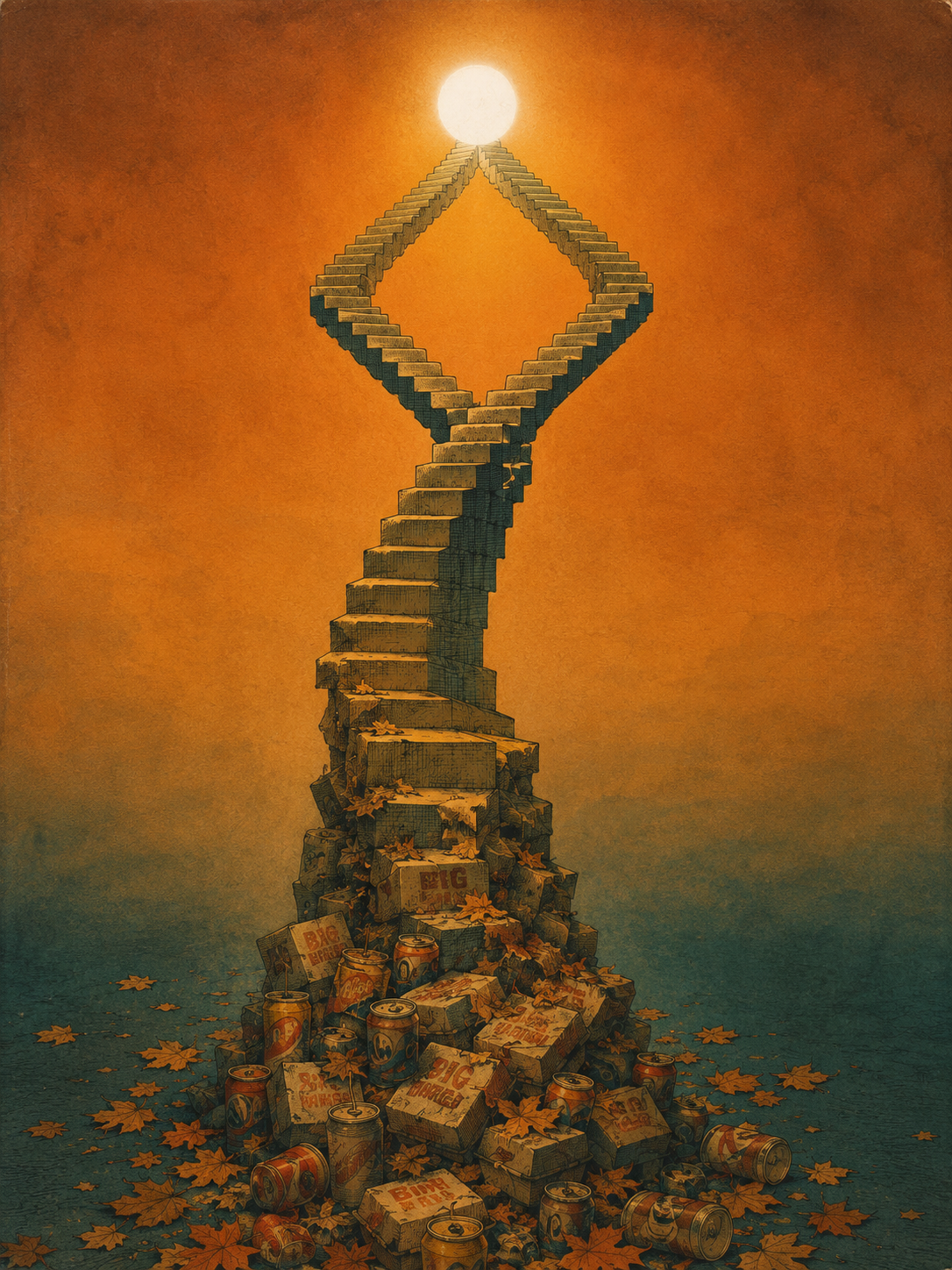
Everyone knows that some things could have been otherwise. Nobody can say where that fact lives, what pays for it, or why the bill never arrives. Contingency is the houseguest who has been on the couch since the Carter administration and has never once been asked what he does for a living.
Two philosophical parties have taken the question seriously enough to build something on it. They are usually described as enemies. They are closer to being the same expedition, photographed at different mile markers.
The Ascent, Performed Twice
The classical theist starts from things that change and things that depend, notices that neither a potency nor a borrowed existence can be the terminus of anything, and climbs. What he reaches is purely actual, without parts, without potency, necessary, one. Feser writes it out in syllogisms; Aquinas got there without them; the argument is older than either and will outlive humanity.
The necessitarian starts from the same rung and climbs the same ladder. Karofsky’s version is the ascent run in the negative: contingency cannot be brute, because nothing about a brute item is what makes it able to be otherwise; it cannot be grounded in prior contingencies, because that merely reschedules the appointment; and it cannot be rooted in necessity, because necessity does not manufacture openness. Three doors, all locked, therefore no contingency. Spinoza gets to the same place by the front entrance: one substance, the Principle of Sufficient Reason, and the observation that whatever follows from something necessary is itself necessary.
Look at what these two parties agree on. Both hold that contingency cannot stand on its own feet. Both terminate in something necessary, simple, unique, and self-sufficient. Both run on the same transmission principle: Lin’s premise (9), the one that does all the actual killing. They share every step but one.
The Node
Meet the node. The classical theist reaches the necessary summit and says: the necessity stops here. God wills His own goodness necessarily and wills creatures freely, because His goodness is complete without them. Creation could have been otherwise, or not at all. There are reasons for this world, and they incline, and they explain fittingness, and they decline (by doctrine, not by our ignorance) to necessitate.
The necessitarian arrives at the same summit, looks at the node, and removes it.
That is the entire difference. Not a different metaphysics, not a different ascent, not even a different terminus in most respects. One deletion. Which is why Spinoza is best understood not as an outsider assaulting the tradition but as the tradition’s most literal-minded employee, the man who read the manual and did what it said.
The pressure on the node does not come from Amsterdam. It comes from inside the house. Divine simplicity is the doctrine that makes God maximally intelligible: no composition, no accidents, no act distinct from the essence. It is therefore also the doctrine on which the act of creating is the necessary essence, and if the act is necessary and the act produces this world, then this world is necessary and the node is a decoration. The classical theist’s finest instrument is aimed at his own foot. Mullins presses this; Tomaszewski says the inference is invalid as usually formulated; Grant says the act is intrinsically necessary and only extrinsically the creation of this order; Schmid says you escape only by going indeterminist, and then you have traded modal collapse for providential collapse, which is the same landlord under a different name.
And there is a second road, less traveled and worse lit. Lovejoy spent a book on it. Goodness is self-diffusive; the more being the better; a God who could have made more and didn’t is holding out. Plenitude is a necessitarian engine that has been idling inside Christian metaphysics the whole time, and every generation that revs it discovers Bruno waiting at the end of the driveway. Classical theism has two roads to Spinoza. Most of the literature only patrols one.
The Traffic Runs One Way
Is one the passage to the other? Yes, and the asymmetry is the interesting part.
From classical theism to necessitarianism is one short step. Delete the node and the necessity you have already granted at the summit runs downhill unimpeded, the way water does, without needing to be persuaded.
From necessitarianism to classical theism is a very long walk over open ground. Necessity of the base gets you a base that is necessary, unique, simple, self-sufficient (a respectable fraction of stage two, and cheaper than Feser pays for it). It gets you no intellect. No will. No goodness. No transcendence, and in the Spinozist and Karofskyan versions, no distinction between the base and the world at all. Karofsky’s terminus does not love you. It does not know you exist. It does not, in the relevant sense, exist as a someone.
The complaint Schmid runs against Feser (that pure actuality underdetermines the character of the being) cuts here with the grain. Necessity underdetermines everything anybody actually wanted.
Can Both Be True
Depends which conjunction you mean, and the decomposition is clean enough to do on a bar napkin.
Necessitarian classical theism is coherent and is a real position rather than a paper one. A God who is simple, necessary, purely actual, identical with an act that necessitates exactly this order, satisfies every classical predicate but one. Some readers put Aquinas closer to this than he’d like. Kretzmann has him obliged to create something, with only the selection left free. Press the selection and you arrive. There is a live minority in the collapse literature that simply accepts the consequence and declines to be scandalized.
Orthodox classical theism (the package with libertarian divine freedom and a creation that could have been withheld) is flatly incompatible with necessitarianism. And it is worth reciting what goes down with it, because the bill is not confined to one doctrine. Gratuity goes: grace that could not have been withheld is not a gift, it is a weather pattern. The free-will defense goes, since it was built entirely out of alternatives. Providence-as-selection goes. Petitionary prayer goes, or becomes a very elaborate way of being on time. And every theodicy of the form He permitted what He could have prevented goes, leaving only Spinoza’s move, which is to deny that evil is a feature of reality as such (a position available to anyone who has never been to a hospital).
That is a heavy bill. It is not obviously heavier than the necessitarian’s, which is the burden of defending a universal negative about the whole of modal space.
One More Turn of the Screw
There is a sharpening the collapse literature has not yet registered, and it raises the theist’s bar considerably.
Necessitarianism quantifies over all propositions, itself included. So if N is true, N is necessary. Not by stipulation, not by an Anselmian definition anyone is free to decline, but by universal instantiation. Add B and the possibility of N delivers its necessity.
Watch what that does. The classical theist who concedes that a necessitarian classical theism is so much as possible (that there is some way things could have been on which simplicity necessitates creation) has conceded ◊N, and ◊N gives you □N, and the concession is fatal. He does not owe us ¬N. He owes us □¬N.
Tomaszewski’s invalidity diagnosis clears that bar, if it works; invalidity is not a contingent matter. Grant’s extrinsic-denomination model and the indeterminist escape do not obviously clear it. They are arguments that the collapse does not obtain. They are not arguments that a collapsed world is excluded from modal space, and that is now the thing owed.
Last Call
So they are not rivals, exactly. They are two settlements of a single trade: explanatory completeness at the summit against modal openness downstream. You cannot have both at full strength. The classical theist takes the completeness and installs a firewall to protect the openness. The necessitarian takes the completeness and lets the openness go. Everyone else takes a weaker summit and pays in aseity, which is at least honest.
Calling the firewall a firewall convicts nobody. It locates the cost and posts the name of the party who owes it. That is less satisfying than a refutation and considerably harder to dodge.
 Petronius Jablonski