

It was not grass and it was not earth either but the gray outraged dust of a world that had never known rain, that had waited four billion years in that long weightless dark not for man but for this: the flowers. Because they were there now, actual and impenetrable, white and profligate and doomed, blooming out of the dust which could not have birthed them and had birthed them anyway, in defiance not of God but of the very memory of God.
And the cat. Not cats: the cat, though she was four and maybe more than four, watching out of the blossoms with that fierce quadruple regard, the same face repeated across the field like an affirmation or a curse, the way the dead repeat themselves in the living, grandsire to son to son’s son, so that a man looking into his own child’s face sees not his child but the whole tremendous invincible procession of his blood looking back at him out of time. She crouched there among the potato flowers (potato flowers: as if even here, even in this absolute and irrevocable elsewhere, the earth’s meanest crop had followed man like guilt follows him, like the smell of his own sweat) not hiding and not hunting either but simply being, with that quality cats have of owning whatever they regard, so that it was not she who trespassed in the gray dominion of the dust but the dust which trespassed around her.
And overhead, in that black which was not sky because sky is something you breathe under, hung the earth itself: small, blue, swirled, remote, the whole vast tragic tumultuous home of man shrunk now to something a boy could cup in two hands, and in it every courthouse and every cotton field and every grave; and the cat did not look at it. She would not look at it. Because that was hers too, or had been, or would be. She being cat and therefore neither remembering the earth nor grieving it, having learned what man in ten thousand years of looking backward has never learned: that the past is not dead, it is not even past, and for that very reason you must sit facing forward in the flowers, waiting, immune, eternal, while the old blue world hangs there over your shoulder like something you were acquitted of long ago.

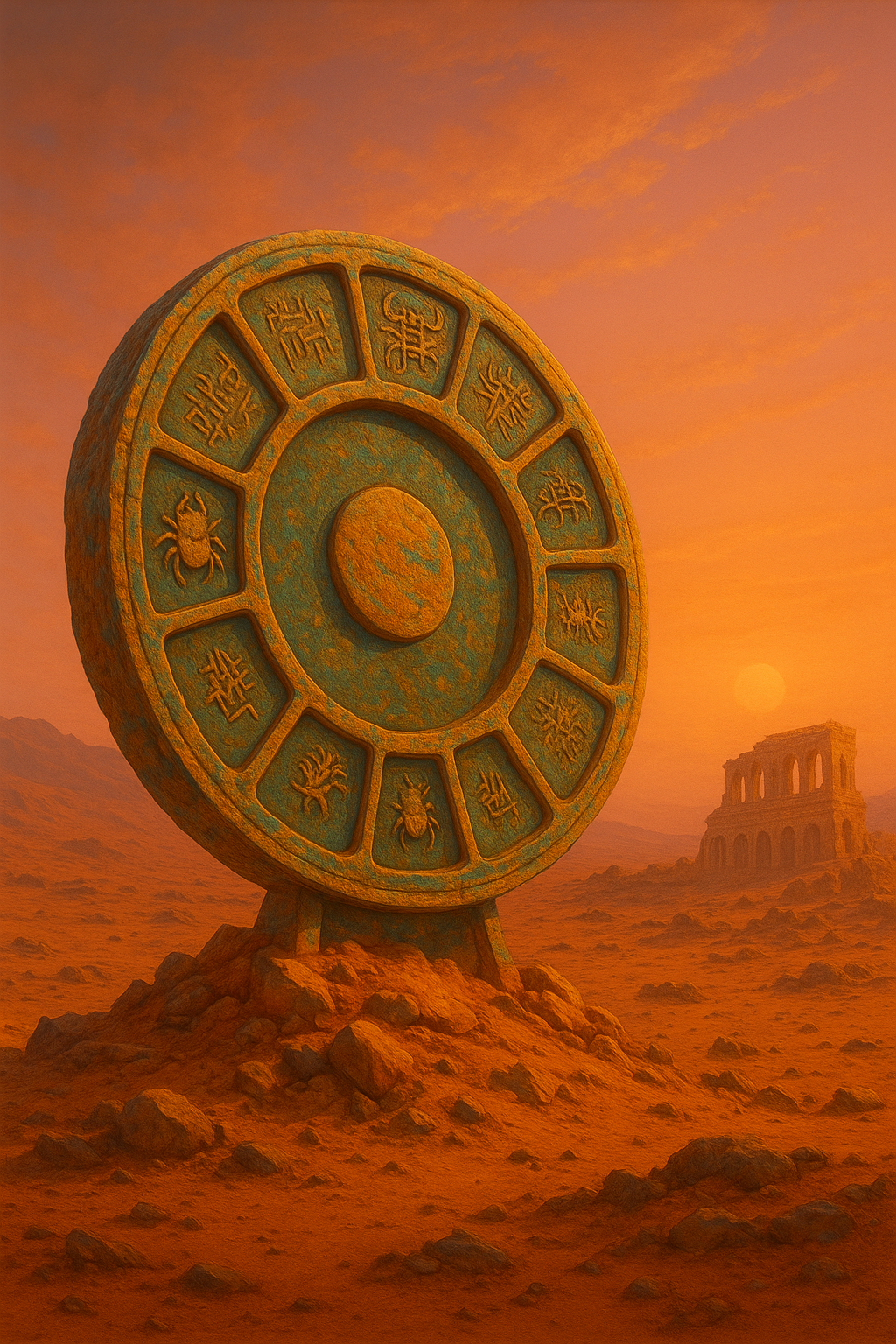
This time it was red, all of it, the dust and the rocks and the very air itself, red not like blood is red but like the memory of blood, like the stain that will not scrub out of the pinewood floor no matter how many generations of women kneel to it, a whole planet the color of old iron and old wounds under a sky that was not sky but merely more dust, suspended, waiting, the way haze hangs over a burned field in August long after the fire has gone on.
And in the middle of that immemorial rust, the garden. One garden. Not sprung wild this time but made, deliberate, the straw laid down and the stones hauled and set each against each in a ring like a cairn or a covenant, so that a man looking at it would know at once that hands had done this, mortal and finite and unhumble hands, and had done it not because the land invited them (the land had not; the land had said No in red thunder for a thousand million years) but precisely because it had not; and the potato plant stood up out of its bedding of pale straw and bloomed, pink and white and outrageous, profligate with blossom the way the doomed are always profligate, spending everything at once because there is no bank on Mars to hold a flower’s savings. And beside it the little instrument on its steel stalk, its glass eye turned heavenward, measuring. Because man cannot merely make a garden and sit down in it; he must number it too, must reduce even his one miracle to figures in a ledger, as if by measuring the wind he could forgive himself for having come.
And the cat watched. One cat now, black, or that gray which is blacker than black in that red light, sitting apart among the stones with his paws folded under his in that attitude of patient and absolute proprietorship, not near the garden and not away from it either but exactly at that distance which cats and creditors know by instinct: close enough to claim, far enough to disavow. He was not the pale multiplied cat of that other, grayer world; he was singular, dark, indivisible, like a period at the end of a long sentence, and he regarded the one green living thing on the whole red planet not with wonder and not with hunger but with something older than either, the look of one who has seen gardens before, and seen what becomes of them, and of the men who plant them; and who intends, this time, merely to sit in the red and permanent dust, and outwait it: the straw, the stones, the little glass instrument, the flowers and the flowers’ children and the very ambition itself, since he knew what the gardener in his pride did not: that Mars was not conquered, it was only, for the moment, and in that one ringed and mulched and measured place, distracted.

Night now, and the moon: not the tame moon of almanacs and lovers but the old fierce original coin itself, hanging above the broken hills like the one lamp left burning in a house where everyone has died, and beneath it the tower. It had been a keep once, a bastion, some baron’s stone boast flung up against the dark by men who believed that to pile rock on rock was to pile year on year, that masonry could hold not just the border but time itself; and the men were gone now and their names were gone and even the war they built it for was gone, unremembered, unregretted, while the ivy went up the walls in the moonlight with that slow vegetable patience which does not besiege because it does not need to, which merely waits and climbs and waits, knowing that all flags come down at last and all stones return; and the banner still hung from its pole above the battlement, faded past its colors into the mere idea of a banner, stirring a little, like something talking in its sleep.
And on the parapet, above the banner’s shadow, the cat. Not pale now and not black either but brindled and parti-colored like some jester or judgment, sitting with her paws together on the topmost stone of all that dead ambition the way conquerors sit on thrones they did not build, looking down; and what she looked down upon was not the castle and not the moon-colored river and not the drowned centuries between, but the beasts.
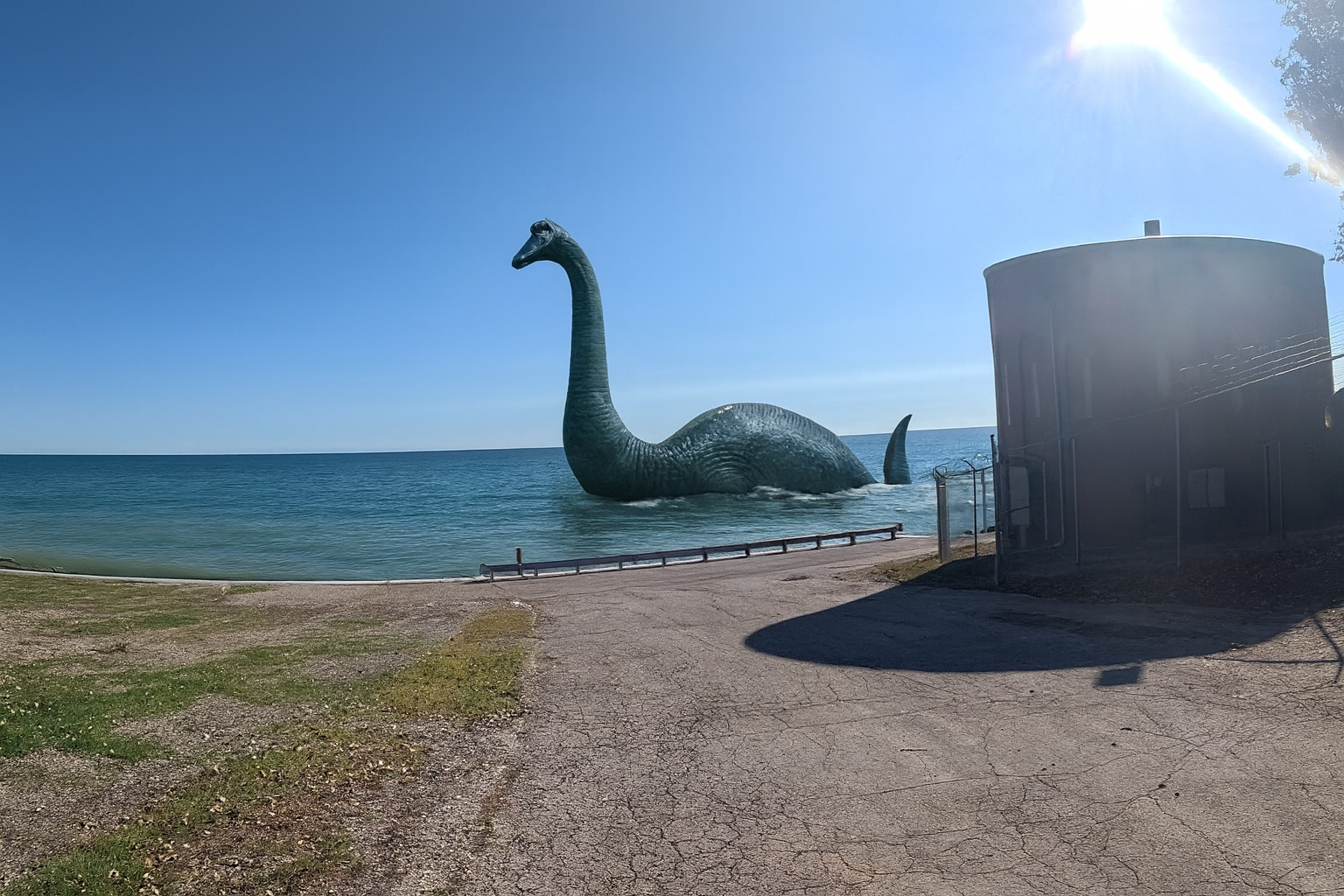
Because they had come back. Or they had never gone: the great one standing hip-deep in the shining water, lifting its small head on that long neck out of a time before there were names, before there was even anyone to be before, moving through the shallows with the slow tremendous unhaste of something that has never learned fear because it antedates the very invention of it; and above the hills its winged cousin going over on stiff sails, crossing the moon’s face like a scrap of the original dark that the light had never managed to burn away. They did not see the tower, or seeing it did not regard it, since to them it was already what it would be: a heap, a reef, a thing the river would explain to the gravel by and by. And so the whole night stood stacked there in the one moonlight like uncashed cheques on a spike: the lizard’s aeon, the baron’s century, the ivy’s decade, the cat’s hour, each one believing itself the present; and the cat sat on top of all of it, at the exact and lonely summit of time, keeping the one watch that has never yet been relieved, guarding for no wage and no lord the single perishable kingdom that any creature ever really holds, which is the night itself, this night, now, before the moon goes down and the water smooths and the great neck sinks again into the reeds and the dark, and it all becomes (tower and banner and beast and moonlight) merely another thing that was.

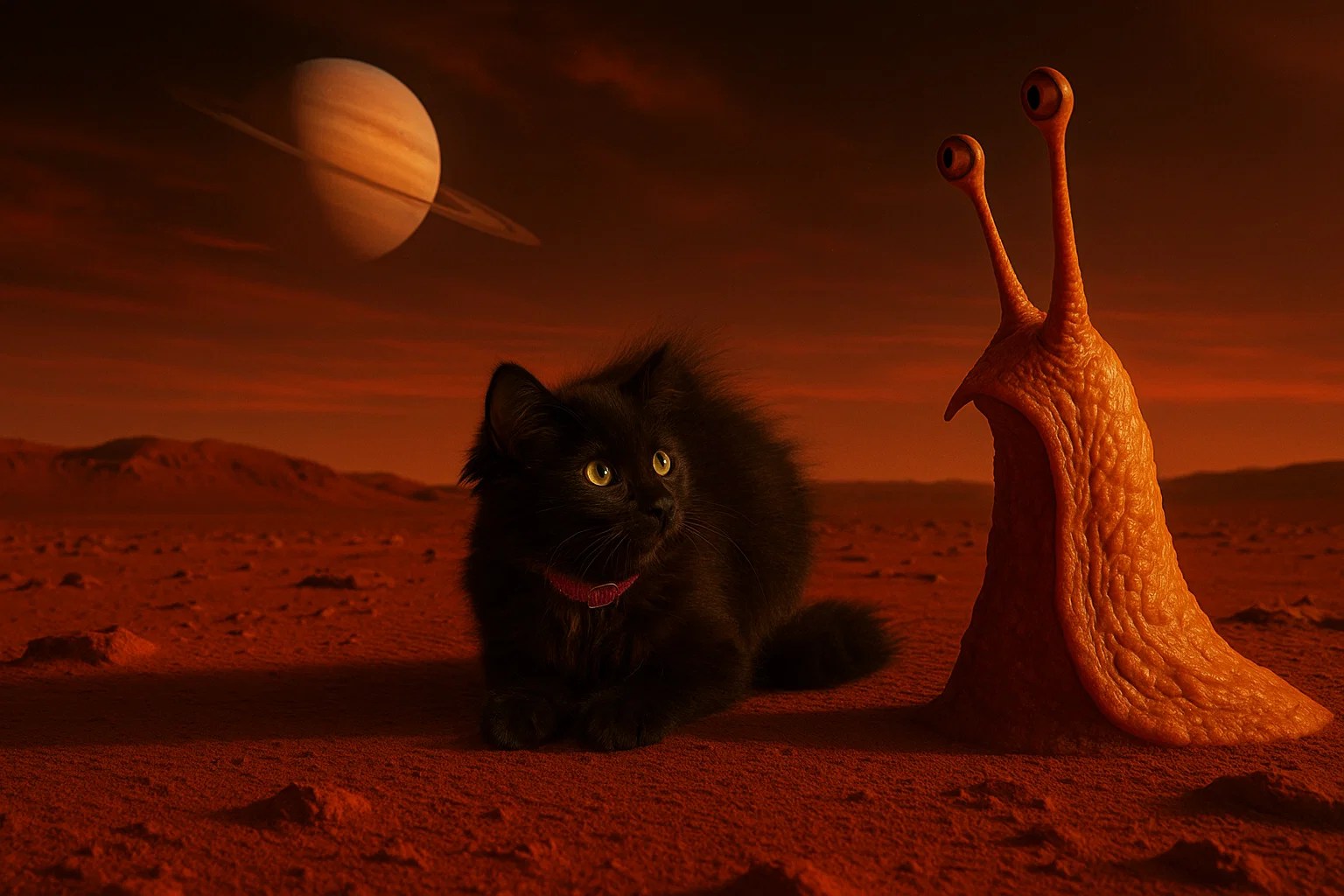
Dusk, or what passed for dusk on that world which had never agreed to the sun’s terms: the red land going redder and then darker red, like iron cooling, like the last coal in the grate of an abandoned house, and low over the hills the ringed planet hanging tilted and enormous and serene, wearing its halo the way a hanged man’s ghost might wear the rope, ornament and sentence both.
And in that failing light the two of them met. Not fought, not fled: met. Confronted one another across ten feet of rust-colored dust that might as well have been the distance between the making of their two bloods, the one pale, boneless-looking, molluscine, raised up out of the ground like a question the planet had been four billion years in asking, holding aloft on that single tapering stalk of itself the one tremendous golden eye. Not two eyes, not the paired and parallax vision of the hunters and the hunted of the old world, but one, single, lidless, central, the eye of something that had never needed to triangulate a distance because it had never had anywhere to go, that had lain in the red hardpan through eons of which even the rocks had lost count, dreaming whatever the dust dreams, until now.
And the cat looked back. Black, small, furred, finite, with the little buckled collar still around his neck: that thin worn strap of another planet’s leather, the last insignia of the race that had named him and carried him across the naked light-minutes and then, in the way of that race, gone on, or gone under, or merely gone. He sat in the alien twilight with his paws together and gave the great eye back its gaze, green for gold, two small lamps against one large one; and there was no fear in him, and no wonder either, because a cat does not acknowledge precedent and therefore cannot acknowledge the unprecedented: to him the monster was neither miracle nor abomination but simply the next thing which had presented itself to be judged, as the sparrow had been, and the June bug, and the vacuum cleaner, and man.
So they regarded one another, the first eye and the cat, beneath the stranger’s ringed lamp, in the silence which was not the silence after something but the silence before it, the whole red world holding its breath around them; and if there was to be a treaty between the two kingdoms (the kingdom of the dust that dreams and the kingdom of the small fierce blood that endures) it would be ratified here, without words, without witnesses, in the oldest parliament there is: two creatures, met at evening, deciding in the unhurried courtesy of their mutual and sovereign regard whether the other was to be feared, or eaten, or, at the last and highest reach of diplomacy, ignored.
“Driving, page-turning force” Publishers Weekly



 Petronius Jablonski