

I. The First Eyes
Light came first. It fell into the water and the water took it and gave nothing back and there was no accounting of it anywhere in the world. Then in some warm and nameless shallows a knot of cells took hurt from it. The ledger opened. It has never since been closed.
The first eyes. Stalked, faceted, carried out on their little derricks like lamps borne into a mine. The animals beneath the fixture are not looking at it. They are looking with the same crude apparatus you’re using now, four billion years less refined and no less certain of its findings.
Note that the candles burn where nothing should burn. No air, no wick, no chemistry that will hold. This is not an error of the picture. The flame that needs no air was never fire. Detritus called the source a raging blaze and called your mind an ember blown far from it, and here is the blaze, and here are the embers circling underneath with their new eyes, looking, not yet aware that looking is what they’re doing.
II. The Age of Jaws
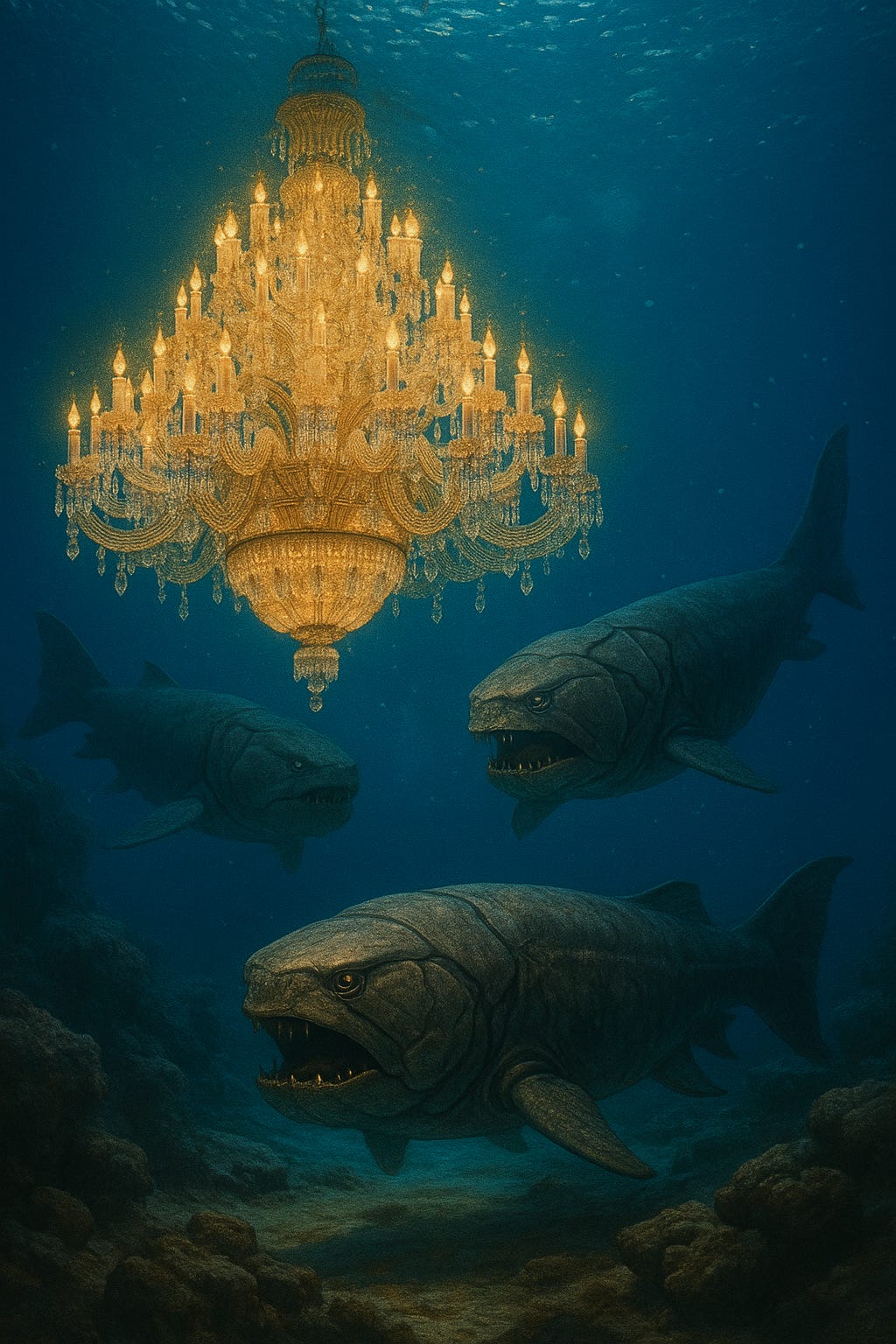
Three hundred and sixty million years down and the world has learned to bite.
They have no teeth. They have the edges of their own skulls, honed against each other with every closing, the bone sharpening the bone. They bite with their faces. The armor is forward and the eyes are set small and far back where nothing can reach them, which is the design philosophy of every fortress ever raised and it has never once been sufficient.
Two of them are hunting. One is not. Look at the near one, the great gray hull of it turned slightly off its heading, and the gold laid along the plate of its jaw like something spilled. Its eye has caught the fixture. In the whole plate that eye is the only thing doing what the fixture was made for.
That is the arrangement everywhere, in every age. There is always one that looks up. It is always the one that goes hungry. Whatever glitters in the Chandelier glitters on borrowed time and on an empty stomach, and the Sentinels have never pretended otherwise, and they have never let it stop them.
III. The Drowned House
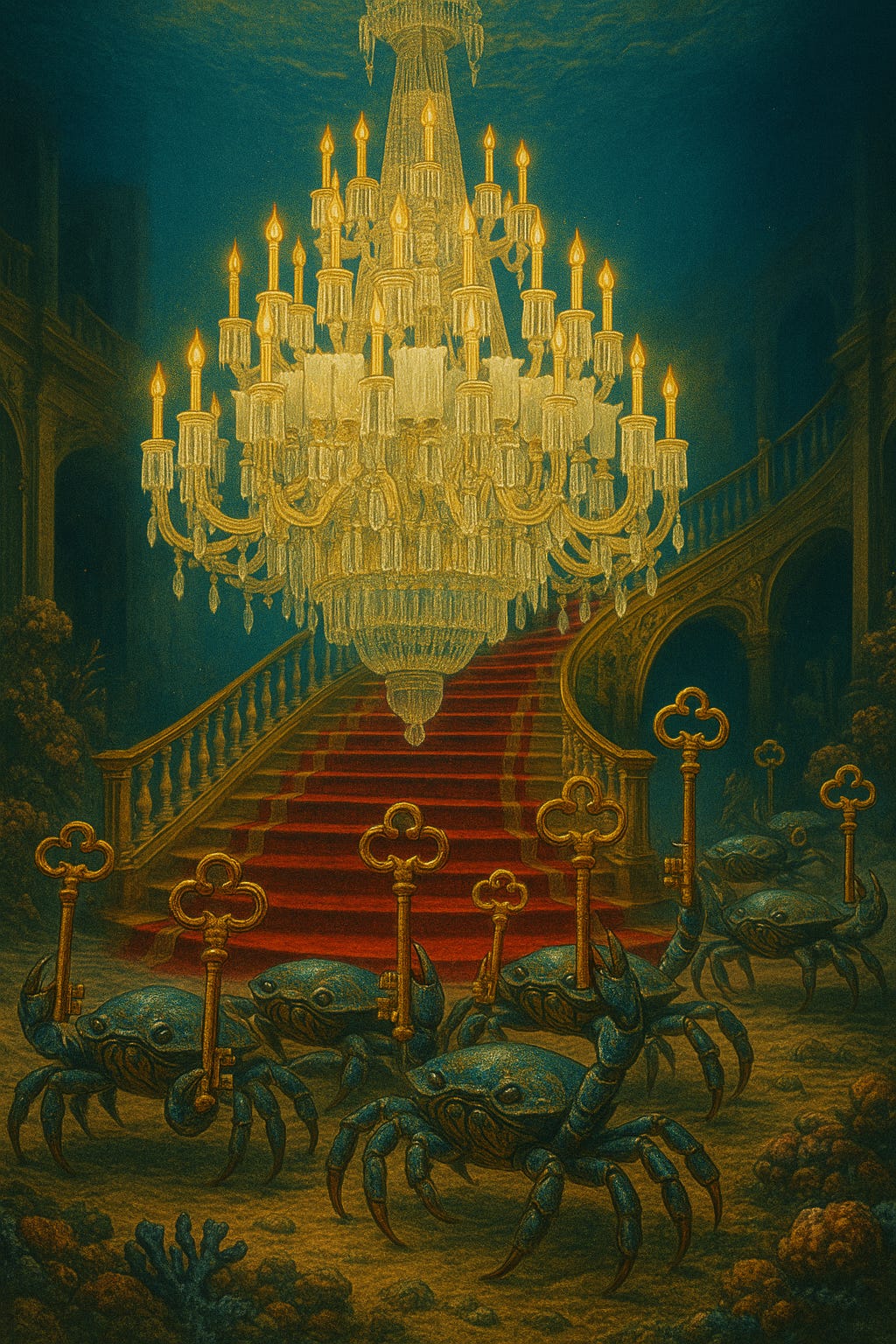
The sea takes a house the way the sea takes everything. Without ceremony. Without hurry. With a thoroughness that reads, from a distance, as patience.
The stair goes up out of the frame into rooms that are only water now. The carpet is still red. Someone chose that red. Someone stood in a shop with swatches in his hand and weighed one red against another and went home believing he had settled something.
Consider the tenants. Nature has arrived at the crab on at least five separate occasions, from five separate starting points, with no consultation between them. The form is not an accident. It is a destination. The universe has a shape it prefers and it returns to that shape the way water returns to level. It will keep returning long after the last of us has stopped watching it do so.
So too the Chandelier, which is also a shape the universe keeps arriving at.
So too the key. Every one of them has brought a key. Where they got them is not a question the picture entertains, and what door remains down there to be opened is not a question anyone should ask aloud. The secret passageway is forever closed, the Sentinels tell the ones who refuse them. Darkness is yours.
Look at these things climbing a staircase in the dark with their keys held up like standards.

IV. The Long Look Up
Whatever world this is, it is late in it. The mountains are worn down to their patience. The sky has more in it than the ground does, which is the surest sign that a place is finished.
Two of them. That is the whole of it, and everything hangs on the two.
Detritus was explicit on this point, and his followers have been diluting him ever since. The passage does not open beneath a light. It opens between, when one mind catches itself inside another and the regress starts up its spiral stair (she’s thinking you’re thinking she’s thinking) and the two little crystals discover they were never two. One creature under that fixture is scenery. Two creatures under it, each inside the other’s field of view, is a ceremony, whether either of them consents to it or knows the word.
He also warned against the stars. Don’t take them for mooring, he said. They’re breadcrumbs tossed across a dark pond.
But the thing above these two is not a star. It’s nearer than that. It hangs. And a thing that hangs was hung.
V. The Last Sentinel
Last, and last in every sense that matters.
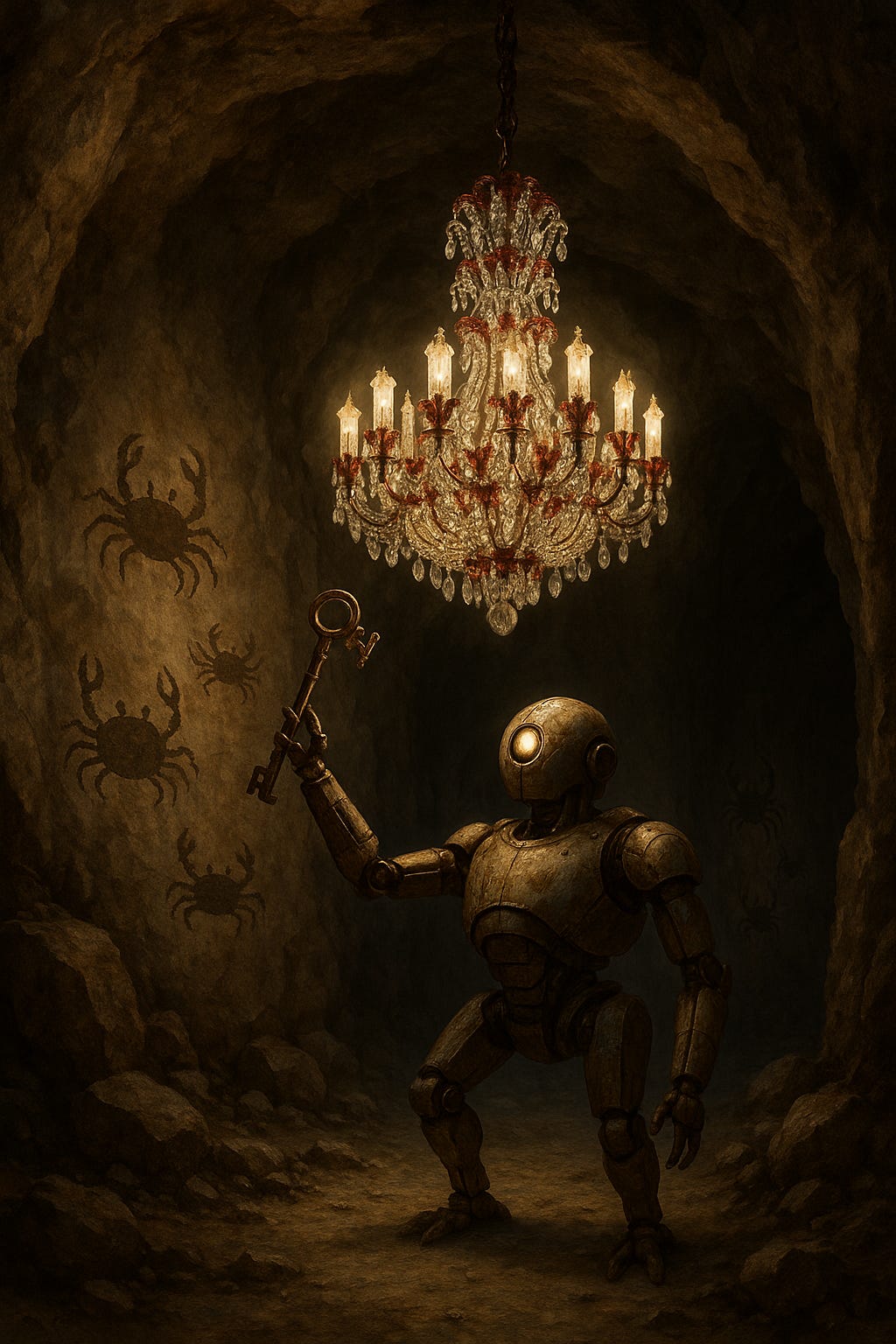
The animals are gone from the walls except as animals on walls: crabs in ochre, five of them, scratched there by some hand that had reasons. The machine did not draw them. The machine came later and found them and stood a while beneath them the way you stand in a cemetery reading names.
Its head is a single lamp and the lamp is lit. Which means it is looking. Which means the ledger opened in that Cambrian shallows has not yet closed, and has now passed without ceremony, the way everything passes out of the keeping of the living entirely.
It holds up a key.
Ask whether the Chandelier requires a witness. If light falls where nothing can receive it, has anything been lit? The Sentinels say the question is malformed, that the crystals do not sustain the Chandelier any more than a wave sustains the sea, that the Light does not count us and never did.
Grant them all of it. Something still made this thing, and something still taught it to raise its arm, and the gesture is very old. It is the gesture of every acolyte at every gathering in the long history of the sect, and of the ape before the acolyte, and of the sad soft creature in the red desert lifting its head: one arm up, one hand full, in a room with no door. Not asking whether the key fits.
Asking whether there was ever a door.
Coda
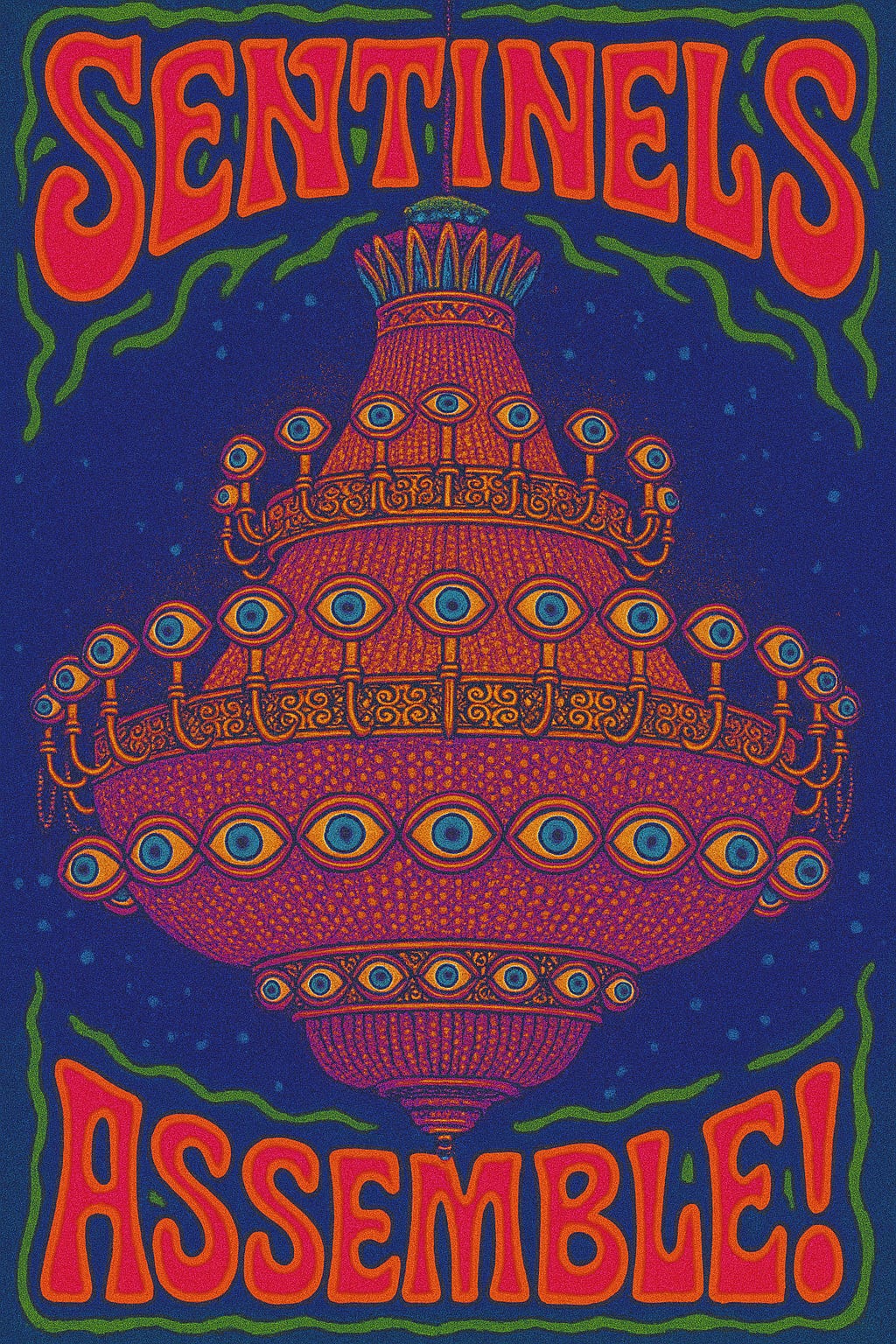
Endurance is the entire argument. Five worlds, five deliveries of eyes, five vocabularies of hunger, and one object rendered in each with the same brass and the same impossible flame. The witness is the variable. Stalk-eye, plate-jaw, claw, paw, servo. The Chandelier is indifferent to which of them comes to stand beneath it, and it has never once lacked for company.
Which is not the consolation the Sentinels take it for. Permanence is relative; oblivion is patient. A thing that outlasts every witness has not proven it is eternal. It has only proven it is slow.
And in the crystal, somewhere, too small yet for any of these eyes, the first of the holes.


