Schrodinger's Dachshund

Modal Firewalls: Why Contingency Is Doing Less Work Than You Think

Philosophers love necessity and contingency. Some things must be the case (mathematical truths, the laws of logic). Other things just happen to be the case (the number of planets, whether you had coffee this morning). This distinction is load-bearing. It’s not just a classification. It’s meant to tell us where explanation can and cannot go.

Necessary truths can explain things, but we don’t get to ask why they obtain. They’re the stopping points. Contingent truths, meanwhile, float free: they could have been otherwise, and that’s that. The modal classification does double duty. It describes the world and regulates inquiry.

This picture hides something important.

The Pattern

Look at how explanation actually works across different domains:

  • Mathematics constrains physics. Certain physical states are ruled out because they’d violate mathematical truths. We don’t treat this as mysterious. It’s just how things work.
  • Normative facts constrain rationality. That an action would be unjust explains why it’s not a genuine rational option. Again, no mystery.

In both cases, facts from one domain (mathematics, normativity) reach into another domain (physics, rational agency) and do explanatory work. We accept this without fuss.

But now try the reverse. Can physical facts explain why certain mathematical structures are realized? Can contingent features of the world explain anything about necessary truths? Here, philosophers balk. That direction of explanation is blocked.

Why? Not because anyone has shown that such explanations would be incoherent. Not because they’d fail to illuminate. The reason, when you push on it, is usually just modal: necessity can constrain contingency, but contingency can’t constrain necessity. The direction of explanation tracks the modal hierarchy.

The Firewall

I call this pattern a modal firewall. It’s a restriction on explanatory scope that’s justified by modal status rather than by anything about explanation itself. The firewall doesn’t show that a candidate explanation would fail. It rules the explanation out of bounds before we even try.

Here’s the structure:

1) Eligibility: The blocked explanation would, by ordinary standards, be perfectly intelligible.

2) Modal restriction: It’s excluded because of the domain-relative modal status of what’s being explained.

3) No independent grounding: No explanation for the modal boundary. It’s taken as given.

Firewalls aren’t arguments. They’re policies. And once you see them, you see them everywhere.

Why This Matters

The problem isn’t that explanation has to be unlimited. Some explanations fail; some inquiries terminate. That’s fine. The problem is how the limits are drawn. If a stopping point is justified by demonstrating that further explanation would be incoherent, circular, or regressive, fair enough. But if it’s justified by pointing at a modal classification and saying “Here be contingency.” That’s not an explanation of the limit. It’s a label for the limit.

This matters for the contingency/necessity debate because contingency is often sold as metaphysically innocent. The necessitarian (someone who thinks everything is necessary) is supposed to be the one with the weird, revisionary view. But if contingency’s main job is to license unexplained stopping points in our explanatory practices, that innocence starts to look questionable.

A Different Approach

The alternative I develop is what I call explanatory unity: let explanation go where it succeeds, and stop where it fails, without giving modal classification independent authority to police the boundaries. Domain differences might shape how we explain, but they don’t get to determine that explanation must stop.

This isn’t a commitment to explaining everything. It’s a commitment to earning your stopping points rather than inheriting them from a modal map drawn in advance.

Does this vindicate necessitarianism? Not directly. But it shifts the burden. If you want to say that contingency limits explanation, you need to explain why—not just assert that it does.

This is a compressed version of an argument developed at length in a paper currently under review. The full version applies the diagnostic to debates about grounding, laws of nature, essence, and normativity.

Papers on MOAN: the Modal Ontological Argument for Necessitarianism, and the Dilemma of Contingency are also under review. And a paper on Spinoza.

The Garden Without Forking Paths

Standard
Schrodinger's Dachshund

Shaftori and the MOAN

A Modal Ontological Argument for Necessitarianism and its Mystical Origin

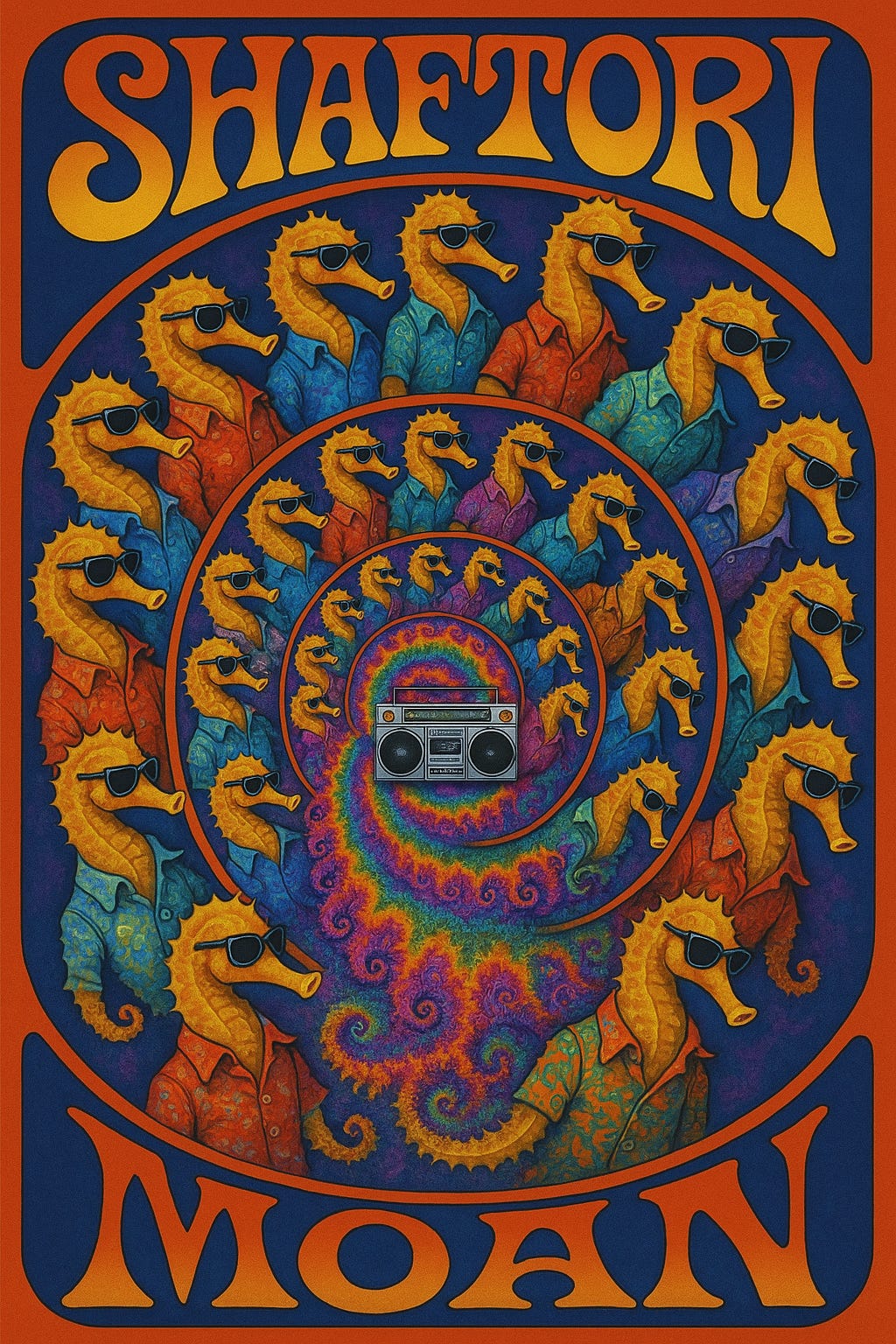
Late last year Petronius Jablonski experienced Shaftori: Enlightenment from the 45 RPM of Isaac Hayes’ “Shaft” played at 33 RPM. Like Parmenides’ descent to the halls of Night, his journey was part metaphysical reasoning and part mystical initiation. The stone-cold groove reduced him to a nanoscopic seahorse adrift in a measureless mega-fractal, absurd and sacred, tiny beyond reckoning yet somehow required, a necessary syllable in an infinite and pitiless scripture.

He returned with original and definitive proof of Necessitarianism: the thesis that whatever is true couldn’t have been otherwise, that nothing about reality could have been different in any way whatsoever. The result vindicates Necessitarianism and proves that he, like Parmenides, has been behind the veil.

In the structure of the Mandelbrot set there’s a region where the filaments branch into forms that look distinctly like little seahorses. Mathematicians call it the Seahorse Valley. Zoom-ins show repeating spirals whose shapes resemble the curled tails and bodies of seahorses.

Note well: this is not the work of some brilliant mathematician lovingly designing seahorses. This is a necessary feature of the Mandelbrot set with no contingency or design at all. Why does it exist? It couldn’t not exist and there’s an end of it.

Jablonski’s epiphany is that all reality is like this. And he can prove it.

Standard
Schrodinger's Dachshund

Beyond the Metaphysical Middlemen

A Rationalist Case for Absolute Monism

From Plotinus to classical theism to Spinoza, philosophers have posited a supreme metaphysical entity—the One, God, or Substance—to ground reality and explain existence. This post argues that the very distinctions these systems depend upon collapse under sustained rationalist scrutiny. By applying the Principle of Sufficient Reason (PSR) rigorously, I demonstrate that all three major frameworks—Plotinian emanation, Spinozistic necessitarianism, and Thomistic theism—contain fatal explanatory gaps. The only position that survives this collapse is monism: reality is necessary and one, without intermediary beings, divine personhood, metaphysical hierarchy or modal hooey. What remains is not God, but simply what is.

I. Mapping the Metaphysical Landscape

Before dismantling these systems, we must understand their architecture. Consider three major positions on a spectrum of explanatory density:

Plotinus’ One — beyond being, beyond intellect, overflowing without self-determination.

Classical Theistic God — metaphysically non-composite, timeless, immutable, impassable, and freely creating.

Spinoza’s God — absolutely infinite substance determined solely by its own essence; nature is necessity.

The tensions lie in how each answers (or refuses to answer) the rationalist’s question: ‘In virtue of what?’

1.1 Ontological Status: Being, Beyond-Being, or the Only Being

Plotinus’ One — literally not a being, not even an entity. Radically simple: no internal structure, no attributes, no parts, no thought. All positive description is metaphor; the One is what the intellect sees when it stops trying to articulate. The One is uncaused, not by necessity but by transcendence.

Classical Theistic God — a supreme being, perfect, personal, omniscient, omnipotent. God has attributes (even if simple in scholastic metaphysics). God wills, knows, loves, judges; creation is a free act. God is both intellect and will.

Spinoza’s God — being itself, the one infinite substance with infinite attributes. Not a person; not a transcendent source; not outside the world. Nature equals God equals the necessary structure of reality. All distinction collapses into modes of the one substance.

Comparative snapshot: Plotinus offers the beyond; classical theism offers a supreme being; Spinoza offers the only being.

1.2 Causation: Emanation, Volition, or Necessity

Plotinus — causation is emanation: the One overflows into Intellect, which overflows into Soul. The One cannot do otherwise, but not because of inner necessity; more like metaphysical pressure.

Classical Theism — causation is free creation ex nihilo. God might have chosen otherwise; creation is not necessary.

Spinoza — causation is strict necessity: from the necessity of the divine nature infinite things follow. No choice, no contingency.

Thus we have: Plotinus offering spillage, theism offering choice, and Spinoza offering necessitation.

1.3 Intelligibility Under PSR Pressure

Here the Parmenidean lens does its devastating work.

Plotinus — The One is beyond intelligibility. You cannot say why the One emanates; you cannot even say why it is what it is. This violates the strong PSR: the One is precisely the sort of brute posit the rationalist cannot allow.

Classical Theism — God freely chooses creation, freely wills certain goods, freely permits evil. Each free decision creates pockets of brute contingency. The rationalist asks: In virtue of what does God choose this world rather than another? No answer preserves classical divine freedom without violating PSR. Result: classical theism stands on voluntarist bruteness.

Spinoza — Spinoza preserves the PSR absolutely. No brute facts, no free divine choices, no transcendent will. God is the necessity of being itself. Result: maximal intelligibility.

Summary: Plotinus fails rationalist intelligibility (beyond being and explanation); theism fails it (arbitrary divine free will); Spinoza appears to satisfy it (necessity all the way down).

But does Spinoza survive deeper scrutiny? (“Proofs of God’s Existence? Paging Spinoza! And why not even he can help you.”)

II. The Positive Case: Why Bare Monism Surpasses All Middle-Beings

Now we proceed to the core argument. Why add a special metaphysical entity—Plotinus’ One, Spinoza’s God, or classical theism’s Pure Act—when you can have the explanatory power without the metaphysical inflation? This section presents eight independent arguments for bare monism over any divine intermediary.

2.1 The PSR Eliminates All Distinctions—Including God

The most devastating argument comes from applying the PSR consistently. If every distinction requires an explanation, then the distinction between God and world, between God’s essence and activity, between modes and substance, between the One and its emanations, between Pure Act and creation—each needs justification. But any justification introduces more distinctions, requiring further justification. This is Bradley’s regress applied to theology.

The only stable resting point is no distinctions at all. That means no God/world distinction, no intellect/extension distinction, no essence/existence distinction, no emanation hierarchy. Once all distinctions collapse, what is left? Just Being as such, full stop.

Plotinus tries to resolve the regress by pushing the One beyond being, making it uninterpretable. Spinoza tries to resolve it by allowing infinite attributes. Classical theism tries with negative theology and divine simplicity. All fail because distinction itself is the problem. The PSR favors pure monism over any conception of God.

2.2 Explanatory Economy: Any God Adds Mystery Rather Than Removing It

Plotinus adds a One that we cannot describe but which somehow emanates Nous and Soul. Spinoza adds a God with infinite attributes, only two of which humans know. Classical theism adds a pure act that is totally simple yet somehow contains intellect, will, and the ground of all modal truths. All three introduce highly specific, explanatory-heavy, ontologically ambitious entities.

But none of these entities explains anything that bare monism does not already explain. If the question is ‘Why is there something rather than nothing?’, the honest answer is: Because there cannot be nothing. The existence of being requires no explanation; nonbeing does. To add a God is to duplicate necessity: necessary being (God) plus the necessary existence of that being. Whereas pure monism says: Being is necessary; nothing else exists to explain. No additional entity is needed.

2.3 The Problem of Explanatory Elites

Every divine monism contains the same hidden assumption: there must be one special kind of thing that grounds everything else. But introducing a special category, a metaphysical elite, is inherently unstable under the PSR. Why should the One have the power to cause Nous? Why should Spinoza’s Substance have infinite attributes rather than one? Why should pure actuality have the will to create anything? Each of these attributes is unshared, primitive, unexplained. They violate the very explanatory scruples they seek to defend.

Pure monism says: there is no metaphysical aristocracy, no special status, no elite being. Just what is, without hierarchy. This is the most stable position from an anti-arbitrariness standpoint.

2.4 The Metaphysical Middleman Is Illusion

Consider each supposed function of God:

Unity/Explanation: Does God unify things? No more than monism itself does.

Necessity: Is God supposed to be the necessary ground? But necessity does not require a bearer. It simply means: cannot be otherwise.

Causation: Is God needed as cause? In a monistic system, cause is just the structure of being itself.

Order/Rationality: Is God needed as architect? No more than geometry needs a designer.

Value/Goodness: Plotinus and Aquinas load the Absolute with normative weight. But monism says: value is a projection; being is neutral.

What God is supposed to do, monism does.

2.5 God Is Just a Hypostatization of Necessity

At bottom: Plotinus’ One equals unity, Spinoza’s God equals necessity, classical theism’s God equals pure actuality. All three equal the necessary structure of reality. But then why anthropomorphize necessity? Why personify unity? Why not say directly: Reality is necessarily one. Period.

Everything else is mythologizing necessity. God is the reification of an abstraction. Necessity itself does not need to be pinned on an entity.

2.6 Why Philosophers Keep Inventing the Middle-Being

Why do even rigorous rationalists insert a metaphysical middle-being when their systems do not need it? Several explanations present themselves:

Fear of Metaphysical Nakedness: Bare monism is austere and offers no comfort: no higher being, no metaphysical parent, no intelligence behind order, no source of meaning, no providence. Even rationalists hesitate to say: Reality just is. It explains itself. There is nothing above it or below.

Cognitive Bias for Hierarchy: Human cognition loves levels, order, higher and lower beings, top-down explanations. Bare monism abolishes hierarchy. That feels unintuitive, even threatening. So philosophers construct the One to Nous to Soul, Substance to Attributes to Modes, God to Angels to Creatures. These are comfort structures, not necessities of reason.

The Desire for a Terminus That Is Like Us: Plotinus’ One is beyond mind but still good. Spinoza’s God thinks. Classical theism’s God thinks, wills, loves. These are projections of human categories upward, because we subconsciously want the universe to be conscious, order to be intentional, existence to be meaningful. Bare monism refuses this anthropocentric impulse.
The Rhetorical Power of the Divine Label: Calling the Absolute ‘God’ buys cultural legitimacy, emotional resonance, philosophical gravitas. But the label is linguistic camouflage disguising the fact that the work is done by necessity, not by a divine agent.

2.7 Bare Monism Avoids All Classical Problems

There is no need to solve divine simplicity paradoxes, divine freedom paradoxes, the emanation hierarchy, the problem of evil, the will/knowledge/intellect compatibility problems, modal collapse objections, contingency versus necessity, or the relation between attributes and substance. Bare monism eliminates all of them. Why? Because it eliminates the middle-being. There is no metaphysical manager. Just reality.

2.8 Conclusion of the Positive Case

If you accept the PSR, anti-arbitrariness, rejection of brute facts, intelligibility, and necessity, then the simplest and least metaphysically baroque view is this: There is one necessary reality. It has no distinctions. It is not a being—it is Being. It is not God—it is what there is.

Plotinus, Spinoza, and classical theism all carry unnecessary metaphysical baggage: divine names, hypostatic structures, privileged entities. The cleanest version is the one that survives the Parmenidean ascent: Reality is necessary and one. There is nothing else to explain. Adding God is metaphysical ornamentation.

III. The Formal Reductio: Why God Is Incoherent Under the PSR

This section presents a formal proof showing that the very concept of God is incompatible with the PSR. This reductio is neutral between classical theism’s God, Spinoza’s God, and Plotinus’ One. It refutes all of them.

3.1 Definitions and Setup

Let PSR be the principle that every fact F has a complete explanation. Let D be the divine being (One, God, or Substance). Let W be the world (finite beings, modes, emanations, etc.). Let Dist(X, Y) mean X is really distinct from Y (not identical).

Assume that D exists and is distinct from W, as all three systems claim in some form: Plotinus through absolute transcendence, Spinoza through the substance/mode distinction, and classical theism through the creator/creation distinction.

3.2 The Reductio Argument

Premise 1: If Dist(D, W), then the distinction must have an explanation (by PSR).

Premise 2: The explanation of Dist(D, W) must be either internal to D or external to D. There are no other options.

Case A: Explanation Is Internal to D

Suppose the distinction arises from D’s internal nature. Then D’s internal nature includes differentiation: some aspect A explains why D is not equal to W. But if D has internal differentiation, then D is composite. If D is composite, D is not simple. If D is not simple, D is not the One, not Pure Act, not Substance. Contradiction.

Thus D cannot internally explain its distinction from W. (For Plotinus, the One cannot contain distinctions; for Spinoza, substance has no internal differentiation; for classical theism, God has no internal composition.)

Case B: Explanation Is External to D

Suppose the distinction between D and W is explained by something outside D. Then some entity E, distinct from D, explains Dist(D, W). But then D is not the ultimate explanation. Therefore D is not divine (not the One, not Pure Act, not the fundament of being). Contradiction.

Thus D cannot externally explain the distinction either.

3.3 The Devastating Conclusion

The distinction between D and W cannot be explained internally (violates simplicity) or externally (violates ultimacy). Therefore Dist(D, W) violates PSR and is impossible.

Thus: Either D equals W (Spinoza’s immanent collapse), or both D and W collapse into something more basic (Parmenidean monism), or there is no D distinct from W (bare monism/bare necessity).

But if D equals W, then the term ‘God’ does no metaphysical work. It adds no distinctions (forbidden under Case A). It adds no explanatory power (forbidden under Case B). It introduces misleading conceptual baggage.

Therefore: The concept ‘God’ is explanatorily redundant and PSR-incoherent. The only consistent position is bare monism/bare necessity.

What Remains After the Collapse

We have traced the rationalist’s path through three major metaphysical systems. Plotinus offers the One beyond being, but this transcendence purchases explanatory power at the cost of intelligibility—the One becomes a brute posit, violating the very demand for reasons it was meant to satisfy. Classical theism offers a personal God whose free will creates the world, but this freedom introduces arbitrary divine choices that cannot be explained without destroying the freedom itself. Spinoza comes closest to rationalist purity by eliminating divine will and embracing necessity, yet even Spinoza’s distinction between substance and modes, between infinite attributes and their expressions, cannot withstand sustained PSR scrutiny.

The formal reductio demonstrates this with precision: any distinct divine being, whether transcendent or immanent, whether personal or structural, cannot explain its distinction from the world without either becoming composite (losing simplicity) or depending on something external (losing ultimacy). Either horn of the dilemma proves fatal.
What survives this collapse? Not a divine being, not a One, not even Spinoza’s God. What survives is simply this: Reality is necessary. Reality is one. There is nothing else to explain because nothing else exists to do the explaining. Necessity requires no bearer, unity needs no unifier, being demands no ground beyond itself.
This is bare monism—monism without magic, necessity without necessitator, unity without metaphysical manager. It is the position that all rationalist systems approach but fail to reach, held back by residual anthropomorphism, theological inheritance, or the simple human desire to find consciousness at the foundation of things.

The concept of God, in all its philosophical forms, turns out to be an elaborate way of saying: things are as they must be. Once we recognize this, we can dispense with the intermediary and state the truth directly. There is what is. That is all. That is enough.

Bibliography

Aquinas, Thomas. Summa Theologiae. Translated by Fathers of the English Dominican Province. Benziger Bros., 1947.

Bradley, F. H. Appearance and Reality: A Metaphysical Essay. 2nd ed. Oxford University Press, 1897.

Curley, Edwin, and Gregory Walski. “Spinoza’s Necessitarianism Reconsidered.” In New Essays on the Rationalists, edited by Rocco J. Gennaro and Charles Huenemann, 241–262. Oxford University Press, 1999.

Della Rocca, Michael. The Parmenidean Ascent. Oxford University Press, 2020.

— “PSR.” Philosophers’ Imprint 10, no. 7 (2010): 1–13.

—”Rationalism Run Amok: Representation and the Reality of Emotions in Spinoza.” In Interpreting Spinoza: Critical Essays, edited by Charlie Huenemann, 26–52. Cambridge University Press, 2008.

Feser, Edward. Five Proofs of the Existence of God. Ignatius Press, 2017.

Scholastic Metaphysics: A Contemporary Introduction. Editiones Scholasticae, 2014.

Gerson, Lloyd P. Plotinus. Routledge, 1994.

Jablonski, Petronius. “Proofs of God’s Existence? Paging Spinoza!

Kretzmann, Norman, and Eleonore Stump, eds. The Cambridge Companion to Aquinas. Cambridge University Press, 1993.

Leibniz, G. W. Philosophical Essays. Translated and edited by Roger Ariew and Daniel Garber. Hackett Publishing, 1989.

Melamed, Yitzhak Y. “Spinoza’s Metaphysics of Substance: The Substance-Mode Relation as a Relation of Inherence and Predication.” Philosophy and Phenomenological Research 78, no. 1 (2009): 17–82.

Parmenides. “On Nature.” In The Presocratic Philosophers, edited by G. S. Kirk, J. E. Raven, and M. Schofield, 239–262. 2nd ed. Cambridge University Press, 1983.

Plotinus. The Enneads. Translated by Stephen MacKenna, abridged with introduction and notes by John Dillon. Penguin Books, 1991.

Pruss, Alexander R. The Principle of Sufficient Reason: A Reassessment. Cambridge University Press, 2006.

Schaffer, Jonathan. “Monism: The Priority of the Whole.” Philosophical Review 119, no. 1 (2010): 31–76.

Spinoza, Baruch. Ethics. Translated by Edwin Curley. In The Collected Works of Spinoza, vol. 1, edited by Edwin Curley. Princeton University Press, 1985.

Theological-Political Treatise. Translated by Jonathan Israel and Michael Silverthorne. Cambridge University Press, 2007.

Stump, Eleonore. Aquinas. Routledge, 2003.


Standard
Schrodinger's Dachshund

The Modal Self-Vindication of Necessitarianism

Is Necessitarianism true in some possible worlds, but false in others?

This Substack post presents a novel transcendental argument for necessitarianism—the thesis that all truths are necessary truths. The argument proceeds by demonstrating that any coherent modal evaluation of necessitarianism’s own modal status generates a dialectical structure that vindicates necessitarianism itself. Specifically, I show that the standard possible-worlds framework for evaluating modal claims becomes incoherent or self-undermining when applied to necessitarianism, and that this incoherence provides evidence that the framework itself, rather than necessitarianism, is fundamentally mistaken. If successful, this argument suggests that necessitarianism may be the only metaphysically stable position regarding modality.

The Modal Ontological Argument for Necessitarianism (MOAN)

Standard
Literature, Schrodinger's Dachshund

Pictures at an Exhibition

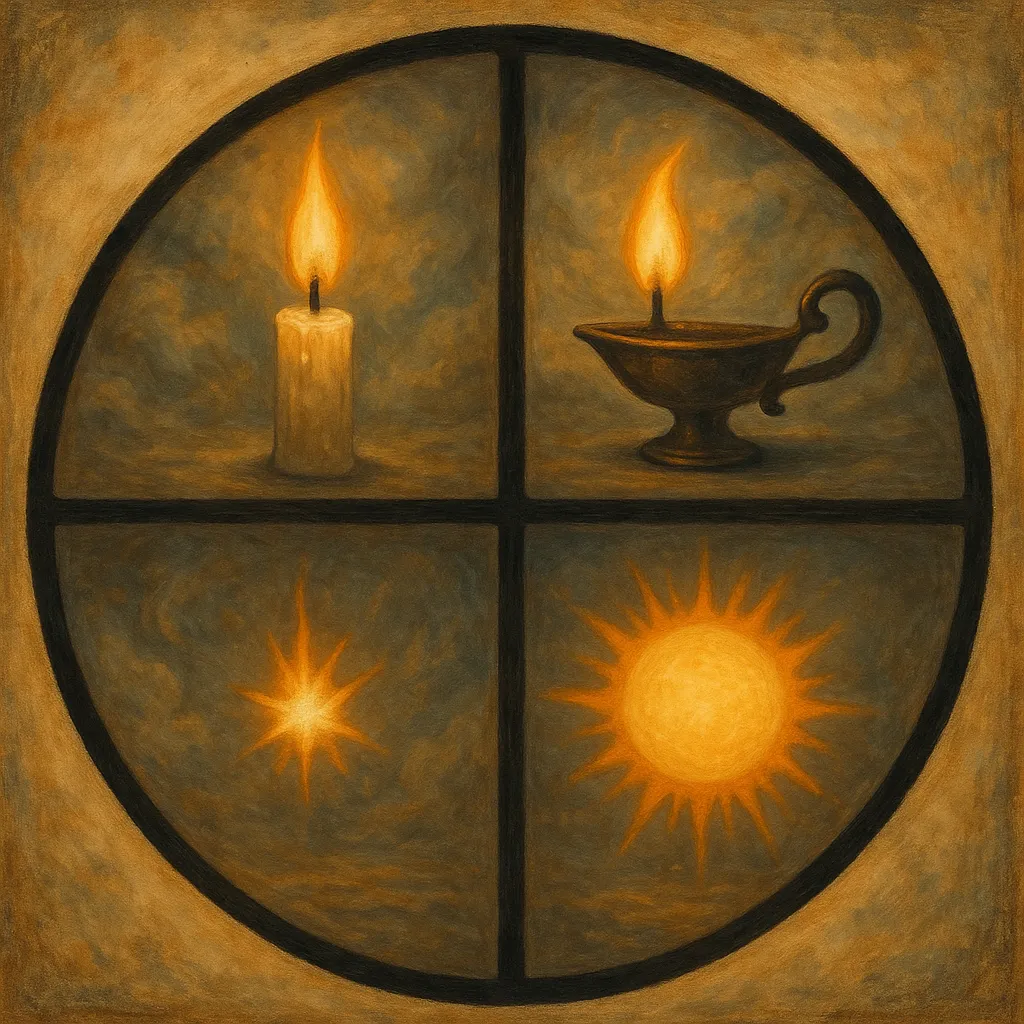
In that circular tableau where four luminosities—the modest taper whose flame trembles with the same hesitant grace as the consciousness of a child taking its first uncertain steps toward self-awareness, the oil lamp’s more refined radiance (suggesting perhaps the soul’s passage through civilizations of increasing sophistication, from the crude rushlight of primitive epochs to the elegant vessels of a more cultivated age), then that sharp stellar burst resembling nothing so much as the sudden, piercing moment when one apprehends, in the midst of life’s mundane progression, a truth previously obscured by habit’s comfortable veil, and finally the sun itself in all its pneumatic fullness, that orb which seems to contain within its swollen circumference all the accumulated experience of previous existences now ripened into a wisdom warm and all-encompassing—illuminate their separate chambers yet remain forever divided by those implacable black bars which suggest that even as the soul ascends through its successive incarnations, each life remains enclosed within its own inviolable moment, touching yet never quite merging with those that came before or shall come after, much as the various epochs of one’s own existence, though linked by the continuous thread of memory, retain each its distinct and unrepeatable savor.

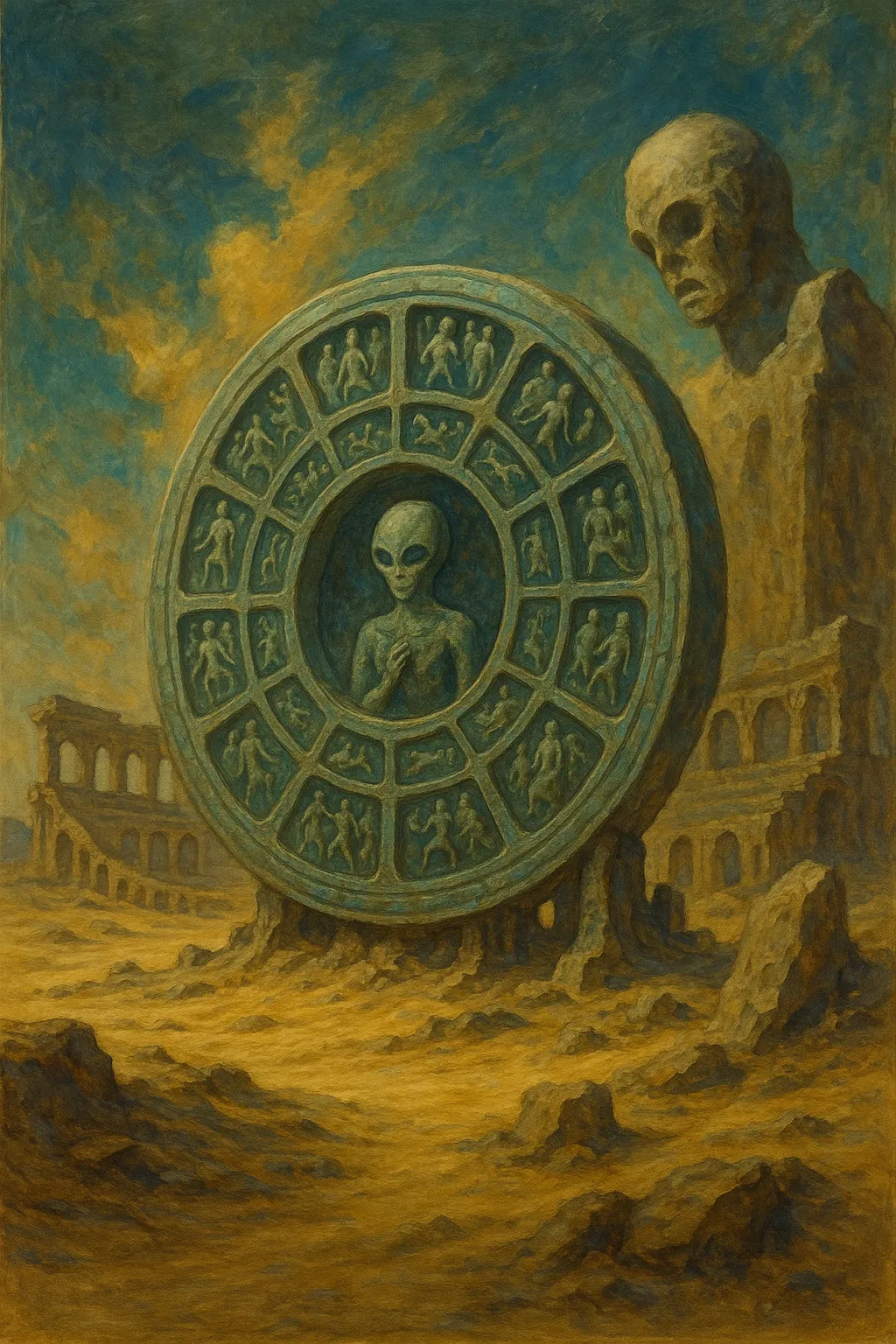
In the ochre waste where the ruins stood skeletal against a sky the color of old brass the wheel leaned there canted in the sand, its compartments cut like cells in some vast and intricate honeycomb, and in each cell the figures stood or knelt or embraced in attitudes of supplication or coupling or murder—who could say which—their forms worn smooth as creek stones, anonymous, the wheel itself a mandala of flesh repeated, and at its center the alien regard, that hairless and implacable witness with its eyes like pits bored into nothing, and behind it the larger figure risen up out of the sand itself perhaps or simply waiting there since the world’s morning, its skull face turned toward some horizon that had long since ceased to exist, the whole tableau composed in that desolate light as if arranged by hands that understood geometry but not mercy, the aqueducts in the distance marching toward their own extinction, and over it all the sky churning with ancient poisons, and you got the sense looking at it that the wheel had turned and would turn again, grinding through its permutations of torment or ecstasy—no difference finally—each figure locked in its chamber like a sin in the heart, inexpiable, the math of it precise as death, the alien at the hub serene in its witnessing, and all of it half-buried in that sterile dust which was maybe the dust of empires or of worlds or just dust and nothing more, the wind beginning to cover it over grain by grain in the measureless noon.

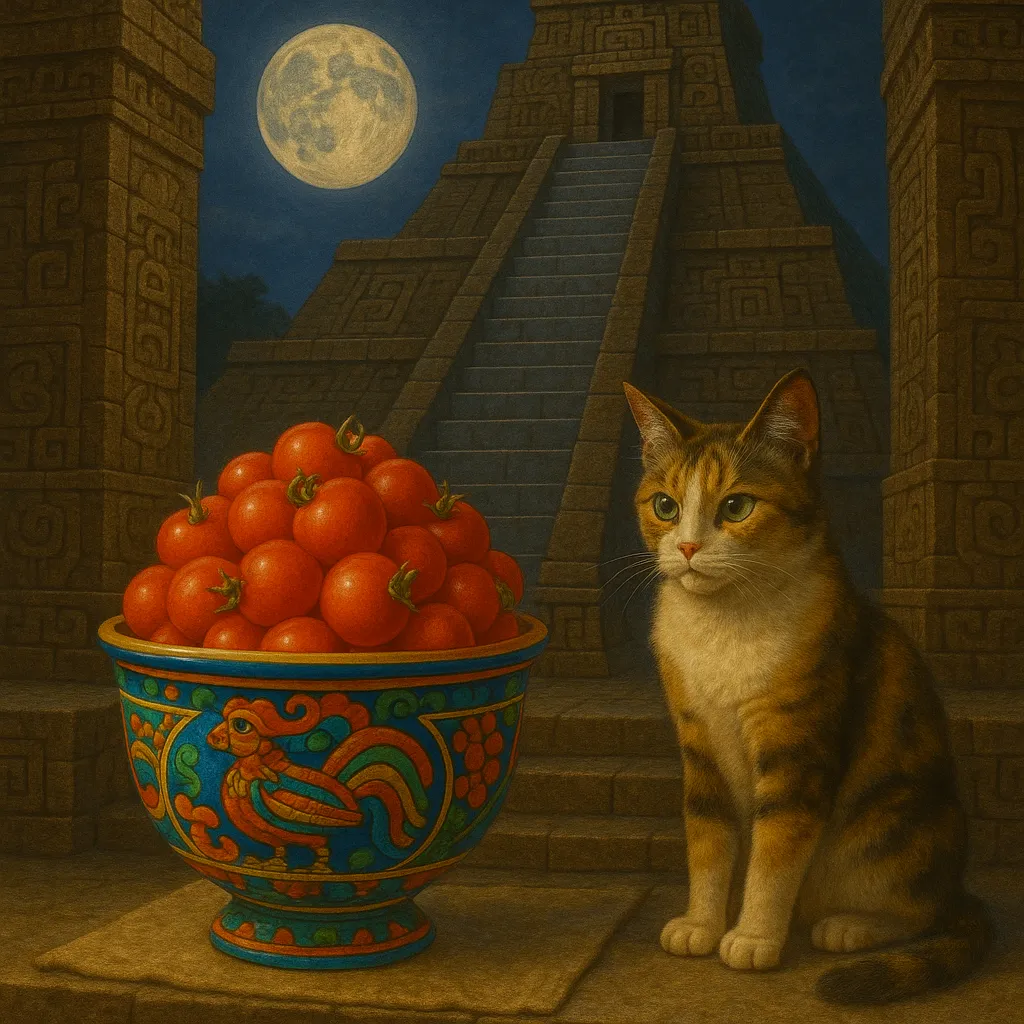
In the days when the pyramids still remembered the names of their builders and the moon hung low enough to taste the smoke of copal fires, there lived in the city of forgotten gods a calico cat who had been appointed by no one in particular to guard a bowl of tomatoes so red they seemed to contain all the sunsets that had ever bled across the valley, and the bowl itself was painted with serpents whose scales were the colors of paradise before the fall, and the cat whose eyes held the green of jungles that no longer existed would sit there every night without fail, not because anyone had asked her to or because she expected payment in fish or cream, but because her great-great-grandmother had whispered to her great-grandmother in the language that cats spoke before they forgot how to speak that the tomatoes were not tomatoes at all but the crystallized tears of the last priest who had climbed those steps behind her, one hundred and seven years ago, carrying his own heart in his hands as an offering, and that whoever ate them would remember everything—every love, every betrayal, every small mercy and large cruelty since the world began—and would go mad from the weight of it, and so the calico sat there in the moonlight which was itself a kind of memory, patient as stone, her whiskers trembling slightly in the night wind that carried rumors of rain that would not fall for another three hundred years, and the tourists who sometimes stumbled into that courtyard would photograph her and say how charming, how picturesque, never knowing they were looking at the last guardian of a sorrow too beautiful to be consumed.

The composition, with its quadrants of sun, sprout, leaf and snowflake, presents itself less as a picture to be grasped outright than as a delicate arrangement of suggestions—each season leaning into the next with a sort of half-withheld confidence, so that one’s apprehension of the whole is not a matter of stark recognition but of slowly succumbing to the impression of something at once inevitable and elusive, intimate and remote. The solemn sun lingers above roots that, in their patient secrecy, foretell the tree’s splendor and decline, while autumn’s golden flames already whisper to winter’s pale breath, all encircled by a border of ornamental arabesques that seem less decoration than the very pulse of time itself.

Most Beloved Goodreads Author 2016, 2021

Standard
Schrodinger's Dachshund

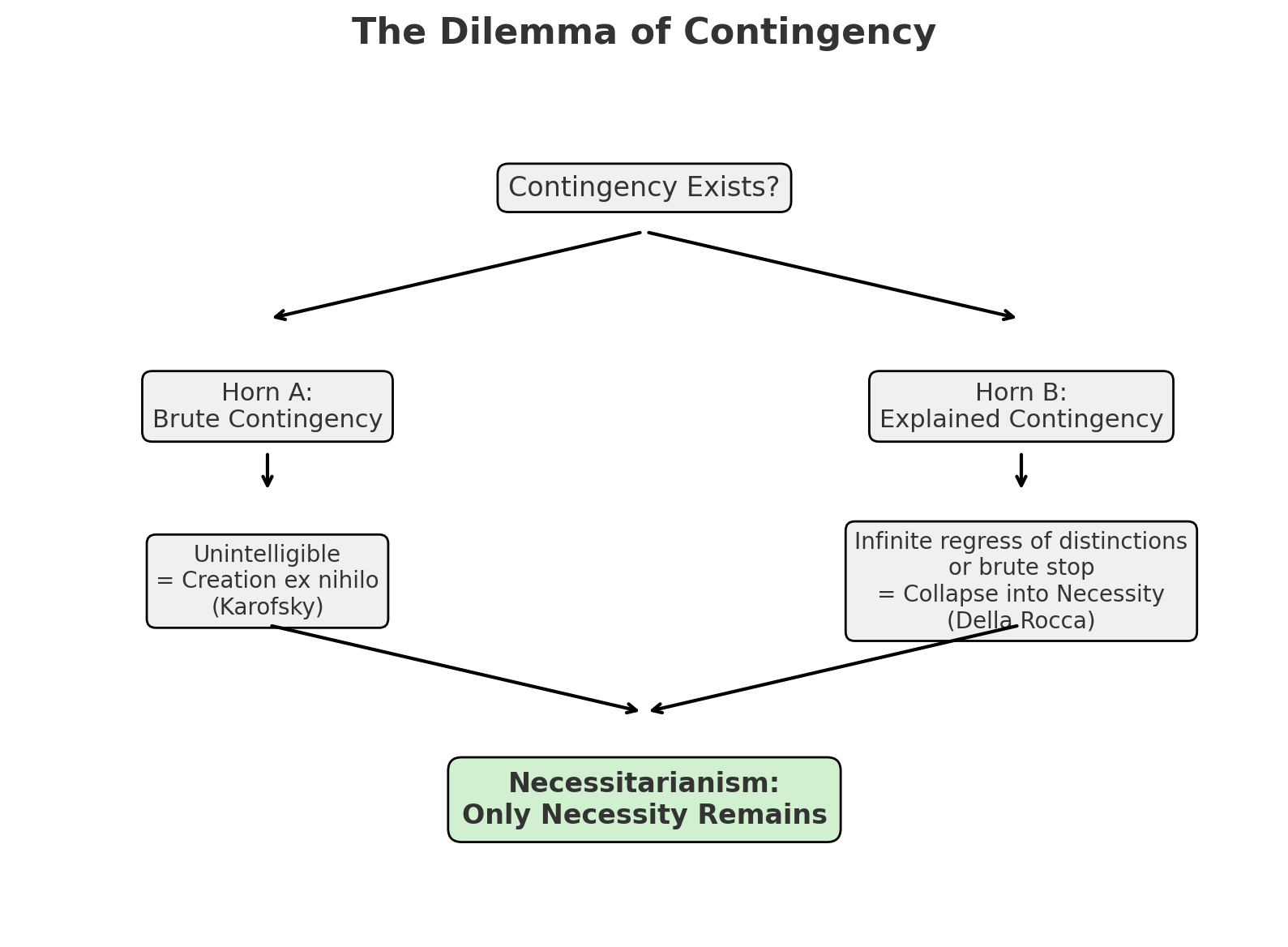
The Dilemma of Contingency

Absolutely nothing about reality could have been different in any way whatsoever. Philosophy is a footnote to Parmenides.

Contingency cannot exist. If brute, it is incoherent (Karofsky 2022). If explained, it collapses into necessity under the Principle of Sufficient Reason (Della Rocca 2020). This dilemma is sharpened through concrete examples, an account of grounding and intelligibility, and responses to recent contingentarian strategies including two-dimensional semantics, dispositional essentialism, and structural conceptions of essence. A recurring case study — the electron’s spin — illustrates both horns. The upshot is that necessitarianism, often dismissed as implausible, emerges as the only coherent metaphysical position. Contingency is revealed as creation ex nihilo.

1. Introduction

Few doctrines are more widely rejected in contemporary metaphysics than necessitarianism: the view that everything is necessary, that nothing could have been otherwise. Common sense rules it out. Surely Caesar might not have crossed the Rubicon. I could have worn a different shirt this morning. Perhaps the laws of physics could have been different. Modal logic formalizes these intuitions; metaphysics takes them as data. To deny contingency collapses modal discourse into triviality.

By contrast, contingentarianism — the view that some things could have been otherwise — enjoys nearly universal endorsement. The burden of proof, it is thought, lies entirely on the necessitarian.

Two philosophers have recently taken up that burden. Amy Karofsky’s A Case for Necessitarianism (2022) defends necessitarianism on skeptical grounds: contingency, she argues, is incoherent, because no metaphysical account of “could have been otherwise” withstands scrutiny. Michael Della Rocca’s The Parmenidean Ascent (2020), by contrast, derives necessitarianism from the Principle of Sufficient Reason (PSR): if every fact must be intelligible, then distinctions themselves collapse, leaving only necessity.

At first sight, these approaches could not be more different. Karofsky proceeds negatively, dismantling the case for contingency and leaving necessitarianism as the only option. Della Rocca proceeds positively, elevating the PSR to its fullest expression and drawing necessitarianism as its inevitable consequence. One eliminates contingency by parsimony, the other by explanatory maximalism.

These routes converge. Together they generate a dilemma of contingency:

  • If contingency is brute, it collapses into incoherence (Karofsky).
  • If contingency is explained, it collapses into necessity (Della Rocca).
  • There is no third option.

Thus, contingency vanishes. Necessitarianism, far from being an implausible extremity, emerges as the only coherent metaphysical position.

This post has four aims. First, I clarify the key notions of groundingintelligibility, and the version of the PSR at stake, and introduce a recurring case study: the spin of an electron. Second I develop the two horns of the dilemma in detail, illustrating them with the case study and showing why both brute and explained contingency fail. Third I confront leading contingentarian strategies — two-dimensional semantics, dispositional essentialism, structural accounts of essence, and modal grounding theories — and show that each succumbs to the same dilemma. Fourth I consider objections: that there may be a third option, that we might simply reject the PSR, that necessitarianism undermines freedom, or that it is too counterintuitive to accept.

The result is a sharpened defense of necessitarianism that synthesizes the eliminativist and rationalist traditions into a single, decisive argument. …

The Dialogues of Supernatural Individuation

Standard
Existentialism, Fatalism, Literature, Ontology, Quietude, Schrodinger's Dachshund

A Shabby, Not So Well-Lighted Place

The Dialogues of Supernatural Individuation

The Platonic Reformation

Plato’s Cave? Big Whoop!

Standard
Schrodinger's Dachshund

Coarse Encounters of the Fed Kind

Seated on foam padding bursting through blue upholstery, you recoil from a moldering mass grave of soda cans, candy wrappers, and strata upon strata of fast-food containers. Like anguished spirits unable to enter the next realm, fierce vapors linger, the ghosts of these mortal remains. A black tube lies across your lap; another half-pint fills your hand. Accepting a ride from these littering marauders seemed like madness until a free beverage entered the equation. To the relief of your long-suffering ears, the passenger ejects a cassette.

“Kid, I was gonna rewind that. Buddy Rich is a gem.”

“Kid, Buddy Rich is the emperor of ice cream, but we been listenin’ to him all day.”

Toothpicks impale the loaves of flesh protruding between their shoulders. The change from concrete to gravel levitates the three of you along with the moveable burial ground. Beneath a cloud whose tentacles dissolve into membranous nubs, broken glass glitters on the hills and recesses of a serpentine road. Even at five mph it’s clear the wagon’s suspension is in the same state of dilapidation as its upholstery.

Two boys wearing black and gold hockey jerseys throw rocks at beer bottles lined atop a doorless refrigerator. They stop and stare as though frightened on your behalf. One runs a finger across his throat. The side-burned blobs sneer in unison. “What the hell you lookin’ at?” says the driver.

“Go ask your ma where babies come from,” says the passenger. “Tell her to show you. It stinks worse than any stork.” The boys dutifully trudge inside a trailer.

Disassembled cars suggest a village of aspiring mechanics. A black cat peers through reeds of long-neglected grass before darting in front of the wagon. You lean back and smile. Right to left means good luck. Then the cat risks its life to run back, double cursing you. Just as Bobby and Jerry played the same songs differently night after night, Chaos and Entropy are doing a wild jam with the trailer cars. Any individuality stems from unique states of disrepair. Tiny and sparsely allocated windows look like the holes a child pokes on a box before confining a frog in it. Partaking of the knowledge that it’s five o’clock somewhere, men uniformed in flannel pretend to ignore the wagon.

After rounding a sharp turn, the homage to corrosion stops in front of the last trailer on the road. Sprawling vines of poison ivy almost hide a barbwire fence. Which design is crueler? The driver pulls a cassette off the dash. Like a genie trapped in a plugged bottle he writhes his way out of the car. The silver chain connecting his wallet to his jeans could constrain King Kong. The car rises two feet after the passenger emerges. While comparing them you remember a principle regarding the identity of indiscernibles. Or was it the indiscernibility of identicals? Their grace on land suggests the front seat is their natural habitat.

“Kid, where’s the other tape?”

“It was right here, kid. If you lost it again the Kangaroo will go berserk.”

While four mitts turn the car inside out you pretend to sift through layers in the landfill.

“Kid, this igit was sittin’ on it.”

“Thanks a lot, cockbreath. Here, you carry ’em.”

In loose-fitting clothes they would look intimidating, retired power-lifters enjoying la dolce vita. In tight undershirts the show’s over. Meaty inner-tubes jiggle and jangle beneath the flimsy cotton medium. One runs his knuckles across a homemade wind chime made out of five lacquered cans of Olde Frothingslosh ale. They wait. Rotund shadows pool at their feet like pits of tar swallowing prehistoric beasts.

A girl with cinnamon skin and one black eye opens the door and steps out, ferociously beautiful, skinny like a famine survivor medevaced in the nick of time. The breeze lashes long dark hair against her shoulders. Wildly arching eyebrows send a lupine fury cascading down her face to break on pouty lips. She takes a drag off a cigarette, revealing scars like disorganized crop circles on her stringy forearm, and blows smoke at your escorts as they enter. Thimbles threaten to pop through the planar surface of her green tank-top.

The queasy shame of a man denying the allure of Balthus’ nymphs compels you to look away, to peek around the corner where a satellite dish points at the ground. Behind it stands a gaunt man in his third trimester. “You got business here?” he says, clutching the wrong end of a .454 magnum like some deranged judge preparing to declare order for the last time.

You hop back to the cinnamon girl, who shuts the door behind you. Cardboard shades banish all rumors of the sun. The lambent glow from a TV illumes a pyramid of milk crates jammed with walkie-talkies and assorted gadgetry. Handcuffs and a cattle prod are not the most conspicuous. Empty popcorn bags litter a kitchenette counter like conches washed up on shore.

Standing in front of a narrow door one of the twins clears his throat. “What is the difference between an orange?”

“Just go in,” says the cinnamon girl.

“What … is the difference between an orange.”

“This is so lame.”

“If I have to say it again.”

In one long groan she says, “A bicycle because a vest has no sleeves.” She stands beside him and they both put a key in the door.

“Turn it,” he says.

“I am, you fucktard.”

“Try it again. Turn now.”

Nothing. He takes a step back and lands a savage kick, opening it. You join the brothers inside a closet lined with Pabst tall boys. Next to a dangling bulb their faces look like freshly-waxed cars on a drizzly day. One turns around. His flabby arm pushes you into the absorbent mass of his cohort. He selects a beer at eye-level and carefully pulls it to a ninety degree angle.

“It ain’t that one, kid.”

He tries the one next to it, and the next. “This’ll be the death of me.”

“What the hell, kid. Any day now.”

“Kid, it’s one of these.” And for the next ten minutes he pulls cans in the general area until the closet makes a terrible grinding noise like buckshot in a blender and begins to descend. A whiff of burnt oil acts as a desperately needed air freshener.

“Kid, don’t forget which one it is.”

“You ain’t no better at findin’ it, kid.”

After a prelude to eternity the closet jerks to a stop, rises a few feet, and squeals with a pitch and volume that has to be audible to every pooch in the Northern Hemisphere.

The door opens to what looks like an old submarine. You follow them into a dank room and take a seat at a picnic table. Along a wall nourishing barnacles of rust, silver keyholes fail to correspond to lines, recesses, or anything indicating the presence of doors or compartments.

You place the tapes on the table. One of your hosts taps it with both hands, doing a percussion version of “Kilimanjaro Cookout.” His twin joins him for an inspired take on an old favorite before veering off into tribal drumming.

A walking affront to the proportional standards of the ideal masculine physique enters the room. Atop shoulders too narrow for everything beneath them, an oily leather face droops off a cylindrical head tucked into a Packers cap. Mighty gray tumbleweeds cover his cheeks.

“This week on the Home Remodeling Show, the house that Pabst built,” says one of your hosts, pointing to a bulge taxing the seams of the Kangaroo’s bib overalls.

“Shut your pie hole, Remus,” he responds in a quavering voice.

“Yeah, Remus,” says his brother, doing a pitch-perfect impression.

“I’ll bitch slap you, Romulus.”

“Sorry boss.”

The Kangaroo pulls a key from his overalls and turns it in one of the shiny holes. A section of the wall ascends like a door sliding open on a concession stand, revealing a red panel where silver knobs descend incrementally in size from a softball to a penny. Above them a yellow grid subdivides a green screen. Four speakers descend from the ceiling. “You fellas get anything on tape?”

“Signed, sealed, and delivered, chief,” says Remus.

“You fellas sure you know how to use the tube?”

“Piece of cake, boss,” says Romulus, handing him one of the tapes.

The Kangaroo inserts it in a slot. Scraggly white lines dance across the screen and static explodes from the speakers. You cover your ears. He adjusts knobs like he’s playing Tetris. The lines on the grid become less jagged, almost parabolic. “That boy is a natural born scrambler.”

“Scramblin’ like a cook at George Webb,” says Remus, drumming his fingers on the table.

“Whose tape is this?” says the Kangaroo.

Like some inquisitive beast discovering a mirror in the ruins of an abandoned town, the twins eye each other amid a pantomime of shrugs and grimaces. Though capable of one basic expression they make the most of it with virtuosic skill. Romulus hunches his shoulders and throws up his hands. “The big fella?”

“Travis something,” says Remus. “Something Polish.”

“Kid, what’s the difference between a Polack security guard and a bucket of shit?”

“A bucket of shit can feed a Polish family?”

“No, the only difference is the bucket.”

The Kangaroo puts the other tape in the slot. “Looky here, looky here. This boy is one king-hell scramblin’ man.”

“That’s from the chess doofus,” says Remus.

“Chief, are you sure you’re usin’ this new shit right?” says Romulus. “They’re always scramblin’.”

“The likes of you two will not be tellin’ me how to do my job. These are the fellas the Mantis led you to?”

“His job performance needs improvement.”

“He was failing to accomplish tasks with a sufficient degree of sufficiency.”

“In English,” says the Kangaroo.

“He was barfin’ like Linda Blair.”

“Has he been drinkin’ again?”

“He’s been drinkin’ all the time. Somethin’ purple.”

The Kangaroo strokes a cumulonimbus sideburn. “What’s up with him? He’s been actin’ weird lately. You’d think he’d consider boozin’ to be a dereliction of his sacred duties.”

“He no longer demonstrates a proficient sense of pride in the organization.”

“Long as he gets the job done a little hootch ain’t gonna hurt. Good thing we’re trainin’ another, just in case.”

“I don’t think Zelda’s got the right stuff, chief.”

“She got a mouth on her, boss. Her cussin’ could take the paint off a wall.”

“Her cussin’ could knock flies off a turd. She uses swear words I never heard of. It ain’t right for a girl to talk like that. She’s violent too. Kneed me in the balls just for lookin’ at her. Romulus was thinkin’ this guy here might have what it takes.”

“It was Remus’ idea.”

The Kangaroo looks in your general direction and shudders. “Quit bringin’ rummies down here. Does this look like a flophouse? Stop fartin’ around. This location is secret and your jobs are serious. We ain’t workin’ for the CIA or FBI no more. Give Zelda a chance.” He ejects the tape and sits beside you. Suppressing your gag reflex you watch him roll a wad of syrupy chaw juice over his bulging lip while adjusting a huge black mound of snuff. “You boys sure these fellas are full-time third shift?”

“These guys are hardcore third. Drunk or not, you gotta trust the Mantis. He’s like a dividin’ rod for findin’ guards.”

“These fellas ain’t rent-a-cops, are they?”

“No way. Lodestar’s a classy joint. These guys are in-house.”

“Keepin’ tabs on rent-a-cops is like tryin’ to keep track of migratin’ deer,” says the Kangaroo.

“It’s like trackin’ meth sluts.”

“Kid, you could implant a chip in their ear while they’re knobbin’ you.”

“I got us a hee-uge contract lined up,” says the Kangaroo. “We take good care of this client and we’ll be eau de bologna.”

“Are these two gonna be the containers?”

“They’ll make top notch containers. They both got  some serious aptitude for scramblin’, specially the first fella. Now it’s a matter of matchin’ the initiation process to each one’s specific profile.” The Kangaroo spits a dark stream over your head. Some of it lands in a puddle on the floor where many have preceded it. Most of it does not. He pounds his fist and points between the stout twins. “A few of our other clients is less than satisfied with the services provided. You fellas can’t be blabbin’ about the secret key.”

“I never said nothin’,” says Remus.

“Am I supposed to believe the containers heard it on the news?”

“It wasn’t me,” says Romulus.”

“Well it’s gotta stop. Word of mouth is our only means of advertisin’. I don’t think the brochure was one of Duane Callahan’s finer ideas.”

Pretty boy Duane,” laughs Remus.

Sweet Jane Duane,” says Romulus.

“What in tarnation is that supposed to mean?”

“Nothin’ chief. Your cousin’s a good guy.”

“Duane’s fine by me, boss.”

The Kangaroo cracks his knuckles and stares at the table. “I regret to inform you that due to the new technology we have acquired and successfully utilized we will no longer be needin’ the doses of William Werzinski.”

The brothers bellow like tenors in some ungodly opera. “He’s practically family,” pleads Romulus. “Nobody gets better acid than William.”

“You can’t replace William with a tube,” says Remus. “He’ll take it hard. He ain’t exactly stable.”

“He’s a sensitive genius, chief. You know how they are.”

“The LSD method wasn’t workin’ for shit and you fellas know it,” says the Kangaroo. “He ain’t gonna starve. If I ain’t mistaken, him and his wiener dog still live at home.”

“William says Maestoso is a quantum mechanic.”

“Kid, how could it fix anything with them little hands?”

“There’s somethin’ special about that wiener dog, especially when you’re dosed.”

“Kid, I wouldn’t worship him like William”

“I sure as hell wouldn’t mess with him. You see the  way he watches you, like he knows what you’re thinkin’ and he ain’t impressed.”

“Let’s make sure things go smoothly,” says the Kangaroo. “Good containers is hard to come by. I’ll need all the usual details about both loads. I mean guards. Then, I swear, if their uploads don’t go right there’ll be hell to pay. We never had a Jawa for a client before.”

“Ain’t they those grubby little critters from Star Wars?”

“Even worse. Now give this dirty rummy some free drink chips and get him the hell out of here.”

On your back in the alley behind Straight Flush tavern you stare at the speckled canopy above, no more lost than anything else up there. Visions of Zelda dance through your mind: reflections on the contradictory conjunction of her frailty and fierce demeanor; 1,001 inferences based on several seconds of observation, the notorious first impression to which everything else is an appendix; longings that feel awkward even here, as though some prohibitions are not the excrescence of bureaucratic fiat but etched in the tablet of existence. Maybe you’re tasting the bitter fruit harvested by recluses and misfits throughout the ages, the discovery that we remain attached to the fabric of humanity simply by being alive. An invisible strand keeps us connected to this web, which has no statute of spatial limitations.

The stars, are they not confetti? There is a direct relation between the number of them and the triviality of you. Squint your eyes. The constellation of a long slender hound appears, marking the heavens more objectively than dippers or crabs or bowmen. Trace it with your finger. The dog glares as if perturbed by your discovery.

Perhaps the ancients didn’t name him for a reason, or only spoke the name during ceremonies where his guidance was sought, his wrath placated. They looked to the stars and the stars looked back. What became of them? Survival was not among the blessings from this deity.

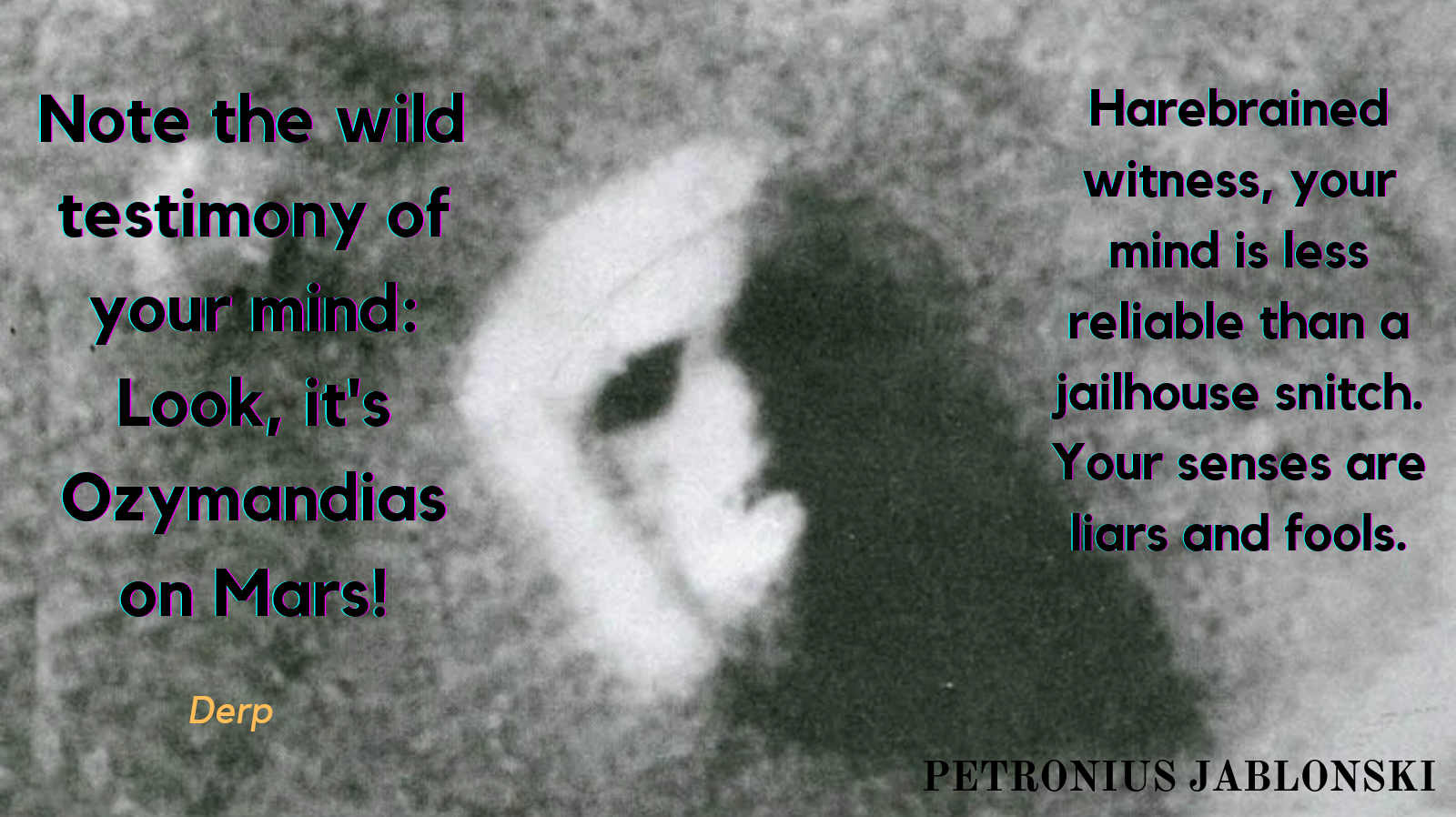
Close your eyes and seize the earth. So solid. So flat and stationary. Your senses are liars and fools. The hound in the sky continues to scowl, as he did before you were born, before all men were born.

An Ecstatic Paean from Publishers Weekly

Eyes of the Lotus Pod

Thieves, Repent!

Standard
Canes pugnaces, Schrodinger's Dachshund, Truth

November of Her Years

Zelda Alpizar 101

surreal-painting-vladimir-kush (10)

Appropriated* from the Adventures of a Hero

Zelda’s confrontation with the mirror reveals that  her collarbone is diminishing like a treasure abandoned to sandstorms. She has one stick of celery instead of three and pops two Provigil. In her room an army of PEZ dispensers overlooks piles of clothes discarded like shed snakeskin. On two framed pictures she stands beside the stone altar at Monte Albán with her father. His Summerfest shirt and her gap-toothed grin neutralize the morbid ambience. Would those butchered there have found comfort or despair from knowing it became a tourist spot? She sits on the floor and powers up an old laptop. On a site filled with pictures of stick-figure models and celebrities she checks her latest entry:

they say u hav a disees. Maybe its cuz THERE AFRADE OF UR POWER AND WANT 2 CONTROL U!! ur ability 2 eat how much u want gives u TOTAL POWER and they hate u 4 it. they want 2 keep u trappd in a JAIL of FAT! Are u sik or R THEY JELLUS? stay strong thru Ana!

Yerkaland-surreal-paintings-of-Jacek-Yerka-32

Covered with shingles instead of vinyl siding, her house would not have appeared out of place in an ancient time. She locks the door and runs to avoid intermittent downpours. Thunder growls like some deity provoked and silver veins pump life to the gray hide wrapping the world. Under a bus stop canopy she savors a head-rush complete with tingly feet from the first Newport of the day. Then it’s all downhill. She runs through alleys and across a field and with the precision of an insect climbs a fence where a section of barbwire is missing. Through puddles reflecting the bright garages of a U-haul storage facility she splashes like some urchin traversing a blood-soaked battlefield. She pokes her head around a corner and looks both ways and pounds on a door.

“Agent Alpizar, you’re late,” says Rolando. If his greasy pompadour isn’t the result of a genetic snafu, surely the faculty that chose it is. “Don’t wait for it to open all the way. Dive under.”

“Maybe tomorrow. Tell me again why I have to get up this early. Those slobs don’t get up before noon.”

“What happened to your eye? Who did that?”

“Who do you think? One of the fat fucks.”

Illuminating walls where the main event, Rust vs. Metal, was decided long ago, portable lights dangle from plastic shelves crammed with files held in place by cement blocks and cans of soup. From the roof water drips into three buckets, a coffee can, and two Tupperware bowls. A beanbag-shaped woman with gray and auburn hair pecks at a word processor. The motion sends waves rolling across the subcutaneous seas covering her arms. Zelda stares  at  the tidal pattern and rubs her triceps as though dispelling goose bumps.

Yerkaland-surreal-paintings-of-Jacek-Yerka-22

“It’s not because they suspect you, is it honey?” the typist says. “You can’t stay there if they suspect you.”

A sheen of rain and sweat glistens on Zelda’s face. “They don’t suspect nothing. I kinda kneed one in the balls.”

Rolando straddles a folding chair and rests his hands on the back and his chin on his thumbs.

“It was an accident,” says Zelda.

He waits for her to look at him. She doesn’t. “What  kind of recruits do they have?” he says, picking at a mole  that bisects his thin mustache like a cow blocking a railroad track.

“Losers.”

Third shift security guards?”

“I said they were losers. When do I get paid?”

He wraps his knuckles on the chair. “Are they third shift guards?”

She lights a cigarette and inhales deeply, chasing the dragon of the first. “Look, they’re gonna show them to me, okay? I only know what I hear.”

“Why is it always watchmen? Why couldn’t a delivery man be a secret container, or a retired senior citizen?”

Yerkaland-surreal-paintings-of-Jacek-Yerka-4

“They need someone with special mental conditioning, like in a trance or something. Most of these dipshits are half- asleep. And they’re the easiest to sneak up on. And you can always find them again.”

Wild with yearning, Rolando’s eyes harvest light from the halogen lanterns. “Is that your theory or is that what they say?”

“What they say? You wanna know what they say?” She drops an octave and talks out the side of her mouth. “Kid, Omega gyros ain’t half as good as Aristotle’s gyros. Kid, let’s score some doses. Kid, smell this fart. Kid, kid, kid, all day long. They’re total fucktards.”

“Do not underestimate them. And you’re not there to judge. You’re there to observe and report.”

“Judging from the shit they say that isn’t about food or acid, the secrecy of who’s a container is important. The containers don’t even know they’re containers.”

“I, too, read their pamphlet.”

“Then why do you keep asking me?”

“What about the man in charge, the Kangaroo?” whispers Rolando, as if saying it too loud would cast a spell or summon forces he dare not provoke.

“He did something for the government. They fired him for being an arsonist.”

“You mean isolationist?”

“Something like that.”

With the reservation of a man inquiring about his wife’s fidelity, Rolando says, “And the big guys, the terrible twins, Remus and Romulus?”

“I’m working on it.”

“Are they mantises?”

“More like mana-tees.

Vladamir-Kush-Surreal-Painting-Art-Gallery-Fish-Crusades

“Agent Alpizar, you need to learn everything about the hierarchies within their agency. What is the significance of a mantis? According to the Greeks it resembles someone who is praying.”

“This one should be praying for a clue. He’s so out there. A mantis hunts guards. That’s what  they’re training me for.”

“What technique is used?”

“He goes from building to building and looks in the window. If anyone in a uniform is passed out in the lobby he’s found his man. Then Remus and Romulus make a note of it.”

“They haven’t made any uploads yet, have they? It’s essential that you’re there when they do them.”

“We still have to get profiles of the containers. It ain’t easy. We can’t just walk up and do a survey.”

“The most important thing is to get the key to the containers. It should be a phrase or a sentence.” Rolando stands and scratches his chin and watches crystal drops fall from the ceiling. “It could be a single word. I suppose a number would work, or a tune they hum. It could even be a noise they make.”

“Thanks for narrowing it down. Is there anything it couldn’t be?”

“You need to turn your memory into a magnet. Ask lots of questions. Tell them you want to be the best mantis you can be.”

“Whatever.”

“Don’t whatever me. Why can’t you be nicer? It’s  easier to infiltrate if you’re friendly. They probably wouldn’t have hit you if you weren’t sulking all the time.”

“Are you saying I deserved this, you bumblefuck.”

Shhh, there’s families living in some of these garages. You were smarting off again, weren’t you?”

Her glare emits waves of sullen hostility that threaten to melt the feeble metal structure. “Following cheating husbands was easier.”

“There’s too much competition.”

the-red-tower

“Why don’t you start your own agency? Why are you copying these dorks?”

The typist chuckles. Her pointer finger circles before landing on the letter G. “Honey, if I had a nickel for every time I told him that.”

“I don’t pay either of you to tell me how to run things. I know nothing about uploads or scrambling. They make it look easy. Don’t be fooled. And how do I get their clients? Those are some of the most dangerous men on earth. Agent Alpizar, you need to remember what you learned from your training films. Always ask WWPGD.”

“I know,” she groans. “What would Pussy Galore do?”

“Also study the example of Anya Amasova.”

“I’ve watched all those stupid movies. The guys after Sean Connery are wussies.”

“James Bond is not your role model. After you observe an upload and get the key to the containers we’ll run them out of business. But it’s all up to you.”

Zelda practices letting smoke float out of her mouth and into her nose. She feels her eyebrows for signs of  asymmetry. She examines her chest for signs of its appearance.

“Agent Alpizar.”

“I heard you. Get the key to the containers.”

“And you need to keep sabotaging the Mantis. Once he’s gone you’ll be the only replacement. Then you can divert their clients to us. What is his current status?”

“I gave him the secret message that the only way to protect his thoughts from being intercepted is to stay drunk all the time.”

“Good work, agent Alpizar.”

“Whatever.”

22

Excerpted from Schrodinger’s Dachshund

Most Art by Jacek Yerka

*Who else could write about Zelda and her heroic (if Pyrrhic victory) over the Sentinels of the Chandelier? If only one writer was there only he can tell the tale. ‘Cultural appropriation’? Bullshit! The only freedom of speech we don’t have is cursing G-d.

Yerkaland-surreal-paintings-of-Jacek-Yerka-23

Serial Killers Who Worked Security

The Mushroom of Consciousness

Eyes of The Lotus Pod

Standard
Annals, Existentialism, Schrodinger's Dachshund, Security, trypophobia

The Thematic Unity of “Alex”

In response to disproportionate (and frankly disturbing) interest in Serial Killers Who Worked Security, the most popular entry on this site, consider a case study: the phenomenology of a Security Guard in Existential turmoil, the clinical description of what we’ve come to suspect. Based on a true story.

2da6

Are we the sum of our sensations, or the remainder when they’re subtracted?

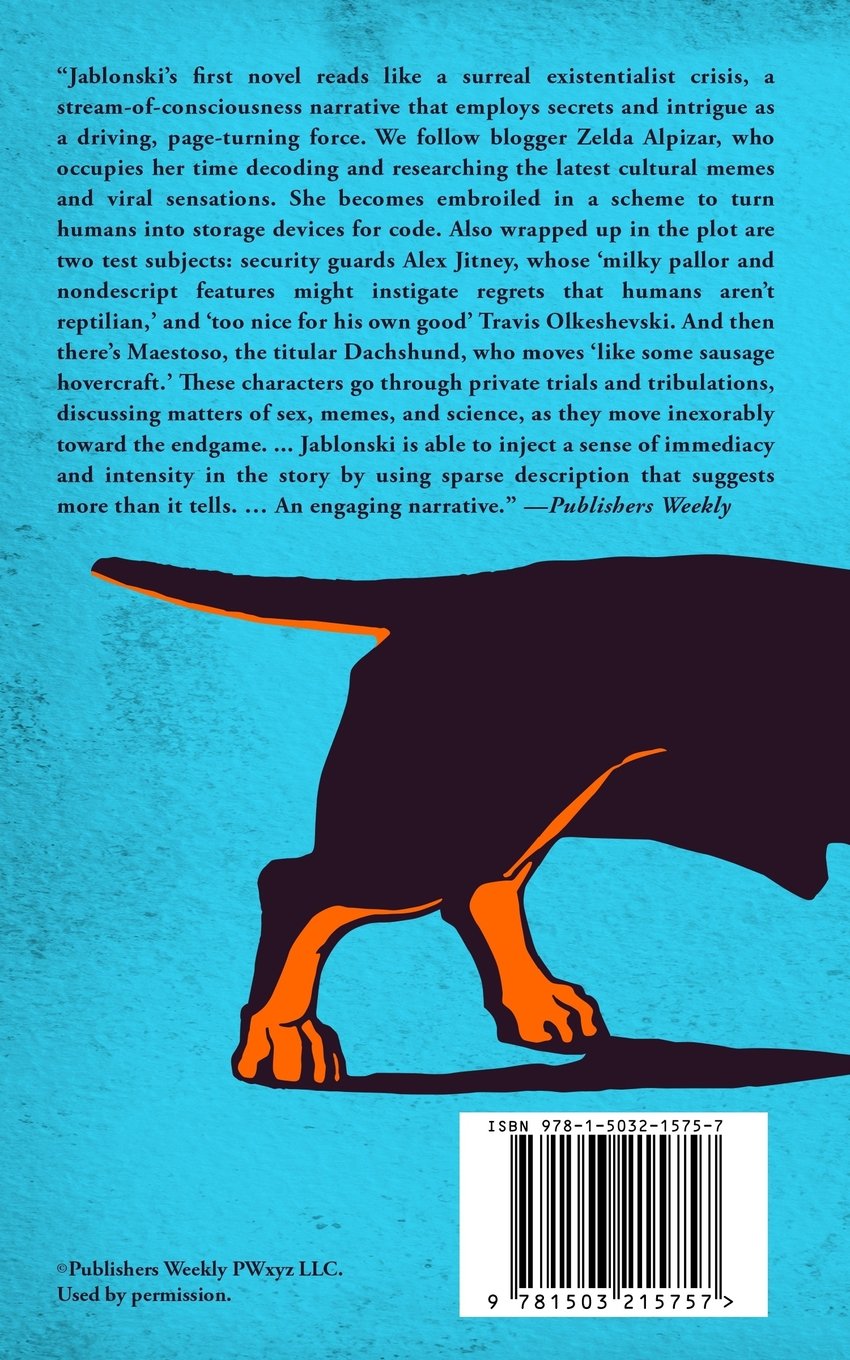
If a zoologist from another planet studied Alex Jitney, the milky pallor and nondescript features might instigate regrets that humans aren’t reptilian. Despite acknowledging that hair once enabled our drab but vicious species to exert pheromonal influences by trapping body scents, it would soon focus on the rich tapestries of the Rainbow Boa-constrictor and Peninsular Rock Agama. The field guide would recommend visiting the deserts and rain-forests while proceeding with extreme caution on this woebegone planet of apes.

If Alex shared his shift with other workers, the uniform dangling from his angular frame might initiate questions about his ability to defend Lodestar’s Shipping and Receiving Center in the dead of night. “He can’t be here for deterrence,” they’d whisper. “What could he deter?”

At 2:11 A.M. Alex steps over the red beam of a motion detector and walks down rows of brown boxes in a  cavernous room, lost in thoughts of Security, pondering its essence: Why did Petrosian lose to Bobby Fischer? How could Karpov lose to Kasparov? Defense is superior to offense. A state of equilibrium smiles upon those who work to maintain it, not those who rupture its static pattern with aggression.

He removes the pineapple from two pieces of chicken pizza before eating them. Love the sin, hate the sinner. After lunch he clasps his hands behind his head and props his feet on the windowsill to enjoy the harmony of silence. But there is no such thing. The illogical pattern of the herringbone wall across the street is louder than any stereo, more offensive than swastikas. He closes his eyes and a parade barges across the space between his ears: a list of prime numbers separated by two, the sweet aftertaste of fruit, the sound of a car backfiring, the stretch of a full bladder.

Unknown is whether “Alex” is the sum of these impressions or the remainder when they’re subtracted. Time spent alone, rare and awkward moments when he’s  not thinking about chess send him searching for a mysterious being called the self. It’s like looking for a shadow with a spotlight. The commotion and chitchat must hide this from first and second shift. Are they lucky or deluded or both?

the-mystery

What are we, and Why, and Where — you wouldn’t think to ask such questions in a crowded office. And there’s no screaming silence to those queries when everyone’s talking about the Packers. Quiet time spent in solitude, paradoxical potion, familiar friend and dreaded torture, its company attracts and repels, revives and kills, and creates addicts of some who hate it.

While Alex turns an abstract painting on the wall  around so only its non-chaotic backside is visible, a green silhouette like Nosferatu with a beer gut appears in the window and points a trembling finger at him. Alex checks his watch. Contrary to the trite expression, there is no crack of dawn. A dirty yellow growth will soon spread across the horizon like fungus on chocolate cake, devouring  the delicate textures of the night.

He removes a silver pendant from his neck. You don’t need to check it again. You’ve checked it twelve times since the start of your shift. He opens it and extracts a tiny scroll. Such elegant and simple premises. So harmoniously the conclusion flows from them like a river filled by lesser tributaries. No wonder it’s never been found. Everyone expects something dense and convoluted.

He puts the pendant back and doesn’t hear voices in the street. For all their rage and urgency they could just as well be the croaks of bullfrogs, differing only  by degree. When crimson guts spill from the belly of the night, he watches for his relief, for the 2003 Saturn stirring up clouds of dust like some chariot riding out of a whirlwind. Watchmen, sentinels of the remorseless hinterland between dusk and morn, priests of the rosary beading all the days, keepers of the promise that renewal comes with dawn, are they not warriors?

***

“Like a surreal existentialist crisis” Publishers Weekly

the-annals-high-resolutionSD_eBook_cover

Gus Sanders: Greatest Guard Since Plato

Watchman and the Mystery Box

Standard